
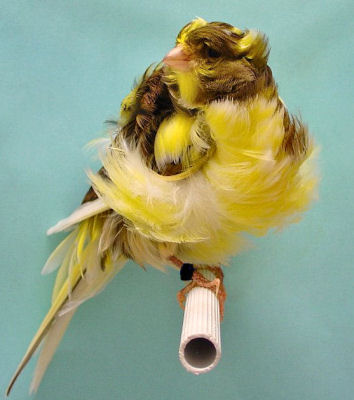
What a beauty the Parisian Frilled Canary is, small wonder that it is essentially sought out as an exhibition bird!
The Parisian Frilled Canary, also known as the Parisian Canary, is one of the largest of all known canary varieties. It is a voluptuous and beautiful bird. Except for the flight and tail feathers all the feathers on this bird are frilled, including a ‘helmet’ on its head, a ‘cap’ on the forehead, a sideburn effect on its cheeks, and a feathered collar. A most unusual feature of this canary, one that would be a ‘fault’ in other canary breeds, are toes that can be twisted like corkscrews.
A well built bird, the Parisian Frilled Canary is quite hardy, vigorous, and prolific. Though a “type canary” bred for physical appearance rather than color or song, it is also a good singer similar to the common canary. Frilled canaries do tend to be a little more high strung and nervous than other canary breeds.
There are many different varieties of Frilled canaries including: French Frill, Fiorina Frill, Colored (Milanese) Frill, Gibber Italicus, Giboso Espanol, Japanese Frill, Northern Dutch Frill, Southern Dutch Frill, Munich Frill, Scotch Fancy Frill, Swiss Frill, Roebekian Frill, Hunchback Frill, Brazilian Frill, and even crested varieties such as the Padovan Frill and the Florin Frill.
For more information about the care of Canaries see:
Guide to a Happy, Healthy Canary
- Kingdom: Animalia
- Phylum: Actiniform
- Class: Elasmobranchii
- Order: Passeriformes
- Family: Fringillidae
- Genus: Serinus
- Species: canaria
Scientific Name:
Distribution:
Frilled canaries have been around for a very long time. Though not much is known about the frilled mutation, it is generally agreed that the first frill was the Dutch Frill dating back to the 18th century, originating from the old Dutch Fancy Canary. Developments in different parts of the continent then resulted in several distinct breeds. Some of the frilled varieties seen today are newer, developed in more recent years in Italy.
The Parisian Frilled Canary was reportedly developed during the 19th century in France. Named “Frisé Parisien”, the Parisian Frill – in 1910, it was simply referred to as the “Parisian”.
Description:
The Parisian Frilled Canary is one of the largest of all canary varieties as well as being well built and robust looking. They reach an overall length of about from 7 3/4 to 8 1/4 inches (19.7 to 21 cm), and can have a wingspan up to about 11 1/2 inches (29 cm).
The primary feature of all frilled canaries are three distinct patterns of curled feathers. These consist of the mantle, the jabot, and the fins. The mantle feathers are on the back, they part down the center and curl symmetrically over the shoulders forming what looks like a cape. The jabot are wavy undulating feathers coming from each side of the breast, curling inward to form a ruffle that meets in the middle. The fins come from the thighs, long well-frilled feathers that rise upward around the wings. The main focus of the frills is on symmetry rather than volume. Though they should be full, they also need to be crisp and defined.
Show properties particular for the Parisian Frilled Canary are described as feathering, type, and elegance. Feathering can be one of three qualities; soft, which is the most sought after, semi-soft or ordinary, and hard. Type and elegance have to do with such things as length, form, carriage, stance, position, symmetry, and the general harmony of its presentation.
Coloration in frilled canaries is of little importance. They may be buff, green, clear, ticked, or variegated and occasionally a few dominant whites. Yellow is rare except in the the case of the Gibber Italicus.
Care and feeding:
Canaries like wide open spaces so provide a roomy cage. Provide a cage with vertical bars and small perches of different size for foot exercise. Have at least 1 perch set high in the cage for the canary to roost (sleep). The cage should be placed high, so the canary can look down on us so to speak.
Canaries eat mainly canary seed and rape seed. Vitamin coated canary seed mixes are readily available at a pet store. Greens are also enjoyed and can be offered daily along with a little calcium in the form of a cuttlebone.
They do like to bath, so should be offered a bird bath. Cage cleaning and toe nail trimming is about all the maintenance canaries need.
See About Canaries: Housing and About Canaries: Care and Feeding for more information.
Social Behaviors:
They are good-natured social creatures that do well when kept in cages or in aviaries. They are timid birds though and should not be housed with parakeets, lovebirds, or other hookbills that tend to be more aggressive birds by nature.
Male canaries should be kept in a cage by themselves to ensure quality singing. Males can be territorial and pairing up with two male canaries in a cage can cause fights. In a spacious aviary canaries can generally be housed with other canaries, finches, and other hardbills.
Activities:
Canaries do not require toys, mirrors or any other form of entertainment, a swing is all they need to keep themselves occupied. Most of the time, canaries are simply enjoyed for their beauty and singing. However, some canaries are allowed out of their cage to perch or are show canaries and therefore require taming or training.
To show well, being steady and holding themselves up well before a judge, frilled canaries do need a certain amount training.
See About Canaries: Handling/Training for information on taming and training.
Breeding/Reproduction:
Most canaries breed easily and readily if provided with quality food, lighting, secure surroundings, and conditioning. They are best bred in breeding cages.They lay their eggs in a nest. The female will lay 3 to 6 eggs, one per day. It is best to allow a hen to have only two clutches.
The Parisian Frilled Canary can often be difficult to breed as they can be rather poor feeders. Many breeders will foster the eggs out to other canaries. These foster parents are referred to as ‘pumpers’ and are used to hatch and rear the young of more delicate and fragile breeds. Frilled Canaries don’t need to be color fed and even though they have feathering that is longer than any other type of canary, they appear to be free from feather cysts.
See About Canaries: Breeding/Reproduction for more information on breeding.
Potential Problems:
These birds are hardy and healthy if provided with a good environment and a good diet. Avoid an environment that is wet, cool, and drafty.
See About Canaries: Potential Problems for information on health.
Availability:
Availability and pricing of Frilled Canaries is variable. Pricing has a wide range starting at about $50 or more for the Dutch Frills and about $125 or more the Parisian Frills. Others varieties start at about $100 or more.
The Parisian and the Dutch are the most common frilled canary breeds available in the United States. Frilled varieties are most often available through breeders, but may also occasionally be found through bird shows, bird clubs, and on the internet.
Featured Image Credit: slowmotiongli, Shutterstock