
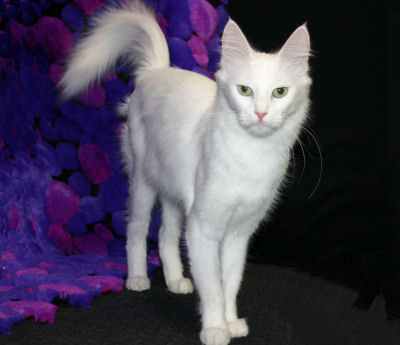
The Turkish Angora is a rare cat breed and a valued treasure in the cat fancy community!
The Turkish Angora is just about the perfect breed for anyone who wants a pet cat. It is a great pick for cat owners that love long-haired cats, but don’t want the commitment of daily grooming. This cat breed has a beautiful, lush, silky coat. Although its coat is long, it requires infrequent grooming since it has no wooly undercoat.
This is an out-going, intelligent, and social cat. The Turkish Angora is very affectionate and loving toward people and other animals. A loving and playful cat breed, it enjoys being in the middle of family activities and it loves interaction. It will dance around and pounce on all sorts of small toys, as well as its owner’s toes. It is also a well-behaved breed and can be taught to retrieve and perform tricks. The Turkish Angora makes a wonderful companion for families, couples, or individual cat owners. It is also graceful and adaptable, making it a good companion for children.
This Turkish cat is an ancient natural breed cat originating from the Ankara region, previously Angora, of central western Turkey. This is a distant cousin to the Turkish Van Cat. It is a medium-sized, finely boned breed with a long slender body and neck. The head is small, contrasted with long ears that are pointed and tufted. This cat breed was originally favored for its shimmering white coat, but today there are more than 20 different color and color pattern varieties.The eyes can be several colors like blue, green or amber, or there can be odd eyes, having one that’s blue and the other that’s amber. It has also been crossed with other natural breed cats to create other stunning varieties, one possibility are the Balinese or Long Haired Siamese Cats.
With their shimmering white coats, the Turkish Angora Cats are considered a prized breed and a national treasure in Turkey, especially those that have the “odd eyes”. The Ankara Zoo, founded in Turkey in 1933, began a dedicated breeding program to protect and preserve this valued Turkish cat. In the 1950’s this zoo also imported a few to the United States for breeding programs. Today it is found in America and Europe, but less so in Britain since it is not recognized by their main cat fancy association, the GCCF.
For information about keeping a pet cat, see:
Cat Care: How to Take Care of a Cat
- Kingdom: Animalia
- Phylum: Chordata
- Class: Mammalia
- Order: Carnivora
- Family: Felidae
- Genus: Felis
- Species: domesticus
Background
The Turkish Angora originates from the central western region of Turkey, near Ankara, formally named Angora, Angora is the city this breed was named after. These cats are believed to be descendents of longhair cats brought to Europe by the Vikings in the 10th century.
By the 1900’s, this breed was used in Persian breeding programs. The Persian Cat became widely popular, while the Turkish Angora almost vanished. These cats are a considered a national treasure in Turkey. They were prized for their shimmering white coats, and especially favored if they had odd eyes, with one being blue and the other being amber. The Ankara Zoo, founded in Turkey in 1933, began a dedicated breeding program to protect and preserve this valued Turkish cat.
In the 1950’s, a few of the remaining Turkish Angoras were imported to the United States from the Ankara Zoo, and new breeding programs were begun. This white version of this breed was first registered in 1968 by the Cat Fancier’s Association (CFA), (the leading American cat breed organization. Colored varieties were accepted ten years later in 1978. The Turkish Angora is currently not recognized by the Governing Council of the Cat Fancy (GCCF), which is the leading British cat breed organization, but is recognized by other associations in Europe.
Description
The Turkish Angora is a medium-sized, finely boned breed. It has a long, slender torso and neck. The head is small to medium-sized and tapers toward the chin. The ears are large, pointed, and tufted, and the eyes are large and almond-shaped. The tail is long and tapering. They have a long average life span of 15 or more years.This breed ranges from 6 to 11 pounds.
The Turkish Angora’s coat is medium-long in length, fine, and silky. It develops a thick coat in the winter, but sheds it in the summer, causing it to look like a short haired breed. Turkish Angoras were originally only accepted in competition if they were white with blue eyes, but they are now accepted in a variety of colors. They are accepted in many colors, excluding the color patterns that indicate hybridization, which are chocolate, lilac, cinnamon, fawn, color point, or Burmese color patterns.
Care and Feeding
This breed requires no special diet. It prefers meat, but is not finicky.
Housing Your Cat
This breed can live in an apartment or house. It would enjoy a yard, but does not require one. It should be provided with toys and a scratching post indoors.
Maintenance
Unlike most long hair breeds, the Turkish Angora only needs weekly brushing and combing. It does shed in the warm season,
Social Behaviors
The Turkish Angora cat is a social breed that gets along with people and other animals, including dogs. They enjoy interaction and being part of whatever activities are going on. This is a good cat for families, couples, or active cat loving individuals.
Activities
This is an active breed that enjoys playing. It should be provided with toys and room to run. It loves to play with and pounce on a sorts of small toys, almost seeming to dance. Some even refer to it as the “dancing cat”. Turkish Angoras are known for their prowess for swimming. Some are known to truly enjoy the water, yet there are others that don’t, suggesting that it is the independent preference of an individual cat.
Breeding/Reproduction
Turkish Angora kittens become active and begin playing early, but they do not develop the full angora coat until age two.
Common Health Problems
This is a strong, healthy breed, save one genetic tendency. White Turkish Angoras with blue eyes are often deaf, and those with only one blue eye, are often deaf on the side with the blue eye. However, this is a tendency related to the coat and eye color of the cat. It is found in most breeds that produce white cats with blue eyes, not only the Turkish Angora.
Availability
This is a rare breed, but breeders can be located on the internet. Prices range from $150 for a pet quality adult to $400 for a pet quality kitten to $700 for a show quality kitten to over $1000 for a show quality white kitten with blue eyes and no hearing problems.
References
- See Animal-World References: Cat Breeds – Exotic Cats
- Bruce Fogle, CATolog, DK ADULT, 2002.
- Mordecai Siegal, Simon & Schuster’s Guide To Cats , Simon & Schuster, 1983
- Turkish Angora, Wikipedia
Featured Image Credit: Aymara Herrera, Shutterstock