
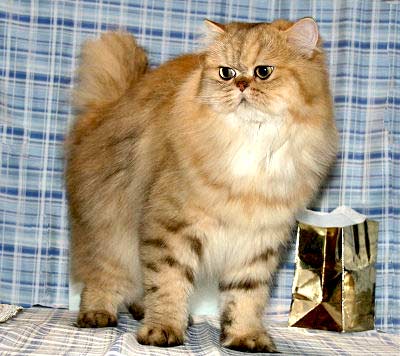
The Persian is an absolutely gorgeous breed, yes,… this is the “aristocrat” cat!
Persian Cats have held the attention and adoration of cat enthusiasts since their discovery in the 1600’s. This medium sized cat breed is very handsome with a round muscular body, a round fairly flat face and big eyes. The rest of its shape can be described with a lot of short. The length of its body is short, its legs and tail are short, and even the nose and ears are short. But oh what a luxurious dense and wooly, yet loosely fitting outer coat this beautiful cat has. No matter what color it is, and it comes in just about all colors, this cat is truly a prancing aristocrat.
It is unknown where the Persian Cat originally came from, though some possible countries of origin include Russia, Turkey, and Persia. Currently, they are popular all over the world, especially in England and the United States. They are known as the Persian Cat or Persian Longhair, and have also been called the Longhair Cat in the past. But today the term “longhair cat” is used in a general sense to describe any longhaired cat that is not pedigreed, or does not belong to a recognized cat breed.
This amenable, affectionate breed is a wonderful choice for families and couples who have time for regular grooming. The Persian is an especially sweet pet cat, known for its docility and affection. It is social, gentle, and enjoys the company of other animals and humans. They need tranquility and enjoy solitude at times. They can be playful, but are rarely aggressive, and some Persians are good mousers. They have a soft melodious voice, but they rarely use it.
For information about keeping a pet cat, see:
Cat Care: How to Take Care of a Cat
- Kingdom: Animalia
- Phylum: Chordata
- Class: Mammalia
- Order: Carnivora
- Family: Felidae
- Genus: Felis
- Species: domesticus
Background
The Persian Cats are natural breed cats, but the exact origins of this highly popular cat breed are disputed. Theories of the Persian Cats origin include stories of various wild cats, Russian Longhair cats, and Turkish Angoras. Some also believe that the Persian was an indigenous breed from Persia. However, this breed most likely originated from a thick-coated cat in the north and was brought down to present day Iran.
No matter its genetic or geographic origins, this breed was first discovered in the early 1600’s by Pietro della Valle, an Italian traveler. He brought two Persians to Italy. By the 1800’s, the breed was imported to France. Shortly after arriving in Britain in the late 1800’s, it gained great popularity, becoming even more prized than the previously popular Angora.
Today, the Persian is the most popular breed at cat shows. It is known as “the aristocrat of the cat family”, and contributes nearly 80% of the cat registrations in America. In Britain, the breed is valued to the point of classifying each different Persian color form as a separate breed.
The common names for this natural breed cat are Persian Cat and Persian Longhair. In its early history it was also called the Longhair, but this has fallen by the wayside. A domestic longhair cat today is a general term describing any cat with longhair that is not pedigreed, or belonging to a recognized cat breed.
Description
This cat breed has a well-muscled, round, short body. The Persian Cat is medium to large in size, weighing approximately 8-15 pounds. The legs and tail are short. The head is round and broad. The nose is short, the eyes are large and round, and the ears are small, wide-set, and round-tipped.
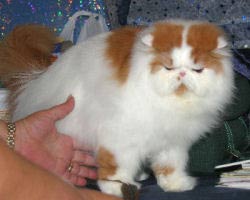 Persian Cat, Bi-color Red and White
 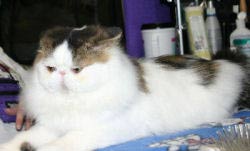 Persian Cat, Tabby Photo © Animal-World: Courtesy Justin Brough
The Persian face is naturally flat in relation to most other breeds, but has become even flatter through selective breeding. The extreme of this trend is known as the Peke-Faced. Persians are known for their luxuriant, long, thick coat. The outer coat is loosely fit and the undercoat is dense and wooly. Persians live long lives of 15 or more years.
Persians are accepted in just about every color form. The different categories and examples include: Self (White), Smoke (Lilac Smoke), Chinchilla (Golden Persian), Cameo (Red Shell Cameo), Pewter (Pewter), Tabby (Silver Tabby), Tortie Tabby (Blue Tortie Tabby), Tortie (Lilac-Cream), Tortie and White (Blue Tortie and White), Bi-Color Solid (Black and White Bi-Color), Bi-Color Tabby (Brown Tabby and White), Van Bi-Color (Red and White Van), Van Tricolor (Tortie and White Van). Persians with a colorpoint form (markings like the Siamese) are known as Himalayans.
Care and Feeding
Persians have no special dietary needs, but benefit from a balanced diet. If overfed, they run the risk of developing cardiac problems. To prevent a weight problem condition, simply control the amount of food the cat consumes and play with the cat to increase its activity level.
Housing Your Cat
Persians are great apartment or house cats. Their placid nature suits them well for life indoors. However, some Persians enjoy some time to roam or hunt outside, and some are great mousers.
Maintenance
Like most longhair breeds, the Persian requires extensive grooming. Daily combing and brushing is advised to reduce knotting and prevent intestinal and respiratory problems due to swallowing fur.
Social Behaviors
Persians enjoy being around humans and other animals. They are good family cats, as long as they are kept from the sticky fingers of young children.
Activities
The Person Cats are usually described as placid cats, but they do enjoy some indoor or outdoor play. Some will even be good mousers. They should be provided with a scratching post if kept indoors, however as adults Persians are not very active or destructive.
Breeding/Reproduction
Persian litters contain approximately 3 to 5 kittens. Birthing is often difficult for Persians.
Common Health Problems
Most Persians are healthy cats. However, Persians have several health risks. Due to their large, protruding eyes, they are susceptible to eye infections, injuries, and irritations. Due to the flat nature of their faces, they sometimes have breathing problems or problems with clogged tear ducts. Deafness is common with white Persians, especially those with blue eyes.
Availability
Since the Persian is an extremely popular breed, they are readily available on the internet and from local breeders. Prices range from approximately $200 to $1000.
References
Featured Image Credit: ANURAK PONGPATIMET, Shutterstock