
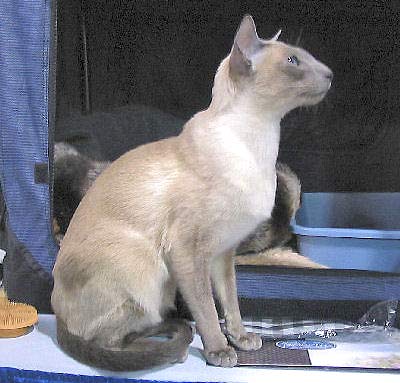
Siamese cats are very distinctive in personality, regal in appearance, and highly esteemed!
The Siamese Cat is a natural breed cat that carries a long and illustrious, though mysterious heritage. Suggested historical ties for this elegant cat breed contains a wonderful assortment of exotic places. Suggested origins range from the Orient and Egypt, to temple cats in Siam, which is the present day Thailand.
This unique cat has a fantastic heritage. Poised as a cat of royalty, such names have been bestow upon it as the Palace Cat, the Royal Siamese, and the Royal Cat of Siam. Old stories tell that when members of the royalty died, this special cat was placed in the burial tomb. But it was able to escape and then carried with it the reincarnated soul of the deceased. Yet no matter what its true heritage, a noble cat breed has evolved for all of us to enjoy and love today.
It is unknown where the Siamese originated from, though it has resided in Thailand since around the 1500’s. Currently, it is a popular breed in the U.S., Britain, and Australia. The Siamese is not only a distinctive cat breed in and of itself, but there are now a dozen or so variants of the Siamese. There is also a silky-haired versions like the Balinese or Long Haired Siamese Cats.
Compared to other cat breeds, the Siamese Cat is extreme in every way, including its demeanor and physical appearance. It is characterized by its pointed coat pattern, being light colored but with dark extremities, and requires little grooming. Its angular features and slender body give it a graceful, unique appearance. It is highly loyal and affectionate, yet it is also hypersensitive and demanding. The Siamese is very vocal, and its voice is loud and distinctive.
The Siamese has a distinctively unique personality compared to other cat breeds. This breed is known for being affectionate, loyal, and intelligent, but it is also known for being emotional, unpredictable, and domineering. The Siamese craves attention, but generally attaches itself to one person. It can tolerate other people, but dislikes sharing its home with other cats. Siamese often become jealous of other animals or people. Interestingly, they can be trained to walk on a leash. Some even say that the Siamese acts more like a dog than a cat. This breed is a great choice for dedicated cat lovers, those who are willing to give this pet the attention it needs.
For information about keeping a pet cat, see:
Cat Care: How to Take Care of a Cat
- Kingdom: Animalia
- Phylum: Chordata
- Class: Mammalia
- Order: Carnivora
- Family: Felidae
- Genus: Felis
- Species: domesticus
Common Name(s)
Siamese, The Palace Cat, The Royal Siamese, the Royal cat of Siam.
Background
Much mystery surrounds the exotic cat from Siam, which is present day Thailand. Several theories exist that attempt to explain the Siamese cat’s origin.
- The first theory posits that the Siamese descended from a wild Oriental species.
- The second suggests that it was bred from Egyptian domestic cats that were brought to the Far East.
- The third states that the Siamese was a product of a pure white cat given to the King of Siam and the brown temple cats.
- The fourth is that Annamese cats were crossed with the sacred cat of Burma to produce the Siamese.
- The fifth and last theory is that a natural mutation occurred in the cats of Siam, which caused their brown coats to become temperature-dependent, which resulted in a dark-pointed coat.
No matter what its exact origins were, the Siamese is known for being a prized cat in Siam. Some believe that it was only kept in the palace with the King of Siam, while others say it was also kept with other royalty. When members of the royalty died, one of these special cats was put in the tomb so that the soul of the deceased would have somewhere to go. When the cat escaped from the tomb (each tomb had several holes in the roof), it was believed that the person’s soul was reincarnated in the cat.
The first record of a Siamese in Britain was in 1871 in the first British cat shows. Then, they started appearing in the United States in the late 1890’s. By some, the cat was regarded as an “unnatural nightmare”, but others saw it as a wonderful exotic addition to the cat fancy world. Currently, the Siamese Cat is one of the most highly praised breeds.
Several variants of the Siamese exist. They include the following:
- Balinese (longhair Siamese with points)
- Javanese (longhair Siamese with new-color points)
- Oriental Longhair (longhair Siamese without points)
- Oriental Shorthair (shorthair Siamese without points)
- Colorpoint Shorthair (shorthair Siamese with new-color points)
- Havana Cat (shorthair Siamese with solid brown coat)
- Foreign White (shorthair Siamese with all-white coat)
- Seychellois (shorthair Siamese with splashed white coat)
- Ocicat (shorthair Siamese/Abyssinian)
- Snowshoe (shorthair Siamese/American Bi-color)
- Tonkinese Cat (shorthair Siamese/Burmese)
Some breeders have begun to develop Siamese that look more like the original specimens, with a round head and solid body. These cats are known by various names, including the Applecat, Apple-head Siamese, Classic Siamese, Old-fashioned Siamese, Opal Cat, Thai Cat, and Traditional Siamese. - Peterbald or Russian Peterbald – this is a hybrid cat breed, created by crossing a Donskoy or Don Hairless with Siamese cats and Oriental cats.
Description
The present-day Siamese cat has a medium-sized, long angular body. The original Siamese had a round head and solid muscular body, but its angular, long features were exaggerated through selective breeding to produce the Siamese body type we see today. The head of the current Siamese forms a long, tapering wedge. The ears are quite large and pointed. The eyes are medium-sized and almond shaped and the nose is long and straight. The legs and tail are both long and slender. The original Siamese had a kinked tail and crossed eyes, but those features were eliminated during breeding programs. This breed weighs approximately 6 to 12 pounds. The Siamese lives a long life of about 15 or more years.
One of the defining features of the Siamese cats is their pointed coat pattern. This breed has a light colored body with dark extremities. This unique pattern is caused by a gene that prevents the fur from darkening when the body temperature reaches a certain level. As a result, the tail, face, ears, and paws are dark, while the rest of the body is light
In the U.S, only four color patterns are accepted: Seal Point, Chocolate Point, Blue Point, and Lilac Point. In Britain, many other variations are accepted, some of which are the Caramel Point, Cream Tabby Point, Cinnamon Point, and Lilac Tortie Point. These additional color patterns are classified as Colorpoint Shorthairs in the U.S.
Glossary term:
- Colorpoint Pattern: The coat pattern in which the body is a light color and the extremities (ears, face, paws, and tail) are a dark color.
Care and Feeding
The Siamese has no special dietary needs. Unlike a number of other popular cat breeds, the Siamese Cat is not prone to becoming overweight.
Housing Your Cat
The Siamese can live in an apartment, but it needs room to run and play. If kept indoors, it should be allowed to run throughout the apartment or house. However, this cat breed also enjoys being outdoors to play and run around, or just relax on a nice day.
Maintenance
This breed requires little grooming, but like most other shorthair cat breeds, a weekly brushing is good.
Social Behaviors
The Siamese is very affectionate towards its owner and demands a lot of attention. It can be social with other humans, but usually prefers to stay away from other animals. If they have their way, their attitude is they would prefer to be the only pet.
Activities
The Siamese is an active cat that enjoys running and playing. When kept indoors, It should be provided with a scratching post and toys to prevent it from turning to couches and curtains for entertainment.
Breeding/Reproduction
Females mature earlier than other breeds. They can become pregnant at five months. The average litter size is six kittens, but larger litters of ten or more kittens are not uncommon. Since the womb is warm, and the Siamese’ coat is temperature sensitive, newborn kittens are completely pale and the color points develop gradually after birth.
Common Health Problems
The Siamese is a generally healthy breed, but some ailments have been noted. Prior to adulthood, Siamese are susceptible to respiratory diseases. Incidences of cardiomyopathy, an inflammation of the heart, which decreases cardiovascular functioning, have been reported. Siamese are also sensitive to anesthetics.
Glossary term:
- Cardiomyopathy : A serious heart condition in which the heart is enlarged or rigid, causing decreased cardiovascular functioning..
Availability
In the late 1800’s and early 1900’s, some Americans were willing to pay up to $1000 for this interesting new breed, possibly making it the most expensive breed in history. Currently, the Siamese is a readily available breed that costs approximately $200 for a pet quality cat to $800 for a show quality cat.
References
- See Animal-World References: Cat Breeds – Exotic Cats
- Bruce Fogle, CATolog, DK ADULT, 2002.
- Mordecai Siegal, Simon & Schuster’s Guide To Cats , Simon & Schuster, 1983
Featured Image Credit: Ana Rosa Debastiani Ribeiro, Pixabay