
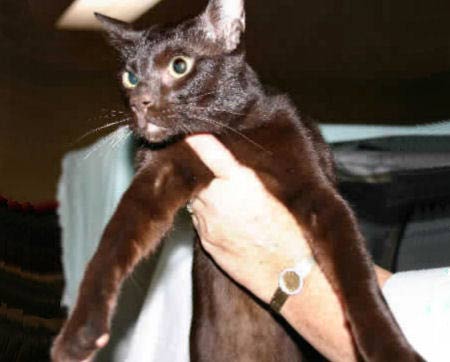
Havana Brown cats are very chic, dressed in a rich chocolate brown mink-like fur and green eyes!
The Havana Brown is a particularly elegant looking cat with a uniformly chestnut brown coat. It has rich, lush fur that is medium in length, glossy and smooth. Except for its green eyes, this breed is all brown from the tip of its nose to the tip of its tail. Even its whiskers and nose are brown. The coat requires little maintenance, only a weekly brushing and then shining it with a piece of flannel or a soft glove to bring out its luster.
Havana Brown Cats are lively, active and playful. They are curious, and even mischievous, but not overly destructive cats. Like their Siamese counterpart, these agreeable cats are affectionate, gentle, and highly intelligent. They carrying themselves with certainty and poise and are adaptable to a variety of situations. These cats are extroverted and enjoy being around people, but yet they are faithful to their keeper and will often become attached to one person.
The Havana loves being inside, and is therefore a good apartment cat. They have been described as being both reservedly affectionate and exceptionally sweet. This may be a product of their tendency to become attached to one person. The Havana’s voice is medium in volume and pitch, but unlike the Siamese they are much quieter.
The Havana is a hybrid breed cat that originated in Britain. it is a fairly rare breed there, and is even rarer in the United States. This cat breed, with the Siamese Cat prominent in its development, has similar traits found in that breed. Its overall build is moderate. This breed has a body that is medium in length and muscular, a medium length to the legs, and a medium long tail. Although it has a solid build, it is not stocky. The British Havana Brown has a stronger Siamese element than the American breed. So the head of those cats are more triangular with a straight nose while American bred Havana has a rounder face and shorter nose. But both groups have large ears and oval-shaped green eyes.
For information about keeping a pet cat, see:
Cat Care: How to Take Care of a Cat
- Kingdom: Animalia
- Phylum: Chordata
- Class: Mammalia
- Order: Carnivora
- Family: Felidae
- Genus: Felis
- Species: domesticus
Background
The first recognized Havana Brown, Elmtower Bronze Idol, was born October 24, 1952 in England, though other Self-brown (solid brown) cats had been recorded in the past, including the Swiss Mountain Cat and the Brown Cat. Interestingly, Elmtower Bronze Idol was the product of a natural breed cat, a Seal Point Siamese male named Tombee and a black shorthaired female (half Seal Point Siamese and half Black Persian) named Susannah. Further mating with Tombee and Susannah resulted in a female Havana Brown named Elmtower Brown Study. Though the breeder, Mrs. Munro-Smith had intended to create a Color-point Persian, she had stumbled across an interesting new breed – the Havana Brown.
The Havana Brown was first shown in Britain in 1953 and achieved championship status in 1958. The breed was imported to America in 1956 and was recognized as an official breed in 1959. The British Havana Brown has a stronger Siamese element than the American breed. It is believed that Russian Blue may have been introduced into the line if the Havana Brown.
Two theories exist to why the Havana Brown was given its name. It is believed that this breed was either named after the “Havana Brown” color of Cuban cigars, since the cat’s coat resembles the color of the tobacco in those cigars, or that it was named after the Havana Rabbit, which has the same colored coat.
While this name accurately describes the breed’s coat color, it led to some confusion concerning its origins. In the late 1950’s, a committee decided to rename the breed “Chestnut Brown Foreign Shorthair” since the breed originated in England, and not Cuba. However, due to popular demand, the original name was reinstated in the 1970’s. Common names for this cat breed include Havana Brown, Havana, Chestnut Brown Foreign, Chestnut Brown Oriental, Chestnut Brown Foreign Shorthair, Berkshire Brown, Reading Brown, and Oriental Chocolate Cat.
Description
The defining feature of the Havana Brown, as signified by its name, is of course its uniformly brown coat. Even the nose and whiskers are brown. All shades of chestnut brown are acceptable. The coat is medium in length, glossy, and smooth.
The body is medium in length and muscular, but not stocky. The legs are medium in length and the tail is medium long. In Britain, the Havana Brown has a more Siamese appearance than in the United States. In Britain, the head is triangle-shaped and the nose is long and straight. In the United States, the head is rounder in shape and the nose is shorter. In both countries, the ears are large and the eyes are oval-shaped and green. This breed weighs 6-10 pounds and lives to be approximately 9-15 years old.
Care and Feeding
The Havana Brown is a hearty breed that has no special dietary needs. Unlike some breeds, the Havana Brown is able to digest milk.
Housing Your Cat
The Havana is an active cat that should be provided with toys and a scratching post indoors. However, it enjoys being inside and can live happily in an apartment. It can benefit from time outside as well, with some time to romp around and play. This breed is known to enjoy jumping in snow.
Maintenance
The Havana Brown Cats require little grooming. It simply needs a weekly brushing and then shining its fur with a flannel or glove in order to maintain its glossy appearance are advised.
Social Behaviors
This breed is not a highly social breed. It is a loving cat, but attaches itself to one person. It is a faithful, affectionate pet.
Activities
The Havana Brown is naturally active and lively. It enjoys playing with its owner, but requires no special exercise program. When keeping it indoors, provide it with a variety of toys and a scratching post.
Breeding/Reproduction
Female Havana Browns are excellent mothers. Litters, on average consist of five kittens. The kittens open their eyes as early as the third day after birth.
Common Health Problems
This is a naturally healthy breed. The Havana Brown is even known for having a natural immunity to upper respiratory infections.
Availability
Due to its scarce nature, the Havana Brown is an expensive cat breed. However, breeders can be found for this breed.
References
- See Animal-World References: Cat Breeds – Exotic Cats
- Bruce Fogle, CATolog, DK ADULT, 2002.
- Mordecai Siegal, Simon & Schuster’s Guide To Cats , Simon & Schuster, 1983
- Hybrid Law, Hybridlaw.com
- Kurt Schmitt, Hybrid Cat Breeds, Cat Lovers Only, Copyright 2004 – 2011
- The Hybrid Cat Breeds of the World, Cat Breeds, Copyright 2009 – 2011
- Havana Brown, About.Com. Cats
- Havana Brown, Wikipedia
Featured Image Credit: slowmotiongli, Shutterstock