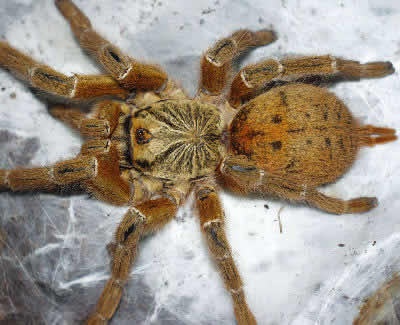
The Mombasa Golden Starburst Baboon Spider has a tough attitude, and a tough constitution!
The Mombasa Golden Starburst Baboon Spider Pterinochilus murinus is a very handsome African tarantula. Coming from the dry savanna scrublands, it is very hardy and adaptable in captivity.
Overall they are golden shade with their namesake starburst pattern on the carapace, but there are variations in their coloring. They can range from tan to a bright gold. These variants are thought to be accorded to each tarantula’s geographic location, and possibly related to the type of soil found there.
Although the Mombasa Baboon Spider is one of the most common African tarantulas available, there are numerous color morphs. Many specimens that are available may not actually be this particular species of Pterinochilus. The name Starburst Baboon Spider actually encompass several species that were imported during the 1990s from Africa. They all have the typical body form but vary in color from grays and black, to pale mustard yellow to bright orange. Taxonomy is no doubt confusing and is in flux these days.
The most popular specimens seem to be the bright golden orange specimens. Common names you will find these specimens under include Starburst Baboon Spider, Mombasa Golden Starburst Tarantula, Mombasa Golden Starburst Baboon Spider, Orange Baboon Tarantula, Usambara Orange Baboon, and even the tongue in cheek name “Pterror,” a pun on its attitude and Latin genus.
The Mombasa Golden Starburst Baboon Spider is a terrestrial species that can live just about anywhere. They tend to be a burrowing spider if the conditions support this, lining their burrow with silk. If the substrate is not adequate for a burrow they will construct their webs anywhere they can.
This spider is very fast and aggressive. If it is provoked it will readily display and bite. It should not be handled under any circumstances, and a bite can be medically significant for some people. Yet despite its aggressive nature, it will readily mate.
For more Information on keeping Tarantulas, see:
Keeping Arachnids and Other Arthropods as Pets
- Kingdom: Animalia
- Phylum: Arthropoda
- Class: Arachnida
- Order: Araneae
- Family: Theraphosidae
- Genus: Pterinochilus
- Species: murinus
Scientific Name
Habitat: Distribution/Background
The Mombasa Golden Starburst Baboon Spider Pterinochilus murinus was described by Reginald Innes Pocock in 1897. They are an “old world” African tarantula found in Zaire, Kenya, and Tanzania. Other common names they are known by are Starburst Baboon Spider, Mombasa Golden Starburst Tarantula, Mombasa Golden Starburst Baboon Spider, Orange Baboon Tarantula, Usambara Orange Baboon, and “Pterror”.
Status
The Pterinochilus murinus are not on the IUCN Red List for Endangered Species.
Description
The true Sunburst Baboon Spider is bright mustard yellow with clean, dark markings. These markings include the characteristic starburst pattern on the cephalothora. Mombasa Golden Starburst Baboon Spiders are medium sized with up to a 6″ (15 cm) leg span. Mature males, however, molt out at a very small size usually in the 2 – 3″ (5 – 7.5 cm) range. Males are slender and long-legged compared to females and they have no tibial hooks for mating.
These spiders are fast growers, a male can mature in under a year with females taking a little longer. They are not as long lived as some of the other tarantulas, having a probably life span of only about 8 to 12 years.
Food and Feeding
In the wild their prey includes insects, lizards, mice, and other small animals. In captivity the Mombasa Golden Starburst Baboon Spider will do well on a diverse diet consisting of adult crickets, grasshoppers, Tenebrio larvae, and only occasional feedings (once or twice a month) of mice.
Housing
The Mombasa Golden Starburst Baboon Spiders live in heavily webbed burrows and are probably one of the most opportunistic of the Theraphosids. They are found in bushes and low trees, in burrows under rocks, in vacated animal burrows, under dog houses and sidewalks, and near human habitation. They commonly find a suitable opening and line it with large sheets of web. As they grow, they add exit holes and often an area to pick up vibrations or to funnel passing prey into close proximity.
Temperature and humidity requirements:
This species can be maintained at about at 77° to 86° F and a humidity of 40 to 60%. They are native to the drier regions of east Africa so need less moisture than many tarantulas. It is reported that even a moist substrate can affect them adversely.
Cage Care
A good habit to get into is cleaning up any uneaten prey items the day after feeding your tarantula as decaying organic matter commonly attracts mites, fungus, mold and other potentially harmful organisms into the enclosure. If your pet has recently molted, remove uneaten prey items immediately. Newly molted tarantulas are vulnerable until their exoskeletons hardens.
Behavior
This spider is very fast and aggressive. If it is provoked it will readily display and bite. In general tarantulas do best if they are housed singly and this works as well for Mombasa Golden Starburst Baboon Spiders. But despite their tough attitude with humans, they will readily mate.
Handling
This species is very aggressive / defensive and should not be handled under any circumstances. The bite can be medically significant for some people. We suggest using a paint brush or other tool to corral the Baboon Spider and to move it from enclosure to enclosure for cleaning, maintenance, or for breeding attempts.
Reproduction
The Mombasa Golden Starburst Baboon Spider has proven very easy to breed in captivity. As with most Pterinochilus species, mature males molt out quite small compared to females. They are usually only in the 2 to 3″ (5 – 7.5 cm) range. They are slender and long-legged compared to females and they have no tibial hooks for mating. This size difference ultimately leads to their demise post-mating.
Adult males should be carefully introduced into the female’s enclosure after he has produced a sperm web. The male can be protected with a piece of cardboard or other tool if he is to be used for further breeding attempts. Once mating occurs, the female should be fed more heavily and a variety of prey items.
Females tend to be very protective of their egg sacs and the young. Their egg sacs hold up well and hatch without much “motherly” attention, simply resting in a hammock in the female’s webbed enclosure. Egg sacs commonly contain between 75 and 100 spiderlings that hatch in about five weeks. Often a second egg sac will be produced in a few months without an additional mating, this is called ‘double-clutching’. Once hatched the spiderlings are easily raised. They are hardy and grow quickly.
Diseases: Ailments/Treatments
Tarantulas are generally quite hardy and adaptable if they are provided with the right environment. A few signs that may indicate that your pet is not acting or feeling normal are a loss of appetite, lethargy, looking overly skinny, or pacing the enclosure.
A tarantula on its back is probably not sick. Most tarantula species flip onto their backs during molting. Though this is a very stressful and delicate time for tarantulas, if the humidity and warmth levels are correct, they will molt their exoskeleton, roll over, harden up, and within a week or two be ready for their next meals.
- Molting
One of the most common reasons for your pet to demonstrate unusual behavior is due to a molting period. As they outgrow their existing skin all tarantulas regularly go through an extensive molt, shedding their entire skin as well as the linings of their mouth, respiratory organs, stomach and sexual organs.
The process starts well before the actual molt. For several weeks prior to shedding they will be growing a new skin under their old one. During this time it is not unusual for a tarantula to get quite lethargic and even stop eating. There may also be lots of web spinning activity as they prepare to molt.
When they begin to molt, they lay on their backs with their legs up in the air looking as if they are dead. Be sure not to disturb your tarantula when you see this. The shedding process goes quickly and smoothly as long the environment has adequate humidity.
Once they have shed, their new skin is pale and very soft. The amount of time it takes for your pet to fully recover and be back to eating well will vary from a day or so up to several weeks depending on its size. Smaller spiders recover much quicker than larger ones. - Other Problems
Other problems are usually the result of some type of environmental stress. There may be a drop in the temperature of the enclosure, there may be parasites, or the tarantula may just not be comfortable with the depth of its hiding place. These things can be easily adjusted or changed, or you can try moving your pet to a new enclosure.
Availability
Baboon Spiders, and especially the genus Pterinochilus, have proven to be very hardy and quite prolific in captivity. Many species of Starburst Baboons are available on a regular basis by tarantula suppliers.
References
- Animal-World Resources: Reptiles, Amphibians, and Land Invertebrates
- Russ Gurley, Tarantulas and Scorpions in Captivity, Living Art Pub, Serpent’s Tale NHBD , 2005
- Samuel D. Marshall, Tarantulas and Other Arachnids, Barron’s Educational Series; 2nd edition 2001
- Russ Gurley, Color Guide to Tarantulas of the World I, Living Art Publishing 1994
- Philippe de Vosjoli, Arachnomannia, General Care and Maintenance of Tarantulas & Scorpion, Advanced Vivarium Systems, 1991
- John G. Browning, Tarantulas. T.F.H Publications, 1989
- R. Conniff, “Tarantulas: Earth Tigers and Bird Spiders”, National Geographic, Sept. 1996, pp. 98-115.