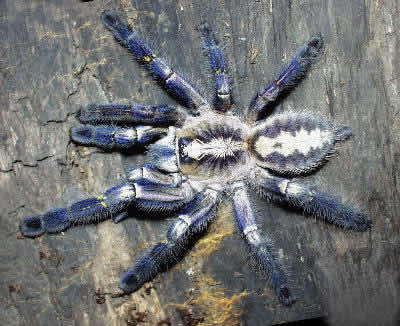
This Metallic blue tarantula is setting the spider hobby ablaze with excitement!
The Gooty Sapphire Ornamental Tree Spider Poecilotheria metallica, a striking arboreal spider from India, and is creating quite a stir. An adult Gooty Sapphire tarantula has an incredible metallic blue colorations on its carapace, abdomen, and legs. Juveniles have a somewhat lavender hue color, but as it grows the lavender fades and is replaced by the beautiful hues of blue. The males are even more intensely colored blue tarantulas than the females.
Metallic Blue Ornamental Tree Spiders are hardy, and relatively fast growing. Mature specimens can have a leg span of about 6-8 inches (14 – 15-20 cm). Females can live up to 12 years. As with all tarantulas, males have a much shorter lifespan, living only a fourth to a third as long as females. This tarantula is a very defensive species, and therefore aggressive. It should be housed individually and not be handled A bite can be medically significant for some people.
P. metallica was originally discovered in the railway timber yard in a town called Gooty, located in central southern India. This led to the common name Gooty Tarantula. It was then rediscovered in in the forest between Nandyal and Giddalur in 2001, after a time lapse of 102 years. There are a number of common names it is known by today, including Gooty Sapphire Ornamental Tree Spider, Gooty Sapphire, Metallic Blue Ornamental Tree Spider, Metallic Tarantula, Peacock Parachute Spider, Peacock Tarantula, and Salepurgu.
The incredible beauty and rarity of captive-hatched Metallic Blue Ornamental Tree Spiders are producing an exhilaration in hobbyists. The Gooty Tarantula is truly the gem of several collections across the United States. This wonderful, bright blue spider is also quite expensive.
For more Information on keeping Tarantulas, see:
Keeping Arachnids and Other Arthropods as Pets
- Kingdom: Animalia
- Phylum: Arthropoda
- Class: Arachnida
- Order: Araneae
- Family: Theraphosidae
- Genus: Poecilotheria
- Species: metallica
Scientific Name
Habitat: Distribution/Background
The Gooty Sapphire Ornamental Tree Spider Poecilotheria metallica was described by Pocock in 1899. They originate from India, found at Andhra Pradesh, reserve forest between Nandyal and Giddalur, and Sri Lanka. It was originally discovered in in central southern India, in the railway yard at town called Gooty. So was commonly called the Gooty Tarantula. It was rediscovered after 102 years, in 2001 in the forest between Nandyal and Giddalur. It is now known by several other common names including Sapphire Ornamental Tree Spider, Gooty Sapphire. Metallic Tarantula, Peacock Parachute Spider, Peacock Tarantula, and Salepurgu.
Status
The Poecilotheria metallica are on the IUCN Red List for Endangered Species as Critically Endangered (CR).
Habitat loss and degradation are major threats to the Gooty Tarantula. Due to timber operations, firewooding, and pressures from other forest uses, the natural habitat of these spiders has been degraded. There is a decline in the quality of habitat for these spiders, who seek cavities and deep crevices in old growth forests.
Description
The Metallic Blue Ornamental Tree Spider is similar in looks to the other Ornamental Tree Spiders, but is covered on the carapace, abdomen, and legs with incredible metallic blue coloration. As a spiderling, Metallic Blue Ornamental Tree Spider has a somewhat lavender hue. As it grows the lavender fades and is replaced by beautiful hues of blue.
The males are beautifully covered in a more intense metallic blue coloration than the females.
Adults can reach about 6-8 inches (14 – 15-20 cm) in length, and have a fairly long lifepan. Females can live up to 12 years with males living about a four to a third as long as females. Mature males are slender and long-legged compared to females.
Food and Feeding
Though Poecilotheria species seem to prefer flying insects such as moths, they will feed eagerly on crickets, grasshoppers, and large specimens will even feed on an occasional small mouse.
Housing
The Gooty Sapphire Ornamental Tree Spider is an arboreal species. It should be kept in a large, vertically oriented enclosure. They need a well ventilated enclosure but with relatively high humidity. A modified aquarium with part screened sides and screened top works best. If the enclosure becomes too dry, the spiders will not do well.
One way to overcome the dilemma of high humidity and high ventilation is to use a deep (4 to 5″) substrate of damp sand and peat moss and provide several live plants within the enclosure. These plants can be placed within the enclosure still in their pots or can be planted in the deep substrate. Live plants will not only provide excellent places for the spiders to establish homes, they will provide excellent areas for breeding and egg-laying.
Add one or two shallow water dishes and mist the entire enclosure once a day to every other day, depending on the conditions of the room in which the enclosure is located. The cage should be allowed to dry out in between mistings.
Temperature and humidity requirements:
This species will do best if you maintain the enclosure at 78° to 82° F with a humidity level of 75 to 85%.
Cage Care
A good habit to get into is cleaning up any uneaten prey items the day after feeding your blue tarantula as decaying organic matter commonly attracts mites, fungus, mold and other potentially harmful organisms into the enclosure. If your pet has recently molted, remove uneaten prey items immediately. Newly molted tarantulas are vulnerable until their exoskeletons hardens.
Behavior
These tree spiders are best housed individually. Though siblings may be okay together before their first molt, they will not be social as adults.
Handling
This species is very aggressive / defensive and should not be handled under any circumstances. The bite can be medically significant for some people. We suggest using a paint brush or other tool to corral the Gooty Tarantula to move it from enclosure to enclosure for cleaning, maintenance, or for breeding attempts
Reproduction
Mature male Gooty Tarantulas are slender and long-legged compared to females and they have no tibial hooks for mating. They are also beautifully covered in more intense metallic blue coloration.
An adult male should be carefully introduced into the female’s enclosure after he has produced a sperm web. The female should be very well-fed before any introductions as Poecilotheria females are notorious for attacking and eating males before any mating can occur. If both male and female are well-fed, success is more likely. The male can be protected with a piece of cardboard or other tool if he is to be used for further breeding attempts.
Once mating occurs, the female should be fed in anticipation of an egg sac.
Diseases: Ailments/Treatments
Tarantulas are generally quite hardy and adaptable if they are provided with the right environment. A few signs that may indicate that your pet is not acting or feeling normal are a loss of appetite, lethargy, looking overly skinny, or pacing the enclosure.
A tarantula on its back is probably not sick. Most tarantula species flip onto their backs during molting. Though this is a very stressful and delicate time for tarantulas, if the humidity and warmth levels are correct, they will molt their exoskeleton, roll over, harden up, and within a week or two be ready for their next meals.
- Molting
One of the most common reasons for your pet to demonstrate unusual behavior is due to a molting period. As they outgrow their existing skin all tarantulas regularly go through an extensive molt, shedding their entire skin as well as the linings of their mouth, respiratory organs, stomach and sexual organs.
The process starts well before the actual molt. For several weeks prior to shedding they will be growing a new skin under their old one. During this time it is not unusual for a tarantula to get quite lethargic and even stop eating. There may also be lots of web spinning activity as they prepare to molt.
When they begin to molt, they lay on their backs with their legs up in the air looking as if they are dead. Be sure not to disturb your tarantula when you see this. The shedding process goes quickly and smoothly as long the environment has adequate humidity.
Once they have shed, their new skin is pale and very soft. The amount of time it takes for your pet to fully recover and be back to eating well will vary from a day or so up to several weeks depending on its size. Smaller spiders recover much quicker than larger ones. - Other Problems
Other problems are usually the result of some type of environmental stress. There may be a drop in the temperature of the enclosure, there may be parasites, or the tarantula may just not be comfortable with the depth of its hiding place. These things can be easily adjusted or changed, or you can try moving your pet to a new enclosure.
Availability
The Gooty Sapphire Ornamental Tree Spider or Metallic Blue Ornamental Tree Spider is currently very difficult to find and is very expensive.
A few dealers in the United States have imported specimens from a breeder in Europe. These specimens were very expensive but sold out relatively quickly. Recently, one U.S. keeper has produced an egg sac and several other keepers have specimens close to breeding size. More and more of these spiders are trickling in from Europe. Hopefully, the price of this wonderful species will reach a level for all hobbyists to experience their incredible beauty.
References
- Animal-World Resources: Reptiles, Amphibians, and Land Invertebrates
- Russ Gurley, Tarantulas and Scorpions in Captivity, Living Art Pub, Serpent’s Tale NHBD , 2005
- Samuel D. Marshall, Tarantulas and Other Arachnids, Barron’s Educational Series; 2nd edition 2001
- Russ Gurley, Color Guide to Tarantulas of the World I, Living Art Publishing 1994
- Philippe de Vosjoli, Arachnomannia, General Care and Maintenance of Tarantulas & Scorpion, Advanced Vivarium Systems, 1991
- John G. Browning, Tarantulas. T.F.H Publications, 1989