Animal-World > Reptiles - Amphibians > Snakes > Colombian Boa Constrictor

Snakes Articles

Colombian Boa Constrictor

Common Boa, Colombian "Red Tail" Boa

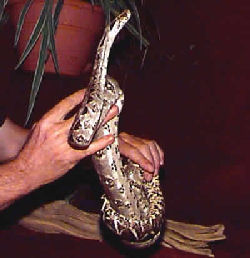
Family: BoidaePicture of a Columbian Boa or Common BoaBoa constrictorPhoto © Animal-World: Courtesy Greg Rothschild
Latest Reader Comment - See More
I bought my husband a seven month old red tailed boa recently. It's the youngest snake we have owned so I'm not sure the proper feeding schedule. Our red tailed boa... (more)  gypsy mills

   The Colombian Boa or Common Boa has an exotic appearance, and is considered by many to be the most beautiful of the constrictors.

   This attractive snake is desirable because it is readily tamed and easy to maintain. The captive born and raised Colombian Boas are usually very docile. They can easily be kept by a beginner as well as the experienced herptile keeper. Very young snakes are delicate and subject to illness so look for small adults.

   Dr. Jungle says... "What's in a name? Lets hear from the expert....!

Picture of a Columbian Boa or Common Boa
Boa constrictor imperator
Photo © Animal-World: David Brough

   "The Boas that we see imported by the thousands from Colombia are not True Red Tailed Boas as they are Boa c. imperator which is found West of the Andes Mountains.

   "These Colombian boas are considered to be non red tailed (although they do possess a red tail). They are instead referred to as "Common Boas " or Colombian Boas.

   "True 'Red Tailed' Boas are the nominant race, Boa c. constrictor. The True Red Tailed Boas are the boas found East of the Andes Mountains in South America (Surinam, Guyana, Brazil, Peru, etc. ).  They get much larger than Colombian Boas and have very deep red tails." ...Vin Russo

Vin Russo is one of the top breeders and most well-respected boa experts in the United States Cutting Edge Herpetological Inc.

For more Information on keeping Snakes see:
Guide to a Happy, Healthy Herptile


Geographic Distribution
Boa constrictor
Data provided by GBIF.org
  • Kingdom: Animalia
  • Phylum: Chordata
  • Class: Reptilia
  • Order: Squamata
  • Family: Boidae

Distribution:    The Colombian Boa or Common Boa is found throughout a large range of South America. They are found in Colombia of course, but also in Guyana, Peru, Suriname, Hogg Island, Venezuela, and more.

Description:    The Colombian Boa constrictor will grow to between six and nine feet, though they can reach up to 12 feet. The males are smaller than the females. This snake is robust, with a triangular head separated from the body by a thin neck.
   Their natural coloring is a pattern of elongated, saddle like, pale gray patches on a background of rich chocolate to almost chestnut brown. The sides are paler with dark brown, diamond shaped spots that have white centers. The undersides are yellowish, spotted with black. The chestnut brown coloring becomes progressively brighter until it is a brick red or pure red, and they are thus sometimes called the 'Colombian Red Tailed Boa'. This name is a bit misleading as the True Red Tail Boa Boa c. constrictor, is the nominant race. (See the box above.)

Feeding:     They are a constrictor and their diet consists of mice, rats, small rabbits and the large snakes can also eat chickens. Feed once or twice a week, depending on the size of the food and the size of the snake. As you get to know your snake, you'll learn what its feeding needs are. Fresh water in a good size water dish should always be available.

Environment:    These snakes are best kept singly except when they are being bred, but you may be able to keep them with other snakes the same size as long as you feed them separately.
   The Colombian Boa constrictor needs a good size cage. Its' housing can be set up as a woodland type terrarium, but keep the decor to the minimum. See the terrarium set-ups described under Basic Reptile and Amphibian Care for more information. A good size water dish will provide moderate humidity as well as a place for soaking and drinking. A heavy limb for climbing on, resting on, and to aid in shedding makes the perfect decor.

Temperature and Lighting requirements:    They do well at 82° to 95° F in the daytime and 72° to 80° F at night. Full spectrum lighting is important for your snakes well being and its long-term maintenance. You can use a substrate heating device for basic heating. For additional heat, you can add a full spectrum incandescent daytime bulb and a blacklight bulb or red incandescent bulb for nighttime heating. Be sure you use a thermometer so you don't let the terrarium become overheated!
   For more detailed information see the Basic Reptile and Amphibian Care: Housing.

Breeding/Reproduction:    These snakes, if not babies, need to be probe sexed for positive sex identification, and they bear live young. Their gestation period can range from four to six months. The litters are large with up to 30 babies, each about 24 inches (61 cm) long and resembling the coloring and patterning of their parents. They are fairly easy to breed in captivity.

Availability:   The Colombian Boa constrictors or Common boas are very common and readily available due to captive breeding.

Author: Clarice Brough, CRS


Lastest Comments on Colombian Boa Constrictor

gypsy mills - 2012-05-07
I bought my husband a seven month old red tailed boa recently. It's the youngest snake we have owned so I'm not sure the proper feeding schedule. Our red tailed boa is approximately 3 feet long but very thin.

  • Jeremy Roche - 2012-05-08
    Really depends on size of food. Once or twice a week is good for that age.
Reply
LaTischa Franzmeier - 2011-07-19
I recently picked up a very young RTB from a local petstore. She was very weak and thin and wouldn't grip my fingers. She did a little bit of climbing around her terrarium, but she seemed to stare off into space a lot, and this morning, I found her dead with her mouth slightly on edge. The space on her cloaca was a light orangey red yesterday and appeared to be swollen, but didn't feel hard. She seemed coordinated enough, but just weak. There are no mites that I can see. Does this sound like IBD? I am freaking out because I am babysitting a friend's python, and I don't want her to catch it.

  • Clarice Brough - 2011-08-01
    Wow, so sorry about loosing your boa. From what I understand, IBD is very hard to diagnose, and takes a liver biopsy to be sure - is what I've heard. It's also primarily transmited by mites. So as long as your area is clean, and you haven't seen any mites during the time you kept your snake.. I'd guess you're okay taking care of your friend's python
  • LaTischa Franzmeier - 2012-01-10
    No worries. It's been a few months and that definitely wasn't it. Just a bad pet store.
  • kc - 2012-03-13
    I have a red tailed boa and he's gasping for air. I don't know what to do
  • Jake the Snake - 2012-03-28
    Might be a respiratory infection, 2 of my ball pythons have had one, so has my friends red tail. What other symptoms does it have?
  • Anonymous - 2012-04-26
    I had a baby CRT die on me from a internal parasite and he was sold to us like that so the store gave us a 1 1/2 yr old CRT male for free. I would get the ball python away from where the other snake died because it can catch it clean everything up immediately. I'm sorry for your loss I know how it feels my snake died in my arms on the way to the vet also had a huge lump and mouth open but it was because his stomach exploded due to the parasite
  • Anonymous - 2012-04-26
    For the respiratory infection, you can either buy medicine or do what I had to do. Just crank the heat up a little bit than how it usually is and make sure it has extra extra humidity. If it keeps breathing out of its mouth get it to the vet ASAP
Reply
Ernest Williams - 2011-09-23
I just discovered after buying 100 mini-pinkies for $65,that my 3 foot baby rtb would not eat them. They are to small for him to consider as prey. I ordered them from Big Apple Pet Supply. I did not have $75 to order 25 rat pups from Big Apple Pet Supply. I looked for another supplier and found Layne Laboratories.com. They have more options in order size 10 a time for most of they mice and rats. They also 25,50,100,500,1000 order sizes. I bought 10 rat pups for $49.24,a big price difference. I like the 10 a time option. I can step up the rat size every 2 months,if I need to keep up with his growth. The rat pups are still a tad small for him,but with in minutes of me offering one to him,he ate it. I will order 10 weaned rats from Layne Laboratories.com next time at $47.34. I would hate to waste the 99 mini-pinkies that are left I will sale them for $40 to any one in the west Atlanta area,you can reach me at wolfman2468@live.com

Reply
happy - 2008-12-12
My family owns a beautiful RTB, we call him McSnakerson. We love him dearly. He has to be the easiet pet to have. However, when it comes to feeding time he can be very agressive. We feed him in a separate feeding area other than his home. We do this to pevent the possibility of him striking. Funny thing though, one time I moved him into his feeding box and he knew it so I began to get ready to put the rat in. McSnakerson kept striking the cage and as I tried to walk to another side to drop in the rat he had his eye on me and just kept following me. Needless to say I had to get someone else in the room to distract him so I could drop in the rat. McSnakerson is the perfect eater though, always ready and quick to it. He is my first reptile pet and my love for snakes has grown cuz of it. We now own a Ball Python as well. He on the other hand, is another story, but loveable just the same.

  • Ernest Williams - 2011-09-23
    You should always use tongs to feed your snake. You should never hand feed your snake, your scent will mix with the feeder rat. I wait until he is in cool hide. I have have half top open,so he can see just the rat. I shake the cage a little, to get his attention. Then I slowly lower the rat to about 2 inches above the hide. He usually take it within a couple minutes. You should should also clean your feeding box with a pet safe cleaner like Zoo Med Wipe Out 1 Disinfectant. That will get rid of the rats smell.
Reply
Trevor - 2012-02-02
I've had my RTB (Ka'ne) for about a 1/2 year, never had any problems, and she has been the best. But due to financial problems, i haven't been able to feed her , her normal 2 mice a week, and had to wait a week and a half, i went to grab her and she bit me, i know it is my fault for not feeding her on time, but just want to know if once they bite you, and taste your blood, will they continue to bite you for no reason, or will i be able to play with her like normal after feeding?

  • mike - 2012-02-21
    Trevor, he only bit you because he probably associated the sound of the cage opening with feeding time and when he saw the movement of your hand he thought is was food. Had he had a chance to smell you before you reached in he would have known food was not present, unless you smell like a mouse ;) and maybe would not have stuck at you. They don't bite for no reason, either food or protection, he won't bite you because he like the taste of your blood. Otherwise, that happens, when you play with fire you get burned, or in this case, when you play with snakes you get bit.
Reply
Lex Bradley - 2012-02-17
I got my red tail black a while ago when she was a year old and so far she's been fairly good. Growing fast. I was thinking about getting rid of her sometime when she gets really big but then again I might not because I want to work with animals when I get a job and having her would help a lot.

Reply

Click to see more Snakes
Back to Snakes

Connect with us on Facebook Watch us on YouTube Follow us on Twitter


After installing a newsreader, click on this icon to download Animal-World XML/RSS feed.After installing a newsreader, click on this icon to download Animal-World XML/RSS feed.

International Index Pages
[French] [German] [Japanese] [Portuguese] [Spanish] [Russian] [Simplified Chinese] [Traditional Chinese]


Copyright © [Animal-World] 1998-2012. All rights reserved.
May 25, 2012, 7:47 pm