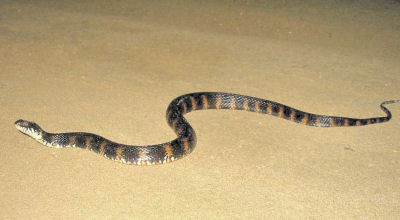
The Banded Water Snake as well as the common water snake are inexpensive and extremely hardy snakes.
The Banded Water Snake may initially be nervous or aggressive. When picked up they will discharge an offensive musky odor as a means of defense, and they may bite.
Generally they calm down with gentle handling and then they will rarely use this odor discharge as a defense measure. Some will gentle to the point of accepting food from your hand while others will always bite.
For more Information on keeping Snakes see:
Guide to a Happy, Healthy Herptile
- Kingdom: Animalia
- Phylum: Chordata
- Class: Reptilia
- Order: Squamata
- Family: Colubridae
- Genus: Nerodia
- Species: fasciata
Distribution:
Banded Water Snakes are found in North America, specifically in the southern part of the United States.
Description:
The Banded Water Snake will grow to an average length of 30 inches (76cm), though they can grow up to four and one half feet. They are a heavy bodied, keeled snake.
Their natural color is a deep brown or reddish-brown background with brown crossbands that are wider on the back and narrowing on the sides. The belly is yellowish, brightly spotted with red and black. Older snakes tend to loose the banding, becoming almost an even brown.
Feeding:
Their diet consists of small fish, frogs, salamanders and crayfish. Feed every few days as they don’t eat much at once and are very active. Fresh water in a shallow dish should always be available.
Environment:
They do not eat other snakes, and so they can be housed alone or in groups with other snakes of similar size and habits.
You can set up their terrarium as either a woodland terrarium or an aqua terrarium. Although they need high humidity and are often aquatic, you must keep the basking side of their terrarium very dry to avoid skin infections, especially boils. See the terrarium types described under Basic Reptile and Amphibian Care for more information. This snake needs a hiding place and a small water dish. They like to climb, so a vertical or semi-vertical tree limb with some plant vining is great.
Temperature and Lighting requirements:
They do well with temperatures around 77° F (28° C) in the daytime and cooler at night. Full spectrum lighting is important for your snakes well being and its long-term maintenance. You can use a a low wattage full spectrum incandescent daytime bulb and a blacklight bulb or red incandescent bulb for nighttime heating if necessary. Be sure you use a thermometer so you don’t let the terrarium become overheated!
Breeding/Reproduction:
These snakes are livebearers and generally have about 25 babies in the late summer months. Robert Anderson states in his book, A Step-by-Step Book About Snakes, 1995, that there have been litters of up to 44 babies reported. The young are about 8 inches (20 cm) long and are brightly patterned. Their musk glands are fully developed and they will bite. They breed readily in captivity.
Availability:
The Banded Water Snake is very common, readily available, and very inexpensive.