Animal-World > Reptiles - Amphibians > Amphibians > White-Lipped Tree Frog

White-Lipped Tree Frog

Giant Tree Frog

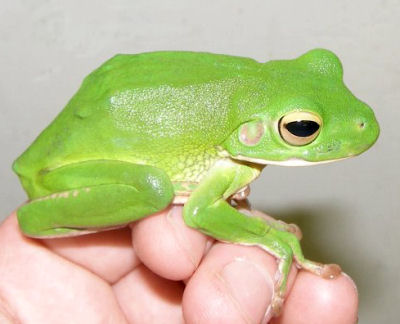
Family: HylidaePicture of a White-Lipped Tree FrogLitoria infrafrenataPhoto © Animal-World: Courtesy Russ Gurley
Latest Reader Comment - See More
I have two male white lipped tree frogs who are approx 10 months old. I have them in an aquarium with a UV light and 100W heat lamp it is also set up with... (more)  Fiona

The adorable White-Lipped Tree Frog, true to its name, has a bright white lower lip!

The White-Lipped Tree Frog Litoria infrafrenata not only has a white lip, but it is the largest tree frog in the world. thus it is also called the Giant Tree Frog. This tree frog's body is a usually a bright leaf green, which makes for a striking contrast to its white lip, and the skin on its sides have a rather granular appearance. A healthy tree frog can also change its color, turning an olive brown shade which helps to camoflauge it when hunting.

The White-Lipped Tree Frog is a close relative of the White's Tree Frog. These two tree frogs are very similar in appearance but there are a few modifications. The similarities between these "cousins" are obvious. The White-Lipped Tree Frog is a slightly larger frog and its supratympanal ridges are not as well-developed as they are on the White's Tree Frog.

This is a very nice frog for the advanced beginner to intermediate frog keeper. Although this Giant Tree Frog is a relative of the White's Tree Frog, it has a personality all its own. It is a little moodier than the White's Tree Frog. It is a little jumpier and more nervous than the White's too, but it is a joy to keep.

For more Information on keeping frogs see:
Guide to a Herptiles: Reptile & Amphibian Care


Geographic Distribution
Litoria infrafrenata
Data provided by GBIF.org
  • Kingdom: Animalia
  • Phylum: Chordata
  • Class: Amphibia
  • Order: Anura
  • Family: Hylidae

Scientific NameLitoria infrafrenata

Habitat: Distribution/BackgroundThe White-Lipped Tree Frog Litoria infrafrenata was first described by Gunther in 1867. It is found in Queensland, northern Australia, Indonesia, and Papua New Guinea and many of the nearby islands. Other common names they are known for are Giant Tree Frog. It has a very wide distribution and in a broad range of habitats from tropical rainforests, wet forests, to woodlands during the monsoons, and also in modified environments. These frogs can be found in gardens and parks, fields, along roadsides, and various forests.

Status The Litoria infrafrenata is on the IUCN Red List for Endangered Species as Least Concern (LC). The White-Lipped Tree Frog has a wide distribution and is adapted to many different habitats.

Description The White-Lipped Tree Frogs are generally 3.5 to 5" (9 - 13 cm) with the females being the largest. There is no definite way to sex this species, which is why they are not one of the most successfully bred species in captivity. They have quite a long life span, living over 10 years in the wild.

As the name would suggest, this frog has a white lower lip. The rest of the body is generally a bright green, though low temperature, stress, and other adverse conditions could change this color. Healthy frogs themselves can change from olive-brown to bright leaf green. The skin appears almost granular, with this effect being seen most often on the sides of the frog.

Food and FeedingThese frogs, true to their similarity to the White's tree frog, are great feeders. The Giant Tree Frog will eat gut-loaded or mineral-dusted crickets, soft (post molt) giant meal worms, and even house flies. Be careful about catching your feed insects from the wild as there is too great a chance that they've dredged themselves through insecticides, pesticides, or fertilizers, all of which could kill your new frog. Wild caught insects could also house internal parasites that are harmful to your pet frog. Feeder insects are inexpensive and readily available from your local pet store.

A shallow water bowl should be kept in the cage at all times and should be changed daily with dechlorinated water. The cage should be misted every night as well, as this will provide another water source and will help to keep the humidity level raised.

HousingFor an adult frog, a twenty gallon ‘high' aquarium will do nicely. The Giant Tree Frogs are arboreal (tree-dwelling) frogs and need to have vines and branches to climb about on. The branches should be about the same width as the frog so it is easier for the frog to hold on. The cage needs to be well-ventilated so a screen top rather than a solid top is needed. Suitable substrates include cypress mulch, peat moss, and plain potting soil (without perlite or vermiculite).

A 50-watt daytime bulb is highly recommended as this will provide the extra heat that the White-Lipped Tree Frogs need in deference to the White's Tree Frog. Place perches at varying heights so that the frog can stay where it is comfortable.

For more information, see the terrarium set-ups described under Basic Reptile and Amphibian Care.

Cage CareThe White-Lipped Tree Frogs can mess up their cage rather quickly, though they seem to be cleaner than the White's Tree Frogs in similar enclosures. Still, misting will help to reduce the amount of cage cleaning and, when you do need to clean the cage, you can use any approved cleaner that can be found at your local pet store.

Behavior As sexing the White-Lipped Tree Frogs is difficult, there really are no particular boundaries for how many frogs you can have together. Just be sure that you provide enough space, perches, water, and general room for the frogs to breathe and grow. They will get along well enough with humans. They are, however, a little jumpier and more nervous than the White's tree frog. This is a very nice frog for the advanced beginner to intermediate frog keeper.

Handling As with most amphibians, too much handling can stress these frogs out. It is important to always wash your hands before and after handling these frogs. Also, try to only take your croaking friend out at a maximum of once a day, preferably only every other day, for sessions lasting only five to ten minutes.

Reproduction In the wild, the White-Lipped Tree Frogs reproduce in the spring and summertime in deep, slow moving streams and in forest pools, as well as in human modified areas like ditches and pools.

In captivity, temperatures in the lower 70s, combined with a reduced photo period for six to eight weeks, cycles these frogs and prepares them for the mating season. After this cooling period, a warm-up to standard terrarium temperatures and increased humidity with extra misting can lead to courtship and breeding in these frogs.

As with many tropical frogs, eggs are laid in the water by the female and fertilized externally by the male. The tadpoles develop in water, feeding on detritus and bits of leaves, aquatic plants, and algae. Depending on the temperature, the small frogs metamorphose and make their way onto land and into the treetops they call home.

Diseases: Ailments/TreatmentsThe White-Lipped Tree Frog is very hardy, but as with all frog species health and hygiene go hand in hand. Providing a proper environment and keeping it clean is the best way to keep a happy healthy frog.

The only thing that captive tree frogs seem to commonly suffer from is metabolic bone disease, which can easily be prevented by a diet that adds an appropriate amount of calcium. Using a high-calcium dust to coat crickets once every third or fourth feeding will help prevent MBD. Using a food source that is rich in calcium (Greenleaf lettuce, carrot tops, romaine lettuce, shredded vegetables, and commercial cricket diets) to gut load your crickets before feeding can help to prevent and in some cases even correct this problem.

Availability The White-Lipped Tree Frog is becoming more readily available for anywhere between $20 and $70.

References

Author: Monica Rearick


Lastest Comments on White-Lipped Tree Frog

Fiona - 2011-09-19
I have two male white lipped tree frogs who are approx 10 months old. I have them in an aquarium with a UV light and 100W heat lamp it is also set up with branches, ledges and foliage. The base of the aquarium is gravel and heated water as we have 3 tiny fish. I feed the boys gut loaded crickets every two to three days. They seem to be very healthy and range from brown to a dark purplish colour.
One of the boys is very much the "alpha male" and can be a little aggressive with the littler boy, knocks him of his perch and into the water. The little one seems to cope well and just goes about his business.
In the last couple of weeks they alpha male has started to croak excessively. He starts to croak continuously around 2:00 clock in the afternoon and doesn't stop until around 3.30am - he wakes the entire family up (including 2 children who sleep very soundly). We can not talk on the telephone unless we go into another room or outside and we have to turn the TV up really loud.
The past two nights I have made a smaller enclosure for the boys in our garage, just so we can get some sleep. The enclosure is heated with a mat rather than a lamp and has a small container of water and some branches and foliage. They either do not croak or we can not hear them. When I put them back in their normal aquarium around 6.30am in the morning they are cool to the touch and bright green.
I am not sure what to do to stop the constant croaking as I don't think it is good for the frogs to be moved every day. Should I drop the temperature in the aquarium - remove the heat lamp (this goes against everything I have been told to do to look after them).
Please help - they are driving us mad!

  • Toby Jungle - 2011-09-20
    Not positive but if not the same frog it sure had to be a relative. Every year, our yard would be invaded - with literally a hundred of these little critters. Looks like them a really very bright bright grren and tiny - maybe 3 - 4 inches at the most with webbed feet. They could walk right up the windows. Huge noise coming from one litle frog. Big huge noise. They were kinda cute but noisy. I called Animal Control as I didn't understand why there were so many and why the big noise. I was told that it was breeding season and they form clusters and that in a couple of weeks all would leave. Every year they came and made a huge noise for a couple of weeks and then they would leave. I doubt this helps but maybe just breeding season and it will stop.
  • Sue Unsworth - 2011-10-04
    Hi Fiona
    Your frogs are making that racket because it is mating season, and they are trying to attract a partner. These little guys are just growing up. This is one of the down sides of keeping them in an enclosed space - they can't get on with the natural business of finding a mate and making babies. The croaking should stop once the mating season is over.
Reply
frog lover - 2010-04-07
Hi, I had 4 white's tree frogs; two babies, one sub adult, and one huge adult.
My first baby lived in a 30 gal. terrarium, he sadly died, and my brother's friend gave me a baby and a sub adult. They lived in a beautiful 75 gal. tank from the grand rapids reptile expo. I purchased the huge one for 20 bucks. Every single one of my tree frogs refused to eat, and they all died. I researched the problem, I pin pointed every temp, they even had a uvb/uva bulb. I covered up one side of the tank with a blanket to relieve stress. If anyone knows or thinks they might know please tell me, I love tree frogs. Would a white lipped be a better choice for me? If so, I know they don't recommend mixing species but because white lips are so big could they live with an aproprietly sized species of gecko that has the same enviromental needs ( humidity, heat, ect... )? Someone please help!

  • RICKY - 2010-08-10
    Yes they can live with them.
  • Amber - 2010-09-21
    I have a white-lipped that is peacefully residing with 2 white-lined geckos. They have been together for over a year (they were all almost full grown when I got them...) there is also a descent sized columbian tree frog in there too....
    Good luck!
Reply
dave - 2011-05-13
I have just thrown a white lipped tree frog out. It kept appearing in the toilet bowl. This evening it was sitting on the rim so I caught it (bare handed -- if it can live in the toilet I will not give it an infection!!). I put it onto a palm tree outside.

Ten minutes later my wife went out to take a photo and we found 2 of them, one with the pinkish legs, one more white in the tree.

The pleasures of living next to a rainforest!!

Dave, Cairns, Qld, Aus.

  • Charlie Roche - 2011-05-13
    Makes your life a little more interesting than us regular old folks. Sounds fun anyway.
Reply
Sue Unsworth - 2011-06-07
I have four white lipped tree frogs that live mostly in my kitchen - they nip out onto the verandah at night to have a swim in the dog water dish and then squelch their way back to the pantry, leaving puddles all over the house! They are also quite clumsy and regularly knock things off shelves during their travels around the house. There has been more than one occasion when I have been woken by the sound of breaking glass as they have sent a vase or jar flying. There are two huge ones, one medium sized one and one "youth" We love them dearly, but wouldn't keep them enclosed in any way. I have decided to leave a bowl of water in the pantry and one on the kitchen bench at night - less mess for me each morning. We are very happy with these house mates, despite their mess. I hope they stay with us for many years.

  • Sue Unsworth - 2011-10-04
    Further to my earlier post, my green tree frog population in the house has increased to at least eight! Those are just the ones I can see - but it seems like every time I move something in the pantry or on the deck, there is another frog hiding behind it! It's like the frog super-highway at night. I think one of the reasons there are so many at the moment is that it is incredibly dry out, and they have access to water here in the house. The doors and windows are always open, so they can come and go as they please. They have a water bowl in the pantry, another in the kitchen sink, the dog bowl on the deck, and now I have put another dish of water in the dining area on the deck. Two of the frogs have taken up residence in a lamp in the lounge, four in the pantry and a couple on the deck. Lots of fun watching these guys. :)
Reply
Cheryl - 2010-04-23
Having geckos, dragons, and skinks, we decided to add to our family 2 white lipped frogs after leaving the store with what we believed to be smaller frogs. Imagine our surprise once researched at our newly acquired baby giants and we would'nt have them any other way. Ollie(because he likes to change from green to olive any chance he gets) and Freddo cause he's littler have already become quite the personalities...Ollie is onto a door or enclosure top being raised at a drop of a hat and likes to jump to the glass whenever he sees me, Freddo is a little more laid back but he does have a gorgeous blue/green spot on the top of his head! I look forward to many more years with our newest family members.

  • Edward\r\n - 2011-09-20
    Much appreciated for the information and share!
Reply
Parker - 2011-07-15
We have 2 green frogs on our porch that look just like the photos of the white lipped green frogs but we live in TX and it's DRY and HOT so what are they?

Reply

Click to see more Amphibians
Back to Amphibians

Connect with us on Facebook Watch us on YouTube Follow us on Twitter


After installing a newsreader, click on this icon to download Animal-World XML/RSS feed.After installing a newsreader, click on this icon to download Animal-World XML/RSS feed.

International Index Pages
[French] [German] [Japanese] [Portuguese] [Spanish] [Russian] [Simplified Chinese] [Traditional Chinese]


Copyright © [Animal-World] 1998-2012. All rights reserved.