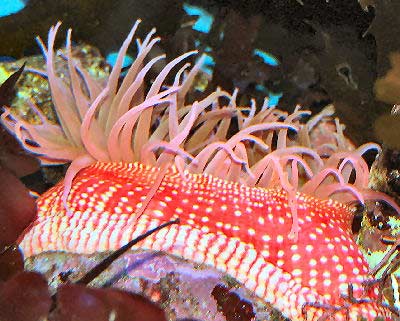
A sea anemone is often called the “flower of the sea”, and like flowers they are quite beautiful and varied, but they are actually animals!
A beautiful sea anemone living with a colorful clownfish is a saltwater aquarium favorite! There are over 1100 described species of sea anemones and we are still being surprised by the discovery of new species. A most recently discovered species, an Antarctic sea anemone from the South Shetland Islands Stephanthus antarcticus, was found and described by Rodriguez & Lopez-Gonzalez in 2003.
Anemones are invertebrates, as are 95% of the earth’s creatures. Invertebrates are animals without backbones and most invertebrates are insects. However saltwater animals like sea anemones, corals, shrimps, snails, and crabs are also invertebrates. Anemones are stinging animals that live their entire lives as a polyp, with the only exception being a short larval stage for some species.
Keeping sea anemones in captivity began way back in 1881, when the first anemone specimen was housed in a tub. A more intimate and dedication interest evolved in the mid-20th century. During this time, advances in SCUBA diving along with international jet transportation, made sea anemones much more available and they began being kept in reef aquariums around the world. They are also used as a food source by people in some areas of the Indo-Pacific and the Mediterranean, eaten as boiled or spiced anemones.
Once established, many types of anemones are known to be quite hardy. However many anemones simply do not fare well in captivity. Much of their demise is attributed to the difficulty in the collection and handling of these delicate animals, but it can also often be attributed to their care after being obtained by the aquarist.
For information about setting up a reef tank see:Reef Tanks – Mini-Reef Aquarium Basics
Sea anemone habitat
These fabulous colorful animals are found in coastal waters throughout the world. Anemones live in shallow waters including the coral reefs, and in the deep oceans. They live in both tropical waters and cold waters.
Anemones are benthic, which means they are attached to rocks or the sea floor. They mostly stay in one place waiting for fish or other prey to swim by close enough for them to ensnare them in their venom filled tentacles. In the aquarium they will often move around until they find a place that they like and then stay put.
Appearance of a Sea Anemone
Anemones have a body that is radically symmetric, but other than that they come in many shapes, sizes, and colors. They come in a wide variety of colors and are usually about 1 to 4 inches (2.5-10 cm) across, but a few species can be as small as half an inch (1.25 cm) across or as large 6 feet (1.8 m) across. The largest and most brilliantly colored anemones occur in coastal tropical waters
Sea Anemone Facts
Taxonomy – Classification: To better understand what sea anemones are, we can gain valuable clues from their scientific classification.
- Kingdom: Animalia
- Phylum: Cnidaria – “to sting”
The phylum Cnidaria includes anemones, corals, jellyfish, and hydras. The term Cnidaria (with a silent “c”) means “to sting”, and this name refers to the cnidae, or nematocysts, which all Cnidarians have. The ‘cnidae’ are the stinging cells, which provide these animals a means of capturing prey and/or defending themselves from predators by inducing a painful sting.
Another phylum name (older) for the Cnidarians is Coelenterata (pronounced “se-len-ter-a’-ta’). This name is from their old phyletic grouping, and may still be used informally in some settings when referring to these animals. Coelenterate refers to the single body cavity that serves as stomach, lung, intestine, and everything else! There is only one opening into this cavity, the mouth, through which everything passes in and out. The mouth is surrounded by several or many tentacles, which contain the nematocysts (cnidae) at their tips. - Class: Anthozoa – “flower-like animals”
Anemones are placed in the Anthozoa class of single or colonial polyps along with corals, sea fans, and sea pansies. The sea anemones are sometimes referred to as the ‘flowers of the sea’. They can be very colorful and can appear similar to flowers, but they are not plants. They are actually predatory, meat eating animals. Interestingly their common name ‘anemone’ is derived from a group of terrestrial plants in the buttercup family. The plant genus Anemone consists of about 120 species of very pretty flowering plants.
Sea anemones Life Cycles: There are two methods by which sea anemones can reproduce, either by sexual reproduction or by lateral fission.
- Sexual reproduction:
Sexual reproduction is where the anemones release eggs and sperm into the water, which then producing free-swimming larvae. - Lateral fission:
Lateral fission is a system of budding, where an identical animal sprouts from the side of the parent anemone, growing until it can survive on its own. Because of its ability to reproduce by lateral fission or budding, pieces of an anemone can turn into new sea anemones.
Anemones are long-lived animals, with some species of sea anemone living 50 years or more.
Types of Sea Anemones
The next level of classification for sea anemones is the Order. This is where types of sea anemones begin to diverge:
- Order: Actinaria – Sea Anemones or ‘True Anemones’
Sea Anemones are in the order Actinaria, and are often called the “true anemones”. They have an adhesive pedal disc or foot used to hold them in place and a hollow cylindrical or column shaped body. They have an oral disc with a mouth at the top which is surrounded by a circle of tentacles containing stinging nettle-cells or nematocysts.
Their stinging cells are used to capture prey and push it into its mouth. With only a slight touch, the tentacles shoot harpoon-like filaments into passing prey, injecting it with a paralyzing neurotoxin, and then guiding it into the mouth. - Order: Ceriantharia – Tube Anemone or Burrowing Sea Anemone
Tube Anemones are in the order Ceriantharia. They are also known as Tube-dwelling Anemones or the Burrowing Sea Anemone. They are solitary animals, living and withdrawing into tubes buried that are buried in soft sediments.
Tube Anemones look very similar to sea anemones, but they have elongated bodies adapted for burrowing and they lack the pedal disc or foot. The cylindrical shaped body is covered by a tube of secreted mucous and is usually hidden in the muddy substrate. The mouth is on a central disk, surrounded by short tentacles in the center and longer tentacles on the margins. Usually only the tentacles are visible above the ground.
Sea Anemone Care
- Zooxanthellae:
Most anemones survive in a symbiotic relation with with marine algae called zooxanthellae. The zooxanthellae are photosynthetic organisms whose waste products are used by the anemone for food. Since the zooxanthellae require light to carry on photosynthesis, anemones in turn require bright light to thrive in the aquarium.
The zooxanthellae are generally a light brown color, the same color as the light brown leather corals that also harbor zooxanthellae. The loss of zooxanthellae, apparent by a whitening of the anemone, usually means the anemone will slowly grow smaller and smaller until it dies. - What do sea anemones eat:
Sea anemones are carnivores, meaning they are meat-eating animals. Though they obtain most of their nutrition from zooxanthellae, symbiotic algae that lives inside their tissues, they will also eat other proteins. Sea Anemones will eat fish, mussels, worms, shrimp, and zooplankton like copepods, isopods, amphipods, and other small crustaceans, and tiny marine larvae. In order to eat, they must wait for their prey to swim by, then sting and ensnare it with their tentacles, and finally guide it into their mouth - Marine lighting – how much light for anemones:
Many anemones need lots of light to do well. They need light to support zooxanthellae, symbiotic algae that live inside their tissues and from which they obtain most of their nutrition. Provide 2 to 5 watts per gallon, preferably with some blue spectrum provided by actinic light bulbs or higher temperature metal halide lighting. The scale of light intensity is:- Low level – 1 to 2 watts per gallon, about a normal marine setup with regular fluorescent bulbs (10 watts per foot bulbs).
- Medium level – 2 to 4 watts per gallon, maximum regular fluorescent to minimum VHO or metal Halide.
- High level – 5 or more watts per gallon, maximum VHO and/or metal halide. See Mini-reef: Lighting for a description of VHO and metal halide
Sea Anemone Predators
There are few sea anemone predators. When an anemone feels threatened, it will pull its tentacles into its body giving it a round ball-like appearance. Though there are very few animals will eat anemones, there are some that do prey on them. Anemone predators include:
- nudibranchs
- snails
- fish
- sea stars
Some specific predators are the Grey Sea Slug Aeolidia papillosa, which feeds exclusively on sea anemones, and also the Tompot BlennyParablennius gattorugine, which enjoys snacking on them if it gets a chance.