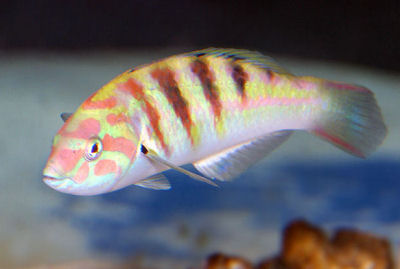
The Sixbar Wrasse or Hardewick’s Wrasse is an interesting variation from the other Thallasoma wrasses, with bold vertical black bars along it’s body!
A hardy fish that is easy to care for, the Sixbar Wrasse or Hardewick’s Wrasse makes a wonderful addition to the right marine aquarium and can live for many years. It gets rather large and is very active during the day, enjoying a lot of rockwork with nooks and crannies for retreating as well as for sleeping at night.
The Thalassoma wrasses do not sleep under the sand like the Halichoeres wrasses and Leopard Wrasses do, nor will they spin a cocoon like fairy wrasses. They hide and sleep within the rock work, so don’t need a deep sand substrate. However this wrasse does enjoy resting on a sandy substrate and may burrow into it when frightened.
In their natural environment juveniles are seen in groups but adults are seen alone or in small loose groups. In captivity the Sixbar Wrasse is aggressive especially with new tank mates. It is best to add a Sixbar Wrasse last to your aquarium. Though it doesn’t bother corals, it will eat crustaceans, invertebrates, and even smaller fish. With these things in mind, provide a large aquarium with plenty of swimming space, plenty of rockwork, a sandy bottom, and large tank mates that can hold their own.
For more Information on keeping this fish see:
Guide to a Happy, Healthy Marine Aquarium
Great illustration of how a Sixbar Wrasse, or Hardewick’s Wrasse, behaves in the wild. These wrasses are very colorful with the males being the brighter sex. They can hold their own with most other fish and do fine in a more aggressive or predator type reef tank. They will reach up to 6-7″ and once they are full grown any small slender fish, like dartfish. will be in danger. These fish are constantly swimming, thus leading to a big appetite and should be fed several times a day. They will rid your tank of unwanted bristleworms, but will also eat other small invertebrates, including sea stars.
- Kingdom: Animalia
- Phylum: Chordata
- Class: Actinopterygii
- Order: Perciformes
- Family: Labridae
- Genus: Thalassoma
- Species: hardwicke
- Beginner Fish – Saltwater fish for beginners
- Community Fish – Peaceful Saltwater fish
- Hardy Fish – Hardy Saltwater fish
Habitat: Natural geographic location:
The Sixbar Wrasse or Hardewick’s Wrasse was described by Bennett in 1830. They are found in the Indo-Pacific Ocean throughout Micronesia; from east Africa to the Tuamotu Islands, north to Japan, and south to the Australian Islands. They range at depths of just a couple inches below the surface down to 49 feet (15 meters), inhabiting shallow lagoons and outer reefs.
Status:
These fish are not listed on the IUCN Red List.
Description:
The body of the Sixbar Wrasse varies from lighter to darker green with 6 vertical black bars dorsally on the back. More mature fish have pink bands spreading over the face. Juveniles are basically the same coloring without the pink bands on the facial area. Sixbar Wrasses are known to be long lived in the aquarium.
Length/Diameter of fish:
Adults can reach up to about 8 inches (20 cm), though in captivity most Thalassoma wrasses only grow to about 6 or 7 inches (15 – 18 cm).
Maintenance difficulty:
Easy beginner fish for a large aquarium. Though it will not bother your corals, it is not considered totally reef safe as it will eat most of your small crustaceans and invertebrates, and even smaller fish. House with other aggressive species of at least the same size or larger.
Foods:
The Sixbar Wrasses are carnivorous. In their natural environment they eat on benthic and planktonic crustaceans, small fishes, and foraminiferans; including such things as snails, worms, sea stars, urchins, and clams. Having very hearty appetites, they are easily trained to eat prepared foods in the aquarium. Feed a varied protein diet strong in small crustacea, formulas and frozen foods such as mysis and brineshrimp, and even flake foods. They are heavy eaters that will eat anything and need to be fed 2 or 3 times a day.
Maintenance:
Normal water changes at 10% biweekly or 20% monthly.
For more information see, Marine Aquarium Basics: Maintenance
Aquarium Parameters:
This fish needs to have a large aquarium with lots of space for swimming, a sandy substrate, and lots of rockwork for hiding and sleeping.
Minimum Tank Length/Size:
A minimum 75 gallon (284 liters) aquarium.
Light: Recommended light levels
No special requirements.
Temperature:
No special requirements. Normal temperatures for marine fish is between 74° and 79° F (23 – 26° C).
Water Movement: Weak, Moderate, Strong
No special requirements.
Water Region: Top, Middle, Bottom
They will spend time in all parts of the aquarium.
Social Behaviors:
In their natural environment juveniles are seen in groups, but adults are seen alone or in small loose groups. Can be kept singly or a male and female in a 125 gallon. Aggressive with fish of similar size and should be housed with fish such as tangs and triggers. Avoid slow moving or smaller fish as they will be harassed, possibly eaten.
Sex: Sexual differences:
Males are brighter than females, with secondary or terminal phase males (females that have changed into males) being slightly more colorful than initial males.
Breeding/Reproduction:
Egg layer. Not yet bred in captivity. Spawning occurs either in groups of fish in the initial color phase or in pairs.
Availability:
The Sixbar Wrasse is not as frequently available as some of the other Thalassoma Wrasses. However they are sometimes available on the internet or as a special ordered through a pet store and range in price from about $50.00 to $80.00 USD.