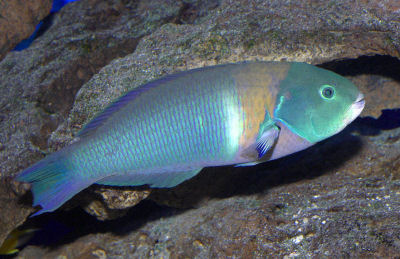
It’s very pretty when its young, but the Saddle Wrasse gets even more colorful as it ages!
The Saddle Wrasse is endemic to Hawaii where it is called “hïnälea lau-wili”. Though it has a limited geographic location, it is one of the most numerous and common fish in those waters. It can be distinguished not only by its color but by its characteristic swimming pattern, beating its pectoral (side) fins up and down in a “flying” motion.
A beautiful hardy fish that is easy to care for, the Saddle Wrasse makes a wonderful addition to the right marine aquarium. It gets rather large and is very active during the day, enjoying a lot of rockwork with nooks and crannies for retreating as well as for sleeping at night. Though quite social in its natural environment it gets aggressive in captivity, especially as it ages. Like all the Thalassoma Wrasses, the Saddle Wrasse enjoys resting on a sandy substrate and may burrow into it when frightened. This wrasse doesn’t bother corals, but it will eat crustaceans, invertebrates, and even smaller fish. With these things in mind, provide a large aquarium with plenty of rockwork, a sandy bottom, and large tank mates that can hold their own.
For more Information on keeping marine fish see:
Guide to a Happy, Healthy Marine Aquarium
The Saddle Wrasses are very handsome fish that grow to about 6-7″ in length. They are definitely one of the Thalassoma wrasses that will hold their own with most other fish! They do well in a reef, but will eat small crustaceans, molluscs, ornamental shrimp, and then very small fish once they are full grown. Yet their ability to get rid of pests such as bristleworms makes them quite valuable in a “predatory reef” set up.
- Kingdom: Animalia
- Phylum: Chordata
- Class: Actinopterygii
- Order: Perciformes
- Family: Labridae
- Genus: Thalassoma
- Species: duperrey
- Beginner Fish – Saltwater fish for beginners
- Community Fish – Peaceful Saltwater fish
- Hardy Fish – Hardy Saltwater fish
Habitat: Natural geographic location:
The Saddle Wrasse was described by Quoy & Gaimard in 1824. They are found in the Eastern Central Pacific, endemic to the Johnston and Hawaiian Islands at depths of 16 to 98 feet (5 – 30 meters). Inhabiting areas from shallow coastal regions to the outer reefs, they enjoy sand bars for quick getaways. They are often found singly or in small groups consisting of females with one dominant male.
Status:
These fish are not listed on the IUCN Red List.
Description:
An adult Saddle Wrasse, in the initial phase, has three distinct colors with some lavender highlights. It has a pretty blue head followed by a broad orangish ‘saddle-looking’ bar, with the rest of the body being green. Secondary or terminal phase males (females that have changed into males) are a dark blue-green. Juveniles are uniformly darker on top and lighter on the bottom, developing their adult coloration – the ‘initial phase’ when they reach about 2.5 inches (6 cm). Saddle Wrasses are known to be long lived in the aquarium.
Length/Diameter of fish:
Adults can reach up to about 11.5 inches (30 cm), though in captivity most Thalassoma wrasses only grow to about 6 or 7 inches (15 – 18 cm).
Maintenance difficulty:
Easy beginner fish for a large aquarium. Generally not considered totally reef safe as it will eat most of your small crustaceans and invertebrates, though it will not bother your corals. Housed with other aggressive species at least the same size or with larger fish. The Saddle Wrasse becomes more aggressive as it ages.
Foods:
The Saddle Wrasses are carnivorous, in the wild they eat benthic animals such as worms, shells, molluscs, brittlestars, shrimps, and other crustaceans . Having very hearty appetites, they are easily trained to eat prepared foods in the aquarium. Feed a varied protein diet strong in small crustacea, formulas and frozen foods such as mysis and brineshrimp, and even flake foods. They are heavy eaters that will eat anything and need to be fed 2 or 3 times a day.
Maintenance:
Normal water changes at 10% biweekly or 20% monthly.
For more information see, Marine Aquarium Basics: Maintenance
Aquarium Parameters:
This fish needs to have a large aquarium with lots of space for swimming, a sandy substrate and, lots of rockwork for hiding and sleeping.
Minimum Tank Length/Size:
A minimum 75 gallon (284 liters) aquarium.
Light: Recommended light levels
No special requirements.
Temperature:
No special requirements. Normal temperatures for marine fish is between 74° and 79° Fahrenheit.
Water Movement: Weak, Moderate, Strong
No special requirements.
Water Region: Top, Middle, Bottom
They will spend time in all parts of the aquarium.
Social Behaviors:
Should be kept singly. Though juveniles sometimes act as cleaners these fish become aggressive as adults, and will eat smaller fish. House with larger fish or similar sized aggressive fish; large angels, tangs, and triggers make good tank mates.
Sex: Sexual differences:
Males have the brightest coloration with a variation of orange to yellow on the light band behind the head. Females have the same coloration as the males, just not as intense.
Breeding/Reproduction:
Not yet bred in captivity. Spawning occurs either in groups of fish in the initial color phase or in pairs, typically with the terminal male being much larger than the female
Availability:
The Saddle Wrasse is only occasionally available. They are sometimes available on the internet or as a special ordered through a pet store.