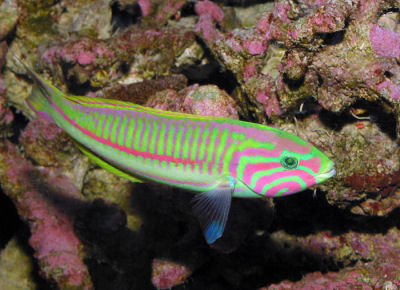
The Klunzinger’s Wrasse from the Red Sea is one of the most distinctive and beautiful of the Thalassoma wrasses… but unfortunately seldom available in the aquarium hobby!
If you chance upon a Klunzinger’s Wrasse be sure to take advantage of it, though it is a more expensive wrasse it is a rare find. They are easily identified by their color patterning and the juvenile, initial, and terminal phases are all quite similar. There is only a difference is in a secondary male where the wrasse will have dark fringes on the fins.
This is an outstanding aquarium fish. Not only for is it an attractive wrasse, but the Klunzinger’s Wrasse is hardy, easy to maintain, and long-lived. It is very active during the day and will need to have plenty of swimming room. It also will need a lot of rockwork with nooks and crannies for retreating as well as for sleeping at night. This wrasse doesn’t bother corals but it will eat crustaceans and invertebrates. Good inhabitant for the community aquarium as long as its tank mates are of a similar temperament. When frightened this fish will hide in the rock work, or may bury itself in the sand.
For more Information on keeping marine fish see:
Guide to a Happy, Healthy Marine Aquarium
The Klunzinger’s Wrasse is a very active fish which will grow to about 6-7″ in captivity. They need a 75 gallon tank or more with plenty of room to swim! They are peaceful for the most part, and can be kept in a reef as they won’t bother most fish tank mates or corals. They will eat some invertebrates like bristleworms, hermit crabs, and small snails. This fish is not found for sale as often as other Thalassoma genus wrasses, and it is a shame since it is so beautiful!
- Kingdom: Animalia
- Phylum: Chordata
- Class: Actinopterygii
- Order: Perciformes
- Family: Labridae
- Genus: Thalassoma
- Species: rueppellii
- Beginner Fish – Saltwater fish for beginners
- Community Fish – Peaceful Saltwater fish
- Hardy Fish – Hardy Saltwater fish
Habitat: Natural geographic location:
The Klunzinger’s Wrasse was described by Klunzinger in 1871. Found in the Western Indian Ocean, the Red Sea. They range at depths of just a couple inches below the surface down to 98 feet (30 meters), inhabiting reef margins and seaward slopes. They will live in small groups consisting of females with one dominant male, and sometimes the young will live is groups.
This wrasse has reportedly formed a hybrid with the Moon WrasseThalassoma lunare
Status:
These fish are not listed on the IUCN Red List.
Description:
The Klunzinger’s Wrasse has a green to bluish body with three horizontal lines, one mid-body and one on the lower body that are red, and another along the top that can be red to purplish. There are a series of vertical markings between the top two stripes that are red to purplish and the head has bold irregular stripes of red to pink. This wrasse basically retains the overall essence of its juvenile coloration throughout life, with the addition of dark fringing on the fins in secondary males. Life span is unknown, though the Thalassoma wrasses are known to be long lived in the aquarium.
Length/Diameter of fish:
Adults can reach up to about 8 inches (20 cm), though in captivity most Thalassoma wrasses only grow to about 6 or 7 inches (15 – 18 cm).
Maintenance difficulty:
This wrasse is hardy and easy to maintain. They adjust very quickly to aquarium life and prepared foods. Generally not considered totally reef safe. Though they will not bother your corals they will eat your small crustaceans and invertebrates. Good for a community aquarium, usually peaceful though secondary males can become aggressive.
Foods:
The Klunzinger’s Wrasses are carnivorous, in the wild they feed on many different invertebrates. Having very hearty appetites, they are easily trained to eat prepared foods in the aquarium. Feed a varied protein diet strong in small crustacea, formulas and frozen foods such as mysis and brineshrimp, and thawed chopped raw fish, and even flake foods. They are heavy eaters and need to be fed 2 or 3 times a day.
Maintenance:
Normal water changes at 10% biweekly or 20% monthly.
For more information see, Marine Aquarium Basics: Maintenance
Aquarium Parameters:
This fish needs to have a large aquarium with lots of space for swimming, a sandy substrate and, lots of rockwork for hiding and sleeping.
Minimum Tank Length/Size:
A minimum 75 gallon (284 liters) aquarium.
Light: Recommended light levels
No special requirements but does enjoy patches of sunlight.
Temperature:
No special requirements. Normal temperatures for marine fish is between 74° and 79° F (23 – 26° C), but can be kept up to 83° F (28°C).
Water Movement: Weak, Moderate, Strong
No special requirements.
Water Region: Top, Middle, Bottom
They will spend time in all parts of the aquarium.
Social Behaviors:
In their natural environment juveniles are sometimes seen in groups, but adults are seen alone or in small loose groups. Aggressive with fish of similar size and should be housed with fish such as tangs and triggers. Avoid slow moving or smaller fish as they will be harassed, possibly eaten.
Sex: Sexual differences:
Male and female have very similar coloring, however secondary will have dark fringes on the fins.
Breeding/Reproduction:
Availability:
The Klunzinger’s Wrasses are rarely available and command a high price, easily up to $90.00 USD.