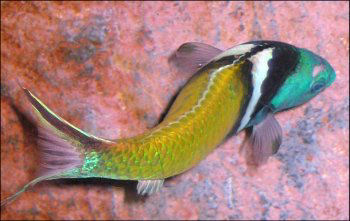
Once the male Bluehead Wrasse attains its adult coloration it is one colorful fish, and either sex does well in a marine aquarium.
Like all the Thalassoma wrasses, the Bluehead Wrasse is a high energy fish and does best with frequent daily feedings to keep up with its energy expenditure. It is very active during the day, enjoying a lot of rockwork with nooks and crannies for retreating as well as for sleeping at night. It also enjoys resting on a sandy substrate and may burrow into it when frightened.
The Bluehead Wrasse makes a wonderful addition to the right marine aquarium and can live for many years.They are easy to keep but they are sensitive to poor water conditions. Provide good water filtration and keep up on frequent water changes. This wrasse doesn’t bother corals but it will eat crustaceans and invertebrates. A good inhabitant for the community aquarium with tank mates of a similar temperament.
For more Information on keeping marine fish see:
Guide to a Happy, Healthy Marine Aquarium
- Kingdom: Animalia
- Phylum: Chordata
- Class: Actinopterygii
- Order: Perciformes
- Family: Labridae
- Genus: Thalassoma
- Species: bifasciatum
- Beginner Fish – Saltwater fish for beginners
- Community Fish – Peaceful Saltwater fish
- Hardy Fish – Hardy Saltwater fish
Habitat: Natural geographic location:
Bluehead Wrasse are found in the Caribbean Sea and the tropical Atlantic. They are found at depths of 10 to 131 feet (3 – 40 meters) and inhabit reefs, inshore non-reef areas, and are also found in beds of seagrass. Juveniles and initial phase fish are seen swimming in dense groups above reefs, while secondary males are territorial, defending an area with a small group of females from conspecifics.
Status:
These fish are not endangered.
Description:
The Bluehead Wrasse has the most notable coloration in the adult male phase. As the name suggests this mature male has a blue head followed by two black cross bands that are lighter in the center, and a blue-green body. Initial phase individuals, both male and females have a yellow coloration with a black stripe along the side of the body. This stripe usually fades to just a shadow as the fish ages.
Length/Diameter of fish:
Bluehead Wrasse adults can grow to 15 cm (6 inches).
Maintenance difficulty:
The Bluehead Wrasse is easy to keep but they are sensitive to poor water conditions. Provide good water filtration and keep up on frequent water changes. Feed young specimens several times a day, and even as adults they will need to be fed 2 to three times a day. Generally not considered totally reef safe. Though they will not bother your corals they will eat your small crustaceans and invertebrates.
Foods:
The Bluehead Wrasses are carnivorous, in the wild they eat primarily zooplankton and many small benthic organisms including various crustaceans. They have also been know to eat ectoparasites on other fish (making them a good cleaner fish in the home aquarium) and even the eggs of other small fish. Sea urchin eggs are a favorite! Feed a varied protein diet strong in small crustacea, formulas and frozen foods such as mysis and brineshrimp, and thawed chopped raw fish, and even flake foods. They are heavy eaters that will eat anything and need to be fed 2 or 3 times a day.
Maintenance:
Normal water changes at 10% biweekly or 20% monthly.They will sleep in holes in the rock or reef, so provide some cover.
For more information see, Marine Aquarium Basics: Maintenance
Aquarium Parameters:
This fish needs to have a large aquarium with lots of space for swimming, a sandy substrate and, lots of rockwork for hiding and sleeping.
Minimum Tank Length/Size:
A minimum 40 gallon aquarium is recommended, although a larger aquarium (70+ gallons) if kept with other fish.
Light: Recommended light levels
Prefers sunlight.
Temperature:
No special requirements. Normal temperatures for marine fish is between 74° and 79° F (23 – 26° C).
Water Movement: Weak, Moderate, Strong
No special requirements.
Water Region: Top, Middle, Bottom
Will spend time in all parts of the aquarium, but usually spending most of the time in the rockwork.
Social Behaviors:
These fish live singly or in groups. Juveniles and females can be housed together in a group and with other fish. Adult males, both primary and secondary, become territorial and aggressive. They should be kept with other aggressive natured fish and can be kept with a female in a very large aquarium, 125 gallons or more. Do not keep these fish with invertebrates as they will snack on them, but otherwise they are generally reef safe as they don’t eat corals or live plants.
Sex: Sexual differences:
Males, both primary and secondary will develop the notable “bluehead” coloration, while females retain the initial phase yellowish coloration, though with a more faded horizontal stripe as they age.
Breeding/Reproduction:
Has not been bred in captivity.
Availability:
This fish is available from time to time.