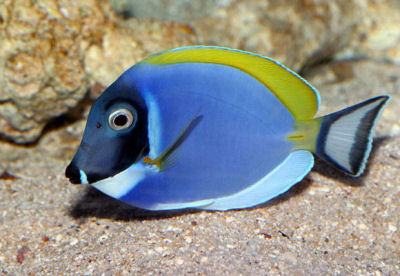
One of the most beautiful and sought after tangs, the Powder Blue Tang has strict yet doable requirements for long term success.
The Powder Blue Tang is a deep bodied, flat, oval shaped fish with the ability to swim very fast. They are a powder to medium blue on their bodies with a black face, white chest, and a yellow dorsal fin. The caudal peduncle is yellow, as well as the pectoral fins and the tail fin is white and outlined in black. They can be white to pale blue on the pelvic and anal fins, and the area behind the eye, depending on the specimen. They have a continuous dorsal fin, slightly protruding mouth and spines on their dorsal fin, anal fin an d pelvic fins besides fairly large ones on either side of their caudal peduncle (fleshy base of the tail fin). Near the tail fin is a yellow accented sharp scalpel or spine used to defend themselves. The Powder Blue Tang grows to 9.1” (23 cm), with tangs growing to 80% of their total length within the first 4 to 5 years. Tangs have a life span of 30 to 45 years (Choat and Axe 1996). This fish is best kept by intermediate aqaurists.
So what do we call them? Well, besides sea cows; since they eat constantly, have very long intestines and produce a lot of poo! Are they “tangs,” “surgeonfish” or “doctorfish?” While all 3 are correct, however, only two of those words, doctor and surgeon, are easy to connect to that very sharp “scalpel-like” spine located on either sides of their caudal peduncle. So where does the word “tang” come from? It is the most common word we use to describe this fish, yet the actual definition is not commonly used in our vernacular these days. We don’t say, “I am going to tang you!” haha! So I looked it up and Tang is defined as: “a projecting shank, prong, fang, as on a knife, file or sword, connected with a handle.” The Powder Blue Tang has a very sharp, scalpel-like, retractile spine or “tang,” located at the fleshy base of the tail fin area. This tang can be flipped out into an erect weapon when the tail fin is swiped sideways toward a threatening fish or cleaner hand. This weapon is also highlighted in yellow in the Powder Blue Tang, which serves as a warning to other fish!
The Powder Blue Tang, although not quite as delicate as the Achilles Tang, is still not the easiest of the Acanthurus genus! The Powder Blue prefers temperatures to be around 82˚F contrary to most posted temperatures for tangs. As far as stress goes, I watched a Powder Blue Tang do very well as the only fish besides a goby in a tank at a chain pet store, however due to the tank being near high foot traffic, not being fed 3 times a day and cooler water temp, it died after 3 months. The Powder Blue Tang will be very aggressive to others from it’s genus and it one of the more aggressive of the surgeonfish family, however not the MOST aggressive. The tank should be located in a calm part of the home and the Powder Blue Tang should be the only tang in the tank, unless the tank is huge, to help keep stress levels low. They need to be well fed, at least 3 times a day, with a variety of veggie foods and some meaty foods. A piece of Nori or other seaweed sheets affixed to a rock with a rubber band during the day is helpful. Also, quarantine them along to help them settle in with no stress.
Unless your tank is hundreds of gallons, do not attempt to house tangs together, especially the same genus. Some have had limited success by adding tangs from different genus, that are different in shape and color. They are fine when young but full grown adults become quite difficult to control. Tangs should all be added as juveniles, at the same time, at roughly the same size into the main display. Do not house with Sohal Tangs or other similarly angry tangs, nor any aggressive triggerfish. The first step is acquiring a healthy, fat, eating specimen with no injuries and is eating. A quarantine tanks is almost a must (and as the only fish in the QT tank) for all surgeonfish, due to their propensity for various illnesses. The Powder Blue Tang will not bother any peaceful fish or small semi-aggressive fish, which are the best tank mates. They MUST be the dominant fish to reduce stress, and we all know stress leads to illnesses. There is the odd man out, or “odd fish out” that is just a beast and attacks everything, however this is usually due to being in a small tank. Even as little juveniles, they should be kept in larger tanks so they do not get a chance to develop a bad attitude! Add them as one of the last fish in a community tank, which commonly fits into the 6 month stocking period.
House your Powder Blue Tang in a minimum sized 125 gallon tank that is at least 6 feet long. There are various tank configurations, however longer is better than taller with all surgeonfish. Provide places for them to hide within the rock work when frightened and swift water movement in at least one area of the tank. For example, point a linear pump (not the pumps that diffuse water) across the back of the tank with an open area that is accessible to the tang, so he has his personal “water treadmill!” Good oxygenation with good water quality, a good skimmer and a sandy substate to allow them to “blow” the sand with their mouth, searching for foods. Feed them several times a day with foods that have marine algae and Spirulina, and blanched broccoli, zucchini, leaf lettuce as treats. Sushi Nori is a favorite made from seaweed. The more varied the diet the better, although marine sourced foods like macro algae, Ogo, Nori, etc, are best! Also feed pellets with high protein and garlic to supplement their veggie diet. Live mysis gut loaded with spirulina flake can encourage them to start feeding, however this is a poor nutritionally based food for them. They do best in a reef that has ocean salinity of 1.023, pH minimum of 8.2, temperatures in the low 80’s, and naturally growing algae.
For more Information on keeping this fish see:
Guide to a Happy, Healthy Marine Aquarium
- Kingdom: Animalia
- Phylum: Chordata
- Class:Actinopterygii
- Order:Perciformes
- Family: Acanthuridae
- Genus: Acanthurus
- Species: leucosternon
- Aquarist Experience Level: Intermediate
- Aquarium Hardiness: Moderately Difficult
- Minimum Tank Size: 125 gal (473 L)
- Size of fish – inches: 9.1 inches (23.11 cm)
- Temperament: Semi-aggressive
- Temperature: 74.0 to 83.0° F (23.3 to 28.3° C)
- Range ph: 8.2-8.4
- Diet Type: Herbivore
- My Aquarium – Enter your aquarium to see if this fish is compatible!
- Beginner Fish – Saltwater fish for beginners
- Community Fish – Peaceful Saltwater fish
- Hardy Fish – Hardy Saltwater fish
- Similar size fish – Fish that are 1 inch bigger or smaller
- Coldwater Fish – Looking for cold water fish? (65 °)
Habitat: Distribution / Background
The Powder Blue Tang, Acanthurus Powder Blue, was first described by Bennett in 1833. The name Acanthurus is greek for “thorn tail.” The only 2 common names also have a variation in the spelling and they are Powder Blue Tang, Powder-Blue Surgeonfish and Powderblue Surgeonfish, which basically describes their coloring.
The Powder Blue Tang is found in the Indian Ocean from eastern Africa to the Andaman Sea; then it is found in southwest Indonesia and Christmas Islands to Bali in the Western Pacific. They are found in singly or sometimes join into large feeding groups. Powder Blue Tangs are commonly found in shallow, clear island coral reefs and coastal reefs on reef flats and along upper seaward slopes at depths up to 82 feet (0 to 25 m). They feed on brown filamentous algae, green macro algae, benthic weeds and small growths of algae within the crevices of reef rock. Their protruding snout allows them to get to the algae found in those crevices.
The Powder Blue Tang is on the IUCN Red List of Threatened Species under “least concern.”
- Scientific Name: Acanthurus leucosternon
- Social Grouping: Varies – Usually found along, however they will occasionally join large feeding groups during certain times of the day.
- IUCN Red List: LC – Least Concern – The Powder Blue Tang is on the IUCN Red List of Threatened Species under “least concern.”
Description
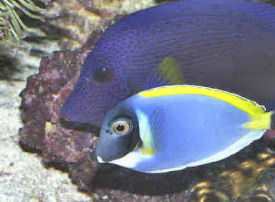
The Powder Blue Tang is a deep bodied, laterally compressed, oval shaped fish. Their bodies are blue with a white chest or chin area below the gill plates, a black head, and a vertical white to pale blue band that runs from behind the eyes to the pectoral fins and joins the white chest and chin area. They have a continuous yellow dorsal fin with the outer edge sometimes appearing to be an electric blue in some lighting. The anal fin and the pelvic fins are white, however they can appear pale blue in some lighting. Their mouth protrudes slightly, used for grazing on algae in hard to reach areas. The caudal peduncle is also blue, however there is a yellow horizontal dash which outlines the scalpel or tang, and the yellow is also found at the base of the actual tail fin. The tail fin is white in the middle and outlined in black. The dorsal fins have 9 spines, anal has 3 and the pelvic fins have 1, besides the two on the caudal peduncle area mentioned above. The Powder Blue Tang grows to 9.1” (23 cm), and lives 30 to 45 years in the wild (Choat & Axe, 1996); however, in captivity their lifespan can be drastically reduced.
|
- Size of fish – inches: 9.1 inches (23.11 cm)
- Lifespan: 30 years – 30 to 45 years (Choat and Axe 1996), possibly less in captivity.
Fish Keeping Difficulty
The Powder Blue Tang is a difficult tang to keep in captivity. First and foremost, do not use activated carbon, since it has been scientifically linked to Hole-In-The-Head and Lateral Line Disease. This fish is similar to the Achilles Tang, being a very active swimmer and needs to be in a tank that is at least 6 feet long long. For any measure of success, your new Powder Blue Tang should be fat and eating when purchased with no physical flaws, and there shouldn’t be labored breathing or excessive flashing (scratching against objects). The best approach is making your Powder Blue Tang the only tang in the tank, which should be mature, with lots of naturally growing algae. Being HUGE eaters due to their high energy output, provide a Nori or other preferred algae sheets and rubber band it to a rock during the day. Feed them 3 times a day with combination of high quality Spirulina flake or pellet, macro algae and other marine greens, which will help them get the calories they need. Human veggies are fine, however they may not have the caloric content that they need. Keep the oxygen levels up with a good skimmer, good water quality, and stress free tank mates. Again, provide a linear blowing pump to satisfy their need to “exercise” in this sort of “underwater treadmill.” Having a 6 foot tank that is at least 18 to 24” from the front to the back wall provides this little exercise area which I personally feel all tangs appreciate!
- Aquarium Hardiness: Moderately Difficult
- Aquarist Experience Level: Intermediate – Possibly closer to advanced.
Foods and Feeding
The Powder Blue Tang is an herbivore. Out of all the genus of tangs, the Acanthurus are the largest algae/veggie eaters in the family. Although they will benefit from some meaty foods like mysis shrimp that may be given to initiate a feeding response, the bulk of their foods come from veggie sources. Feed them a good spirulina based flake or pellet, marine macro algae, nori and other veggie based marine prepared foods. You can also give them blanched broccoli, leaf lettuce, zucchini and other veggies as treats. Each tang will have their own favorites and they do enjoy certain fruits, so experiment but make sure the fruits are also a treat and not a main staple. Feed them 3 times a day and keep a Nori or other algae sheet rubber banded to a rock in-between feeding. It is helpful to add Selcon or vitamins specifically for marine fish to some of the food (follow directions on the product)
- Diet Type: Herbivore
- Flake Food: Yes – The food should have Spirulina in it.
- Tablet / Pellet: Yes – The pellets should have Spirulina in it. Also feed them pellet that has protein and garlic infused.
- Live foods (fishes, shrimps, worms): Some of Diet – If fish is not eating, gut filling live mysis or brine shrimp with spirulina flake may initiate a feeding response.
- Vegetable Food: Most of Diet – Probably about 90% of the diet.
- Meaty Food: Some of Diet – Probably about 10% of the diet.
- Feeding Frequency: Daily – 3 times per day
Aquarium Care
Reef tanks:
-Medium sized up to 90 gallons, perform 15% bi-weekly.
-Large Tanks 100 gallons and over, once water is aged and stable can be changed 10% bi-weekly to 20% monthly, depending on bioload.
Fish only tanks:*
-Medium sized up to 90 gallons, perform 20% to 30% monthly depending on bioload.
-Large Tanks 100 gallons and over, once water is aged and stable can be changed 20% to 30% every 6 weeks depending on bioload.
For more information on maintaining a saltwater aquarium see: Saltwater Aquarium Basics: Maintenance. A reef tank will require specialized filtration and lighting equipment. Regular water changes done bi-weekly will help replace the trace elements that the fish and corals use up. Learn more about reef keeping see: Mini Reef Aquarium Basics.
*Note: If this is the ONLY fish in the tank, with no corals or other fish you can get away 20% monthly.
- Water Changes: Bi-weekly – Do not allow nitrates to climb over 10 ppm.
Aquarium Setup
When capturing your tang, use a container, not a net, due to the various spines they have on their tail, anal and pelvic fins. Do not house in a nano tank, as they will outgrow it too fast and it will cause aggression. Provide live rock with plenty of places for them to feed from, hide in and sleep between. Any substrate is acceptable; however, they do enjoy blowing sand around as they look for food. Light should be high enough to provide algae growth for your massive veggie eater and the tank should be mature enough, at least 6 months old. This aging of the tank is necessary to provide your tang with stable water parameters and plenty of natural algae growth before adding your Powder Blue Tang. They seem to be healthier and happier in water that is in the low 80’s, such as 81˚F to 83˚F, as noted by Bob Fenner. The higher temperature helps increase their appetite. Personally, I think 82˚F to 83˚F also helps to interrupt the crypt cycle, which they seem to be plagued with. In the wild, they are regularly found in waters from 74 to 83˚F (23 to 28˚C). Temperature would be the first water parameter to address if your Powder Blue Tang is not eating well. They do well at the normal ocean salinity of 1.023 and pH between 8.2 and 8.4, however both of these qualities, especially the pH should be stable. They swim at all levels of the tank and should be the only Acanthurus in the tank unless it is 400 to 500 gallons and 10 feet long to establish territory. Do not let nitrates rise above 10 ppm.
- Minimum Tank Size: 125 gal (473 L) – Tank should be at least 6 feet long.
- Suitable for Nano Tank: No
- Live Rock Requirement: Typical Plus Hiding Places – Rock should have algae growing on it before adding your tang.
- Substrate Type: Sand – Any substrate is okay, however sand is appreciated by the tangs.
- Lighting Needs: Moderate – normal lighting – Should be strong enough to grow algae.
- Temperature: 74.0 to 83.0° F (23.3 to 28.3° C) – Powder Blue Tangs prefer temperatures in the low 80’s, and seem to be healthier and eat better.
- Specific gravity: 1.023-1.025 SG
- Range ph: 8.2-8.4
- Brackish: No
- Water Movement: Strong – Provide strong linear water movement across the back of the tank for them to “treadmill swim” against.
- Water Region: All
Social Behaviors
The Powder Blue Tang are one of the more aggressive Acanthurus, however they are not at the top of the list, and individuals have different personalities so results may vary! Some have had no aggression at all, other aquarists have somehow received the most evil Powder Blue Tang from the ocean! It may be that males are more aggressive, as is found with the Hippo Tang. Males are smaller than females, so it may be possible to pick a female out of a group. There should also only be one Powder Blue Tang in the tank. They do not do well in groups, even if the tank is hundreds of gallons. In the wild, they defend large areas for themselves. The only exception to adding another Acanthurus, but a different species, if the tank is 10 feet long (one aquarist had success with this method) and both Acanthurus are added as juveniles at the same time and are a different color. They should be quarantined separately. This aquarist’s success may be the exception to the rule, since there is no way of knowing gender, and in that case of the 10 foot tank, both may have been females or even a male and female that “hit it off.”
The Powder Blue Tang will get along with tangs from other genus that are a different color, shape and only if the tank is hundreds of gallons. Typically, Powder Blue Tangs will stress out in the presence of other tangs and Powder Blues can be quite aggressive toward other tangs, which in turn can make them sick. The great thing about Powder Blue Tangs is that 99% of them will not bother even the smallest, most peaceful goby, blenny or other peaceful fish. They ignore anthias, fairy and flasher wrasses and even large peaceful fish. Aggressive tangs like the Sohal Tang, Triggers, Puffers and other larger and more aggressive fish should be left out of the equation when putting tank mates together. Avoid other aggressive fish including dottybacks and aggressive clowns like Maroon Clownfish, unless the tank is hundreds of gallons, especially if your tang is a baby. The key is a stress free, reef environment (or fish only with good lighting to provide algae growth) with no competition for foods from other herbivores. Small dwarf angelfish that are more chill, like the Coral Beauty should be fine. Large angelfish should not be housed with your Powder Blue Tang unless they are planktivores, who will not complete for veggie foods.
Although literature states that the Powder Blue Tang will nip at large-polyp stony corals, most aquarists who feed their tangs properly will not run into this problem. They may pick at any algae at the base of corals, which was a great service to the coral! Glue corals down so your tang’s “burst of energy” does not dislodge them.
Inverts are not at risk, however a copepod or amphipod may be eaten here or there while the tang grazes on the algae in which they live. On a rare occasion, an occasional tang will find the slime that clams produce quite tasty. While the tang is not biting the clam flesh, the action causes the clam to close often, stressing the clam and eventually killing it. This shouldn’t be a problem with a well fed tang.
- Venomous: No
- Temperament: Semi-aggressive – Peaceful toward other fish except other tangs.
- Compatible with:
- Same species – conspecifics: No – They are territorial and usually found alone in the wild, only coming together to feed for a short time.
- Peaceful fish (gobies, dartfish, assessors, fairy wrasses): Safe
- Semi-Aggressive (anthias, clownfish, dwarf angels): Safe
- Monitor – Large dottybacks and large aggressive algae eating damsels may harass your tang.
- Large Semi-Aggressive (tangs, large angels, large wrasses): Monitor – Only tangs from other genus in hundreds of gallons. Only large angelfish that are planktivores. Large wrasses will not bother your Powder Blue Tang, however the constant swimming may stress your tang out.
- Large Aggressive, Predatory (lionfish, groupers, soapfish): Threat
- Monitor – Seahorses and most pipefish need their own tank. Mandarins will not be bothered.
- Anemones: Safe
- Mushroom Anemones – Corallimorphs: Safe
- LPS corals: Safe
- SPS corals: Monitor – Should not bother LPS if well fed.
- Gorgonians, Sea Fans: Safe
- Leather Corals: Safe
- Soft Corals (xenias, tree corals): Safe
- Star Polyps, Organ Pipe Coral: Safe
- Zoanthids – Button Polyps, Sea Mats: Safe
- Sponges, Tunicates: Safe
- Shrimps, Crabs, Snails: Safe
- Starfish: Safe
- Feather Dusters, Bristle Worms, Flatworms: Safe
- Clams, Scallops, Oysters: Monitor – A very RARE tang will find the slime clams produce yummy, causing the clam to close and stress.
- Copepods, Amphipods, Mini Brittle Stars: Safe
Sex: Sexual differences
In this genus, males are much smaller than females.
Breeding / Reproduction
Unlike other genus of the tang/surgeon family, the females of the genus Acanthurus are larger than males. They are open water spawners and form pairs. These pairs seem to stay together even within groups. The male may exhibit color changes during spawning to attract female and to warn rival males. If they are in a large school, a pair will break away and rise upward toward the surface and release their gametes. These little floating fertilized eggs are spherical and have a single oil globule to aid in their buoyancy and dispersal. Each egg measures around 0.17 mm in diameter. Once they hatch, the larvae look like little kites with a long snout with a small mouth, and they stay in this state for 42 to 68 days. During this time, they fall prey to fish and other marine animals. Once they reach around 1 inch, give or take (23 to 33 mm), the larvae are then changed into the juvenile stage. Once they are ready to join the reef, the larvae settle out of the water column and develop into these 1” juveniles, seeking the protection and food sources of the reef and seagrass habitats.
These fish have spawned in captivity in public aquariums (or very very large tanks), however, there hasn’t been success raising the larvae into viable fish.
See the description in the Breeding Marine Fish page.
- Ease of Breeding: Difficult – They have spawned in captivity, however, the larvae have not been successfully reared.
Fish Diseases
Tangs produce less body slime than other saltwater fish and have been termed “dry skinned” fish by some. This makes them very susceptible to Cryptocaryon (saltwater ich) and other diseases. The most common ailments are bacterial diseases, Hole-in-the-Head Disease or Lateral Line Disease, and parasitic infections such as protozoas (including Cryptocaryon), worms, etc.
As for treatment, some tangs are sensitive to copper. To avoid Lateral Line Diseae or Hole in The Head disease, avoid using activated carbon, as it has been scientifically linked to those diseases. The best routine is a quarantine tank and a stress free environment with good quality veggie foods, places to hide and a quiet area for the aquarium.
For more information see Fish diseases.
Availability
These fish are usually available and are moderately priced for saltwater fish, running around $70.00 for a medium sized fish. (2014)
References
Animal-World References – Marine and Reef
ICHTHYOLOGY at the Florida Museum of Natural History
Education Biological Profiles: Reproduction
By Cathleen Bester