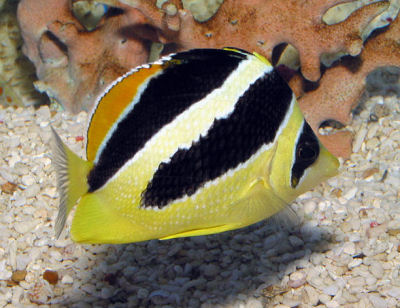
The Indian Butterflyfish has a striking color pattern resembling a fanciful headdress!
The Indian Butterflyfish Chaetodon mitratus is a very handsome and attractive marine fish. Aquarists and deep water divers alike are attracted by the vivid colors and graceful shape of this species. This is one of only a few butterflyfish species that can inhabit very great depths in the ocean. They usually range between 98 – 230 feet (30 – 70 m) below the surface, but have been found down as deep as 590 feet (180 m). Although it is a very popular butterflyfish among aquarists, this deep dweller is quite rare and commands a high price.
This is a rather small butterflyfish species, reaching only about 5 1/2 inches (14 cm) in length. It has a rather triangular shape with strong yellow, black and orange markings. The arrangement of its distinctive markings create a vivid color pattern that bears comparison to a decorative headdress or headband. Thus it is known by several other descriptive common names including Headband Butterflyfish and Oblique-banded Butterflyfish along with Mitratus Butterflyfish and Mitra Butterflyfish derived from its scientific name.
This is a durable butterflyfish and will work well with a variety of tank mates. It does need a good sized aquarium that is well established. A 55 gallon tank is the minimum size for a single fish, and a bigger tank will be needed if you want to keep more than one. Decorate the tank with rocks and/or corals with many hiding places, even for adults, along with plenty of swimming space. It swims freely and usually spends a good deal of its time in the open water, moving in and out of crevices.
No special care is needed to maintain the Indian Butterflyfish. It will immediately accept foods even when first introduced to the aquarium, and It will take a variety of foods. When it is well acclimated it will go up to the surface to take foods from its keepers. Many reef-keepers hope to keep it in a mini reef, but like many butterflyfish it can be a coral eater if living corals are maintained. It can be kept for several years with twelve years being the record.
For more Information on keeping saltwater fish see:
Marine Aquarium Basics: Guide to a Healthy Saltwater Aquarium
Two full grown and healthy Indian Butterflyfish (also commonly known as “Mitratus Butterflyfish”) swimming in a closed aquarium. Quite a few nice closeups of both fish as they lazily search for food.
- Kingdom: Animalia
- Phylum: Chordata
- Class: Actinopterygii
- Order: Perciformes
- Family: Chaetodontidae
- Genus: Chaetodon
- Species: mitratus
- Aquarist Experience Level: Intermediate
- Aquarium Hardiness: Moderately hardy
- Minimum Tank Size: 55 gal (208 L)
- Size of fish – inches: 5.5 inches (14.00 cm)
- Temperament: Peaceful
- Temperature: 75.0 to 79.0° F (23.9 to 26.1° C)
- Range ph: 8.1-8.4
- Diet Type: Omnivore
- My Aquarium – Enter your aquarium to see if this fish is compatible!
- Beginner Fish – Saltwater fish for beginners
- Community Fish – Peaceful Saltwater fish
- Hardy Fish – Hardy Saltwater fish
- Similar size fish – Fish that are 1 inch bigger or smaller
- Coldwater Fish – Looking for cold water fish? (65 °)
Habitat: Distribution / Background
The Indian Butterflyfish Chaetodon mitratus was described by Gunther in 1860, and was first collected in Mauritius Island. They are found in Indian Ocean; East Africa, South Africa, throughout oceanic islands of Madagascar, Maldive, Chagos, Mauritius, Sri Lanka, to Andaman Sea and India, Christmas & Cocos-Keeling Islands at steep reef walls. They usually range between 98 – 230 feet (30 – 70 m) below the surface, but have also been found at depths of 590 feet (180 m).
Due to its deep dwelling habitat, this fish was so rare that it was only known by Gunther’s description for the next 113 years after he described it. That was until 1973 when additional specimens were reported by P. Gueze and L. A. Mauge on the island of Reunion. It is a member of the “Chaetodon tinkeri – complex”.
This species is on the IUCN Red List as Least Concern (LC). They have a relatively wide distribution. Currently there are no major threats identified and they are not thought to be declining in population. Other common names they are known by include Mitratus Butterflyfish, Black and Yellow Butterflyfish, Headband Butterflyfish, Oblique-banded Butterflyfish, Mitra Butterflyfish, and Mitratus Butterfly.
“Chaetodon tinkeri – Complex”
Many butterflyfish species are known to science and most of them are available to aquarists at present, but there are several species that are extreme rare, and not readily found even in nature. One such group is the butterflyfish called the “Chaetodon tinkeri – complex”. It consists of the popular Tinker’s Butterflyfish and its relatives. This group iscomprised of the following five valid species:
- Tinker’s Butterflyfish Chaetodon tinkeri
- Indian Butterflyfish Chaetodon mitratus
- Burgess’ Butterflyfish Chaetodon burgessi
- Marquesas Butterflyfish Chaetodon declivis
- Yellow-crowned Butterflyfish Chaetodon flavocoronatus
They all have a distinct (but almost the same) shape, and wear a variety of color markings on their sides depending upon the species. Some members of the complex are reported and believed to hybridize in their scattered Pacific localities. The Indian Butterflyfish was “discovered” at a southern part of the South African coast, though very rare there. Prior to this it was believed to be restricted to the Indian Ocean where no other species co-occurs. Consequently this species was not known, or thought of, as a possible parent for a hybrid cross until recently.
“The Chaetodon tinkeri – complex (C. tinkeri and allies) were described relatively recently by various authors. C. tinkeri was named in 1951 with others being even more recent, but C. mitratus was named in 1860 and is the oldest member. I asked Richard Pyle several years ago “Why are they called the tinkeri – complex?”, and he replied; “C. tinkeri is the best-known species among the complex so we habitually call it so, but if you hope to call them the C. mitratus – complex, it doesn’t matter. ” I was a bit astonished but realized that no special reason exists for naming for the complex.” …Hiroyuki Tanaka
The Indian Butterflyfish is seen usually seen in pairs, though sometimes singly and occasionally forming small aggregations in its natural habitat. It can be observed upside-down in dark areas such as under rocks or in caves, and among black corals and gorgonians as well. It is rarely encountered by the average diver because of its deep habitat. They feed on benthic invertebrates and planktonic items.
- Scientific Name: Chaetodon mitratus
- Social Grouping: Pairs – Adults are usually seen in pairs, though sometimes seen singly or in small groups.
- IUCN Red List: LC – Least Concern
Description
The Indian Butterflyfish has a distinctive body shape and coloration. Its body is triangle-like and laterally compressed and it has a protruding snout tipped with a small mouth. The dorsal fin is continuous and it has a rounded tail fin. This species can reach a length of about 5.51 inches (14 cm) in the wild, but most available specimens are around 2 3.4 to 3 inches (7 – 8 cm).The lifespan for most of the Chaetodon species is between 5 – 7 years, but these fish have been recorded to live up to 12 years with proper care.
WMBu_AP15UB_med.jpg)
Indian Butterflyfish, 3 cm Juvenile
Photo courtesy: Hiroyuki Tanaka
The adult C. mitratus has yellow in the background with the center of the body being a whitish yellow and with two diagonal broader black bands on the side. One band is on the middle of the body beginning at the head and ending near the anus and another runs from the top of dorsal fin to the caudal peduncle, the latter tapers toward caudal fin. There is an additional black band through the eye, not reaching chest. The fins are yellowish to deep yellow except the pectoral ones which are translucent. The dorsal fin has a narrow blue marginal line posteriorly and the caudal fin is translucent posteriorly.
Juveniles are very similar but with an outstanding black spot on the soft dorsal fin. The spot sometimes remains in some adult specimens. The eye band is orangish below the eye in some specimens. This species is most closely related to the Burgess’ Butterflyfish Chaetodon burgessi from the West Pacific. However the Burgess’ Butterflyfish is white overall instead of yellow, but with similar bands on the side.
- Size of fish – inches: 5.5 inches (14.00 cm) – Most specimens available are around 2.8 – 3.1 inches (7 – 8 cm).
- Lifespan: 5 years – Average lifespan is between 5 – 7 years, but they have been recorded to live up to 12 years with proper care.
Fish Keeping Difficulty
This is a durable Butterflyfish that is generally suggested for an intermediate aquarist. No special care is needed to maintain it and it will become a fairly hardy pet. It will immediately accepts foods even when first introduced to the aquarium and it will take a variety of foods. It will even go up to the surface to take foods from its keepers when it is well acclimated. This fish does not have a reputation as a coral eater but it may take polyps of some stony coral species, so it is not strongly recommended for coral-rich reefs.
- Aquarium Hardiness: Moderately hardy
- Aquarist Experience Level: Intermediate
Foods and Feeding
The Indian Butterflyfish are omnivores, in the wild they feed on benthic invertebrates and planktonic items. No special food is needed in the aquarium, they will readily accept a wide variety of foods. Offer Meaty foods, dried flakes, shrimps, and tablets. Japanese Nori will also be favored. Feed it at least twice a day, and if it is a tiny juvenile feed it three to four times everyday.
- Diet Type: Omnivore
- Flake Food: Yes
- Tablet / Pellet: Yes
- Live foods (fishes, shrimps, worms): Some of Diet
- Vegetable Food: Some of Diet
- Meaty Food: Some of Diet
- Feeding Frequency: Several feedings per day – Offer various foods quite frequently at first. Once acclimated adults need at least 2 feedings a day and juveniles need 3 to 4.
Aquarium Care
No special care or technique is needed to maintain this fish in the aquarium. Though not a very quick swimmer it swims freely, usually spending a good deal of its time in the open water and moving in and out of crevices. Frequent water changes are not necessary, rather normal water changes at 10% biweekly or 20% monthly are fine. Sudden massive water changes can cause trouble.
- Water Changes: Bi-weekly – Change 10% biweekly or 20% monthly and avoid sudden massive water changes.
Aquarium Setup
These fish need a lot of space to accommodate their size and to swim, they can reach about 5 1/2 inches in length. A 55 gallon tank is the minimum size for a single fish, and a bigger tank will be needed if you want to keep more than one. The tank should be well decorated with rocks and/or corals with many hiding places, even for adults. This fish does not have a reputation as a coral eater but it may take polyps of some stony coral species, so it is not strongly recommended for coral-rich reefs.
- Minimum Tank Size: 55 gal (208 L)
- Suitable for Nano Tank: No
- Live Rock Requirement: Typical Plus Hiding Places
- Substrate Type: Mix – Sand + Coral
- Lighting Needs: Low – subdued lighting – It is best kept in a dimly lit tank, but can also be kept under the normal lighting conditions as long as some dark areas are provided.
- Temperature: 75.0 to 79.0° F (23.9 to 26.1° C) – Avoid temperatures higher than 86° F (30° C) or below 72 ° F (22° C).
- Specific gravity: 1.020-1.025 SG
- Range ph: 8.1-8.4
- Brackish: No
- Water Movement: Weak – Water movement is not a significant factor. It can tolerate a rather strong flow but slow-moving water is recommended.
- Water Region: All – It swims freely and usually spends time in the open water.
Social Behaviors
The Indian Butterflyfish is said to be one of the reef safe fish as it does well in a coral-rich tank, but it may harm some species of hard corals and also will attack some shrimps and other moving invertebrates. It will do well in a fish only community tank that is well decorated with rocks/ corals and many hiding places.
This species is not an aggressive fish, so select tank mates that are not overly territorial or aggressive. Almost any other butterflyfish can be kept safely with it, as well as smaller non-aggressive fishes like cardinalfish, gobies, tilefish, sometimes other species butterflyfish, fairy basslets, fairy and flasher wrasses, etc. also are good candidates as tank mates.
It can also be kept with the larger and rather territorial angelfish like Pomacanthus and Holacanthus.Centropyge along with other angelfish members of Apolemichthys, Genicanthus, Chaetodontoplus and Pygoplites could also be good tank mates. Small but very territorial fishes like dottybacks should be avoided. Such fish as basses or scorpionfish, even if they are small enough, should also be avoided.
- Venomous: No
- Temperament: Peaceful
- Compatible with:
- Same species – conspecifics: Yes
- Peaceful fish (gobies, dartfish, assessors, fairy wrasses): Safe
- Semi-Aggressive (anthias, clownfish, dwarf angels): Monitor
- Threat
- Large Semi-Aggressive (tangs, large angels, large wrasses): Monitor
- Large Aggressive, Predatory (lionfish, groupers, soapfish): Threat
- Monitor
- Anemones: Safe
- Mushroom Anemones – Corallimorphs: Safe
- LPS corals: Monitor
- SPS corals: Safe
- Gorgonians, Sea Fans: Safe
- Leather Corals: Safe
- Soft Corals (xenias, tree corals): Safe
- Star Polyps, Organ Pipe Coral: Safe
- Zoanthids – Button Polyps, Sea Mats: Safe
- Sponges, Tunicates: Safe
- Shrimps, Crabs, Snails: Monitor
- Starfish: Safe
- Feather Dusters, Bristle Worms, Flatworms: Monitor
- Clams, Scallops, Oysters: Safe
- Copepods, Amphipods, Mini Brittle Stars: Threat
Sex: Sexual differences
No sexual difference is noted for this species. Butterflyfish species studied up to this time indicate that these fish are gonochoristic, meaning that each fish is either a male or a female and they do not change sex.
Breeding / Reproduction
This species has not been cultivated in captivity. In the wild butterflyfish are pelagic spawners that release many tiny eggs into the planktonic water column where they float with the currents until they hatch. Once hatched the fry are in a post-larval where their body, extending from the head, is covered with large bony plates.
Marine butterflyfish have not reportedly been spawned successfully in captivity. There are however, reports of some success in rearing wild collected larvae of some of the corallivorous butterflyfish. It is hoped these captive reared fish will be adapted to accept aquarium foods, and thus broaden the species selections that can be sustained in captivity. For more information see, Marine Fish Breeding: Butterflyfish.
- Ease of Breeding: Unknown
Fish Diseases
Many of the Chaetodon members are often very colorful and attractive to aquarists. Unfortunately some of them are rather difficult to keep for a long period. Some are exclusively coral eaters, and sometimes they suffer from “ich” (white spot disease) and other infectious diseases. Problems with disease are reduced in a well maintained aquarium. Any additions to a tank can introduce disease, so it’s advisable to properly clean or quarantine anything that you want add to an established tank prior to introduction.
Diseases that marine Butterflyfish are susceptible to include Marine Ich(white spot disease), Marine Velvet, Uronema marinum, and Lymphocystis. Some can be treated successfully with medical care or copper drugs, but some species hate sudden changes of water including pH, temperature, or any drug treatment. In the wild a cleaner wrasse (Labroides sp.) will help them by taking parasites from their bodies, however these wrasses are extremely difficult to sustain in captivity. Alternative fish such as Neon Gobies (Gobiosoma spp.) can help them by providing this cleaning service in the home aquarium.
Fortunately the Indian Butterflyfish seems to be relatively infection-free but could be sensitive to some drugs. Be sure to observe this fish closely when medicating it, so you can remove it if it shows signs of stress. For information about saltwater fish diseases and illnesses, see Aquarium Fish Diseases and Treatments.
Availability
The Indian Butterflyfish or Headband Butterflyfish is not a very common fish at retailers and commands a high price. Most available specimens are around 2 3/4 inches (7 cm) long, Though they may be obtainable, juveniles less than 1 1/2 inches (4 cm) are quite rare.
References
- Animal-World References: Marine and Reef
- Chaetodon mitratus (G{uuml}nther, 1860) Indian butterflyfish, Fishbase.org
- Chaetodon mitratus, The IUCN Red List of Threatened Species
- Helmut Debelius, Rudie H. Kuiter, World Atlas of Marine Fishes, Hollywood Import & Export. Inc., 2006
- Scott W. Michael, Angelfishes & Butterflyfishes: Reef Fishes Series , Microcosm Ltd, 2004
- Kuiter, R., , TMC-Publishing, UK, 2002
- Mark Allen, Roger Steene and Gerald R. Allen, A Guide to Angelfishes and Butterflyfishes , Odyssey Publishing, 1998
- Dr. Warren E. Burgess, Dr. Herbert R. Axelrod, Raymond E. Hunziker III, Dr. Burgess’s Atlas of Marine Aquarium Fishes, T.F.H Publications inc., 1990
- Dr. Gerald R. Allen, Butterfly and Angelfishes of the World Volume 2, Aquarium Systems; 3rd edition,1985
- Gunther, A., Catalogue of Fishes in the British Museum, Vol 2 , Wheldon & Wesley and Verlag Cramer (1860), 1964 edition.