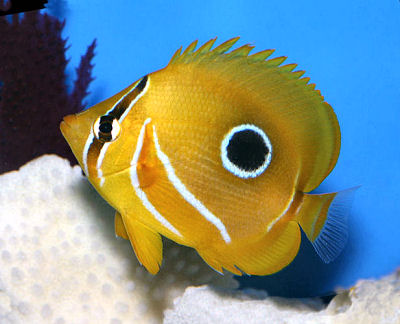
The pretty and colorful Bennett’s Butterflyfish is a very popular fish, especially among divers!
The Bennett’s Butterflyfish Chaetodon bennetti is an exotic beauty, a visual treat for the scuba diver and aquarist alike.It ismoderately sized reaching at most 7 inches (18 cm) in length, andit has a dramatic color patterning. It has agold background contrasted with strong decorative accents. The eyespot on the flank and the stripe running through the eye are dark brown outlined in white, and there are white angular stripes forming an arrow-like design. These decorative markings have led to several other common names including Bluelashed Butterflyfish, Archer Butterflyfish, and Eclipse Butterflyfish.
This fish is popular and is reasonably priced but unfortunately it is one of the difficult butterflyfish to keep in a captive environment. Like all Butterflyfish they are corallivorous, but they take it a step further. They are obligatory coralfeeders that must have corals as a primary part of their diet. These types of fish have a specialized diet that poses a difficult problem for the aquarist. Providing a coral diet is expensive and challenging.
Many of these butterflyfish are poor eaters. In their natural environment they primarily eat coral polyps and some algae. This diet is difficult to reproduce in the aquarium and though some will take substitute foods, many have difficulty adjusting and refuse the foods offered.
Their specialized diet and poor adaptability makes them very difficult to keep. They are only suitable for an expert keeper. A specimen that does start browsing in the tank, feeding on live clams or mussels, filamentous algae and encrusting invertebrates, may then take other substitute foods. Once a Bennett’s Butterflyfish is successfully acclimated it can become a hardy pet.
This fish does need a spacious aquarium with plenty of rocky hiding places as well as open areas to swim. Though not a very quick swimmer, it swims freely and usually spends a good deal of its time in the open water. As it is fond of the live polyps of stony and soft corals it can not be recommended for a reef-type setting. It can do well in a fish only community tank kept with a variety of other species with a similar temperament, as well as the larger and rather territorial angelfish like Pomacanthus and Holacanthus.
For more Information on keeping saltwater fish see:
Marine Aquarium Basics: Guide to a Healthy Saltwater Aquarium
See the Bennett’s Butterflyfish in the wild “fluttering” among the rocks, followed with a Tomato Clownfish in his anemone. Oddly they are not reef safe, but need a reef to survive! They grow up to 7″ and need a 75 gallon tank minimum, filled with yummy corals. These butterflyfish eat almost exclusively on hard polyped corals. They will also eat some algae, but will rarely adjust to other foods in captivity.
- Kingdom: Animalia
- Phylum: Chordata
- Class: Actinopterygii
- Order: Perciformes
- Family: Chaetodontidae
- Genus: Chaetodon
- Species: bennetti
- Aquarist Experience Level: Expert
- Aquarium Hardiness: Difficult to Impossible
- Minimum Tank Size: 50 gal (189 L)
- Size of fish – inches: 7.1 inches (18.01 cm)
- Temperament: Peaceful
- Temperature: 72.0 to 79.0° F (22.2 to 26.1° C)
- Range ph: 8.1-8.4
- Diet Type: Omnivore
- My Aquarium – Enter your aquarium to see if this fish is compatible!
- Beginner Fish – Saltwater fish for beginners
- Community Fish – Peaceful Saltwater fish
- Hardy Fish – Hardy Saltwater fish
- Similar size fish – Fish that are 1 inch bigger or smaller
- Coldwater Fish – Looking for cold water fish? (65 °)
Habitat: Distribution / Background
The Bennett’s Butterflyfish Chaetodon bennetti was described by Cuvier in 1831, and was first collected in Sumatra, Indonesia. They are found wide-spread throughout the Indian and Pacific Oceans; East and South African coasts through oceanic islands, Sri Lanka, Christmas and Cocos-Keeling Islands, Southeast Asia, southern Japan, Taiwan, Philippines, Palau, Great Barrier Reef, New Caledonia, Papua New Guinea, Solomon Islands, Marianas, Gilberts, Marshalls, Fiji, Samoa, Tonga, Cooks, Societies, Marquesas and Rapa. “Friends of mine in Miyazaki, southern Japan catch many young to adult specimens of some 5-15cm long, especially from May to December. They can be seen all around the year…”, Hiroyuki Tanaka
This species is on the IUCN Red List as Data Deficient (DD). There are no documented declines in the population nor are there currently any major threats to this species.Other common names they are known by include Bluelashed Butterflyfish, Archer Butterflyfish, and Eclipse Butterflyfish.
Adults are usually seen in mated pairs in the wild and occasionally are seen singly. They inhabit rocky shores, clear open coral-reef slopes, and outer reefs at depths between 3 – 65 feet (1- 20 meters). They are an “obligate corallivore”, meaning an animal that feeds on corals. They must have live coral polyps as the primary source of nutrition in their diet.
- Scientific Name: Chaetodon bennetti
- Social Grouping: Pairs – Usually seen in pairs but are occasionally solitary.
- IUCN Red List: DD – Data Deficient
Description
The Bennett’s Butterflyfish has the typical butterflyfish shape. Its body is oval and laterally compressed and it has a protruding snout tipped with a small mouth. The dorsal fin is continuous and it has a rounded tail fin. This species can reach a total length of about 7 inches (18 cm) in the wild, but most available specimens are less than 4 1/2 inches (12 cm). The lifespan for most of the Chaetodon species is between 5 – 7 years, but many of this species do not survive in the home aquarium.
The adult C. bennetti is distinctly colored. The body is yellow and there is a large black spot in the center near the base of the caudal fin that is surrounded by a white circle. The background coloration is somewhat duskier around this circle. There are two diagonal bluish stripes; one beginning behind the eye running through the pectoral-fin base and ending in the anal region, and another beginning in the same area and ending near the anal fin-base. There is a faint vertical band towards the rear and a white-edged black band that runs through the eye and becomes yellowish above eye. The fins are yellow without distinct markings. Juveniles are similar to adults but have a whitish yellow body with two faint diagonal lines on the side.
- Size of fish – inches: 7.1 inches (18.01 cm) – Most available specimens are less than 4.72″ (12 cm).
- Lifespan: 7 years – The lifespan for most of the Chaetodon species is between 5 – 7 years.
Fish Keeping Difficulty
The Bennett’s Butterflyfish is a difficult fish to keep and care for. Their natural diet consists primarily of the polyps of hard stony corals and can be difficult and expensive to recreate in the aquarium. Some individual fish may be taught to accept subsitute foods for a time, but theseindividuals tend to suffer in terms of long term survivability and often live short, sickly lives. To add to the complexity, because their natural diet consists of coral polyps they are harmful to corals and should not be kept in reef-type aquariums. Together these restrictions make the Bennett’s Butterflyfish a picky and difficult fish to keep which should only be kept by aquarists with a high amount of experience and the right resources to properly care for them.
- Aquarium Hardiness: Difficult to Impossible
- Aquarist Experience Level: Expert
Foods and Feeding
The Bennett’s Butterflyfish are omnivores. In the wild they feed primarily on hard coral polyps and algae. Initially provide live clams and mussels, open in their open shell, along with encrusting invertebrates on live rock and filamentous algae. Once it begins to feed, you can then provide a variety of meaty foods, dried flakes, shrimps, tablets, and Japanese Nori (Asakusa-nori). You can also provide algae and commercially prepared formulas containing algae.
Offer various foods quite frequently at first. Once it is successfully acclimated it can become hardy and live for a some period. Feed it at least twice a day. If it is a tiny juvenile, feeding should be tried three to four times everyday.
- Diet Type: Omnivore – In the wild they feed primarily on hard coral polyps and algae.
- Flake Food: Yes
- Tablet / Pellet: Yes
- Live foods (fishes, shrimps, worms): Some of Diet
- Vegetable Food: Some of Diet
- Meaty Food: Some of Diet
- Feeding Frequency: Several feedings per day – Offer various foods quite frequently at first. Once acclimated adults need at least 2 feedings a day and juveniles need 3 to 4.
Aquarium Care
Though not a very quick swimmer it swims freely, usually spending a good deal of its time in the open water and moving in and out of crevices. Frequent water changes are not necessary, rather normal water changes at 10% biweekly or 20% monthly are fine. Sudden massive water changes can cause trouble.
- Water Changes: Bi-weekly – Change 10% biweekly or 20% monthly and avoid sudden massive water changes.
Aquarium Setup
These fish need a lot of space to swim as they can reach about 7 inches in length. A 50 gallon (190 liters) tank is the minimum size for a single fish, and a bigger tank will be needed if you want to keep more than one. The tank should be well decorated with rocks creating many hiding places, even for adults. But they also need plenty of open space for swimming. This fish is a coral eater, nipping the polyps of hard stony coral species. Consequently it is not recommended for coral-rich reefs.
- Minimum Tank Size: 50 gal (189 L) – 50 gallons is minimum for a single fish and larger to keep more than one.
- Suitable for Nano Tank: No
- Live Rock Requirement: Typical Plus Hiding Places
- Substrate Type: Mix – Sand + Coral
- Lighting Needs: Moderate – normal lighting – It is best kept under the normal lighting conditions, but can also be kept under very bright light as long as some dimly lit spaces are provided.
- Temperature: 72.0 to 79.0° F (22.2 to 26.1° C) – This species lives in both tropical and temperate areas. Temperatures of 72 -79° F (22 – 26° C) will serve them well, avoid extremes higher than 86° F (30° C) or below 64° F (18° C).
- Specific gravity: 1.020-1.025 SG
- Range ph: 8.1-8.4
- Brackish: No
- Water Movement: Weak – Water movement is not a significant factor. It can tolerate a rather strong flow but slow-moving water will be more favorable.
- Water Region: All – It swims freely and usually spends time in the open water.
Social Behaviors
The Bennett’s Butterflyfish is a non-reef safe fish. Though it does well in a coral-rich tank, it will nip the polyps of hard stony coral species. It it best kept in a fish only community tank that is well decorated with rocks/ corals and many hiding places.
This species is generally not an aggressive fish. It is best to select other tank mates that are not overly territorial or aggressive. It can however be kept with the larger and rather territorial angelfishes like Pomacanthus and Holacanthus.Centropyge, along with other angelfish members of Apolemichthys, Genicanthus, Chaetodontoplus and Pygoplites could also be good tank mates.
Smaller non-aggressive fishes like cardinal fish, gobies, tilefish, fairy basslets, fairy and flasher wrasses, etc. are also good candidates as tank mates. Small but very territorial fishes like dottybacks should be avoided. Such fish as Basses or scorpionfish, even if they are small enough, should also be avoided. Larger frogfishes can swallow everything, so also should be avoided.
- Venomous: No
- Temperament: Peaceful
- Compatible with:
- Same species – conspecifics: Sometimes – Personalities can be variable, but it may get along with its own kind if the tank is large enough. It also helps reduce any aggression butterflyfish are different sizes.
- Peaceful fish (gobies, dartfish, assessors, fairy wrasses): Safe
- Semi-Aggressive (anthias, clownfish, dwarf angels): Safe
- Monitor – Add the butterflyfish to the tank first and let it fully acclimate before adding more tenatious tankmates.
- Large Semi-Aggressive (tangs, large angels, large wrasses): Monitor
- Large Aggressive, Predatory (lionfish, groupers, soapfish): Threat
- Monitor
- Anemones: Monitor
- Mushroom Anemones – Corallimorphs: Monitor
- LPS corals: Threat
- SPS corals: Threat
- Gorgonians, Sea Fans: Threat
- Leather Corals: Threat
- Soft Corals (xenias, tree corals): Threat
- Star Polyps, Organ Pipe Coral: Monitor
- Zoanthids – Button Polyps, Sea Mats: Monitor
- Sponges, Tunicates: Monitor
- Shrimps, Crabs, Snails: Monitor
- Starfish: Monitor
- Feather Dusters, Bristle Worms, Flatworms: Monitor
- Clams, Scallops, Oysters: Monitor
- Copepods, Amphipods, Mini Brittle Stars: Monitor
Sex: Sexual differences
No sexual difference is noted for this species. Butterflyfish species studied up to this time indicate that these fish are gonochoristic, meaning that each fish is either a male or a female and they do not change sex.
Breeding / Reproduction
The Bennett’s Butterflyfish has not been cultivated in captivity. In the wild butterflyfish are pelagic spawners that release many tiny eggs into the planktonic water column where they float with the currents until they hatch. Once hatched the fry are in a post-larval where their body, extending from the head, is covered with large bony plates.
Marine butterflyfish have not reportedly been spawned successfully in captivity. There are, however, reports of some success in rearing wild collected larvae of some of the corallivorous butterflyfish. It is hoped these captive reared fish will be adapted to accept aquarium foods, and thus broaden the species selections that can be sustained in captivity. For more information see, Marine Fish Breeding: Butterflyfish.
- Ease of Breeding: Unknown
Fish Diseases
Many of the Chaetodon members are often very colorful and attractive to aquarists. Unfortunately some of them are rather difficult to keep for a long period. Some are exclusively coral eaters, and sometimes they suffer from “ich” (white spot disease) and other infectious diseases. Problems with disease are reduced in a well maintained aquarium. Any additions to a tank can introduce disease, so it’s advisable to properly clean or quarantine anything that you want add to an established tank prior to introduction.
Diseases that marine Butterflyfish are susceptible to include Marine Ich(white spot disease), Marine Velvet, Uronema marinum, and Lymphocystis. Some can be treated successfully with medical care or copper drugs, but some species hate sudden changes of water including PH, temperature, or any drug treatment. In the wild a cleaner wrasse (Labroides sp.) will help them by taking parasites from their bodies, however these wrasses are extremely difficult to sustain in captivity. Alternative fish such as Neon Gobies (Gobiosoma spp.) can help them by providing this cleaning service in the home aquarium.
The Bennett’s Butterflyfish is a stony coral eater and it can also be sensitive to some drugs. Be sure to observe this fish closely when medicating it, so you can remove it if it shows signs of stress. For information about saltwater fish diseases and illnesses, see Aquarium Fish Diseases and Treatments.
“I have kept several individuals of the size ranging from 5-10cm in a fish community tank, and kept these beautifully marked butterflyfishes without great trouble except choice of foods. White spot diseases attacked them on occasion, and some of them successfully recovered by using an appropriate copper sulfate. However some seemed quite sensitive to drugs and so could not be treated. Most of these did not take any food before or after infection and starved to death.” …Hiroyuki Tanaka.
Availability
The Bennett’s Butterflyfish is occasionally seen at retailers. Most of those that are available are less than 4 3/4 inches (12 cm ), but juveniles less than 1 1/2 inches (4 cm ) are rare. This fish is very reasonable priced, ranging from about $15.00 USD and up depending on size. Adults will start at about $25.00 USD.
References
- Animal-World References: Marine and Reef
- Chaetodon bennetti (Cuvier, 1831) Bluelashed butterflyfish, Fishbase.org
- Chaetodon bennetti, The IUCN Red List of Threatened Species
- Robert M. Fenner, The Conscientious Marine Aquarist: A Commonsense Handbook for Successful Saltwater Hobbyists, TFH Publications, 2001
- Helmut Debelius, Rudie H. Kuiter, World Atlas of Marine Fishes, Hollywood Import & Export. Inc., 2006
- Scott W. Michael, Angelfishes & Butterflyfishes: Reef Fishes Series , Microcosm Ltd, 2004
- Mark Allen, Roger Steene and Gerald R. Allen, A Guide to Angelfishes and Butterflyfishes , Odyssey Publishing, 1998
- Dr. Warren E. Burgess, Dr. Herbert R. Axelrod, Raymond E. Hunziker III, Dr. Burgess’s Atlas of Marine Aquarium Fishes, T.F.H Publications inc., 1990
- Roger Steene, Gerald R. Allen, Hans A. Baensch, Butterfly and Angelfishes of the World, Volume 1, John Wiley & Sons, 1980
- Warren E. Burgess, Butterflyfishes of the World, TFH Publications,1978
- Cuvier, G. in Cuvier, G. & Valenciennes, A., Histoire naturelle des poissons, 22 vols. (1828-1849), Kegan Paul Intl, 2002
- Kuiter, R.,, TMC-Publishing, UK, 2002