WMA_Ap8SA.jpg)
The Koran Angelfish is less touchy than its peers, and has a truly amazing color change as it matures!
The Koran Angelfish or Semicircle Angelfish, Pomacanthus semicirculatus , is said to be the easiest of the Pomacanthus angels. To a certain extent that is true. They have the same needs as other Pomacanthus , but they are just not a “touchy” making them an easier angelfish to keep. As they move into adulthood they are smart and become very personable.
Like many angelfish, the Semicirculatus Angelfish changes color when it enters adulthood. Watching an adult swim around, one may wonder where the name Semicircle Angelfish even came from. The juvenile is colored dark blue with lighter blue edging and white semicircular markings. The name describes one of the juvenile’s semicircle shaped white stripes, the one that is near the back of the tail fin. The other stripes are curved a little, but the last one has a sort of “C” shape, it can be an “O” shape in some individuals. The “C” shaped stripe can be helpful to identify the correct species when purchasing. Other common names it is known by that are describe its juvenile form are Semicircle Angelfish, Semicirculatus, Half-Circle Angelfish, and Halfcircled Angelfish.
The Koran Angelfish is of medium difficulty. It is one the best “first” fish for those new to keeping large angelfish. A couple of other good first large angelfish include the Lamarck’s AngelfishGenicanthus lamarck and the Indian Yellow-Tail AngelfishApolemichthys xanthurus. The maximum size of the Koran Angelfish is 15” (38 cm). The size of these angels when they start to change color is from 3 to 6” (8 – 16 cm). As small juveniles, they make good community fish, but as young adults they start becoming contentious towards other angelfish and similarly shaped fish added later on.
A single specimen can be kept in a 135 gallon (522 l) tank. Eventually it will need a very large tank to reach its full adult size and bright coloration, between 225 to 275 gallons (852 to 1041 l). When the correct tank parameters are met, these angels can acclimate and are moderately hardy as adults. The larger sized tank will encourage proper adult coloration, reduce stress and illness, and a longer lifespan.
The Semicircle Angelfish are not considered reef safe. For a fish only tank, the Koran Angel has attitude even as a juvenile, so they need to be added to the tank last. They “don’t play nice with others,” bullying smaller peaceful fish like blennies, clownfish, etc. They will also attack other Angelfish. Adding them to a tank that is at least 6 months old is advisable so there is plenty of live rock to graze on. Shape the rocks into cave type formations to provide several hiding areas, and choose a juvenile between 2” to 5” for best results.
For more Information on keeping saltwater fish see:
Marine Aquarium Basics: Guide to a Healthy Saltwater Aquarium
- Kingdom: Animalia
- Phylum: Chordata
- Class: Actinopterygii
- Order: Perciformes
- Family: Pomacanthidae
- Genus: Pomacanthus
- Species: semicirculatus
- Aquarist Experience Level: Beginner
- Aquarium Hardiness: Moderately hardy
- Minimum Tank Size: 135 gal (511 L)
- Size of fish – inches: 15.0 inches (38.10 cm)
- Temperament: Semi-aggressive
- Temperature: 72.0 to 82.0° F (22.2 to 27.8° C)
- Range ph: 8.1-8.4
- Diet Type: Omnivore
- My Aquarium – Enter your aquarium to see if this fish is compatible!
- Beginner Fish – Saltwater fish for beginners
- Community Fish – Peaceful Saltwater fish
- Hardy Fish – Hardy Saltwater fish
- Similar size fish – Fish that are 1 inch bigger or smaller
- Coldwater Fish – Looking for cold water fish? (65 °)
Habitat: Distribution / Background
The Koran Angelfish Pomacanthus semicirculatus , is also known as the Semicircle Angelfish, Semicirculatus, Semicirculatus Angelfish, Half-Circle Angelfish, and Halfcircled Angelfish. It is from the Pomacanthidae family, and was first described by Cuvier in 1831. Semicirculatus are found off of Queensland, Western Australia, New South Wales, and New Guinea. Also common in the Indian Ocean from South Africa, the Red Sea, and Sri Lanka eastward to Indonesia and the Western Pacific from New Caledonia, Fiji, and Samoa, northward to Japan. It is on the IUCN Red List as Least Concern (LC), with a stable population.
The young Koran Angel is found in shallow protected areas. Very small juveniles stay in dark caverns and are never seen, but older juveniles will be found in shallow water on top of reefs where there is also a lot of sandy bottoms. Adults are generally found alone, but sometimes in pairs, where there is dense coral growth that provides cover if there is a threat. They found at depths of 3 to 98 feet (1 to 30 m). Semicirculatus feed on sponges, tunicates, algae and other encrusting animals. There has been some success in captive spawning, yet so far getting the larvae to survive beyond 17 days has proved difficult.
- Scientific Name: Pomacanthus semicirculatus
- Social Grouping: Solitary – Usually it is solitary, but at times it is found in pairs on the reef.
- IUCN Red List: LC – Least Concern – Stable population
Description
The Koran Angelfish or Semicircle Angelfish adult looks like someone outlined the body and gills in a bright, almost neon blue. The small mouth is yellow and the head can be a solid pale grayish blue or yellow to dark brownish yellow, devoid of any speckling.The mid section brightens up to a lighter yellow, speckled with dark blue scales. The colors seem to reverse as you go toward the tail, with the body being the darker color having yellow, green or blue scales. This darker color covers the back 3/4 of the body and into the tail fin. Streamers extend several inches beyond both the dorsal and anal fins, and they are tipped in yellow. The same is true for the pelvic fins. The pectoral fins are light yellow.
The juvenile Semicirculatus Angelfish, like others in the Pomacanthus group, is black with white and bright blue striping. Yet this juvenile has much more black, instead of the almost even width in coloring of other species. The very last white stripe makes a crude “C” shape that at times can combine with the white stripe at the base of the tail fin to form a circle. This may be due to the location where it originates from.
|
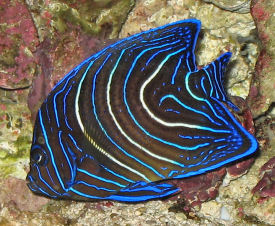
A young Koran Angelfish looks very similar to a juvenile Emperor Angelfish (Imperator Angelfish) Pomacanthus imperator. The Imperator juvenile also has the “C” shape white stripe near the tail, but has a small whitish blue to white full circle within the “C” shape. The Imperator juvenile also has irregular light blue lined circles in the dorsal and anal fin, where the Koran does not. Juveniles begin to change to their adult color between 3.1 to 6.2” (8 – 16 cm).
The Koran Angelfish can grow up to 15” (38 cm), and can have a lifespan of over 21 years in captivity.
- Size of fish – inches: 15.0 inches (38.10 cm) – They can grow up to 15” (38 cm) if given the proper space.
- Lifespan: 21 years – Over 21 years in captivity.
Fish Keeping Difficulty
The Koran Angelfish or Semicircle Angelfish is moderate in care because of the size of the tank needed and the need for good water quality. In a tank of 225 gallons or more, the Koran Angelfish will be easy to moderately easy as adults. As with other angels, they do not do well if the tank is near foot traffic. This will stress them, which can cause illness and not eating.
- Aquarium Hardiness: Moderately hardy – Moderately Hardy, easiest of the Pomacanthus.
- Aquarist Experience Level: Beginner – Beginner to intermediate, depending on the tank size.
Foods and Feeding
Koran Angelfish or Semicircle Angelfish are omnivores, in the wild they eat a wide variety of sponges, tunicates, algae and other encrusting animals. It is important that you feed angelfish all kinds of live, frozen, and prepared formula foods. Feed vegetable based foods as well as meaty foods like chopped squid, scallop, and shrimp. Prepared foods with marine sponge is essential. A good formula that can be made at home consists of mussels, shrimp, squid, and spinach. Many foods offer color enhancing qualities, which are helpful. Feed 3 or more times a day.
- Diet Type: Omnivore
- Flake Food: Yes – With spirulina and sponge material included, and color enhancing foods are also helpful.
- Tablet / Pellet: Yes – With spirulina and sponge material included.
- Live foods (fishes, shrimps, worms): Some of Diet – Brine shrimp, mysis shrimp, as well as other protein sources can be offered occasionally. Vegetable Foods
- Vegetable Food: Some of Diet
- Meaty Food: Some of Diet
- Feeding Frequency: Several feedings per day – They need several small feedings a day that includes vegetable matter, sponge material, and meaty foods.
Aquarium Care
In general, Pomacanthus angelfish are not as forgiving as some other fish when it comes to water quality. The Koran Angel is not as touchy as some of the other species, but still needs cleaner water. Water changes of 30% a month, or 15% every 2 weeks is optimal in keeping nitrates lower. If there are corals in the tank, then 20% every month, 10% every 2 weeks or 5% a week works great.
A large tank is important for this large fish. Because it needs a lot of food, there is a large bio-load on the aquarium and a smaller tank will foul quickly. A suggested guideline is to keep up with your water testing, which will tell you when your tank needs a water change.
- Water Changes: Bi-weekly – Water changes of 15% every 2 weeks or 30% a month. If there are corals in the tank, then 10% every 2 weeks or 20% every month.
Aquarium Setup
The Koran Angelfish, like other large angelfish, needs a stable and established tank which is at least 6 months old. A minimum size of 135 gallons (378 l) is suggested, with between 225 to 275 gallons (852 to 1041 l) for proper adult coloration and size, and for a pair. The tank should be well decorated with rocks/corals arranged with plenty of hiding places as this angelfish likes to have places for refuge. Provide Water parameters of: 72-82° F, pH 8.1-8.4, sg 1.023-1.025.
- Minimum Tank Size: 135 gal (511 L) – A tank that is between 225 to 275 gallons (852 to 1041 l) will ensure for proper coloration and size in an adult, and to keep a male/female mated pair.
- Suitable for Nano Tank: No
- Live Rock Requirement: Typical Plus Hiding Places – Hiding places are needed to help reduce stress.
- Substrate Type: Any
- Lighting Needs: Moderate – normal lighting – Lighting is needed to provide algae growth on live rock.
- Temperature: 72.0 to 82.0° F (22.2 to 27.8° C)
- Specific gravity: 1.023-1.025 SG
- Range ph: 8.1-8.4
- Brackish: No
- Water Movement: Moderate – It can tolerate a rather stronger flow but slow-moving water is preferable.
- Water Region: All – They will spend time in all parts of the aquarium.
Social Behaviors
Semicirculatus or Koran Angelfish adults are generally solitary. In the aquarium they are semi-aggressive, though they can be a good community fish with the proper tank mates, especially when young. They do not tolerate other angelfish so should be kept singly, and can be aggressive towards smaller fish like gobies, clownfish and blennies. Because they establish territories that they will defend, they should be the last fish you introduce into the tank. Slower moving sharks and stingray, especially their eyes, may be picked by larger angelfish.
In a reef environment they will eat at Large Polyp Stony Corals (LPS), most soft corals, Zoanthids, and Tridacnid clams. Use caution with Small Polyp Stony Corals (SPS). They may be a threat to small decorative shrimp.
- Venomous: No
- Temperament: Semi-aggressive – Small juveniles are peaceful and a good community fish, but as they grow they start becoming contentious towards other angelfish and similarly shaped fish added later on.
- Compatible with:
- Same species – conspecifics: No – Only as a male/female mated pair.
- Peaceful fish (gobies, dartfish, assessors, fairy wrasses): Monitor – May pester very passive fish.
- Semi-Aggressive (anthias, clownfish, dwarf angels): Safe – May be aggressive towards dwarf angelfish.
- Safe
- Large Semi-Aggressive (tangs, large angels, large wrasses): Monitor – Will be aggressive towards other large angelfish species.
- Large Aggressive, Predatory (lionfish, groupers, soapfish): Monitor – Slower moving sharks and stingray may be picked on.
- Threat – Angelfish are too aggressive in feeding to keep with slow feeding species.
- Anemones: Monitor – May nip at them.
- Mushroom Anemones – Corallimorphs: Monitor – May nip at them.
- LPS corals: Threat
- SPS corals: Safe
- Gorgonians, Sea Fans: Threat
- Leather Corals: Threat
- Soft Corals (xenias, tree corals): Safe
- Star Polyps, Organ Pipe Coral: Monitor
- Zoanthids – Button Polyps, Sea Mats: Monitor
- Sponges, Tunicates: Threat
- Shrimps, Crabs, Snails: Monitor – May be a threat to small decorative shrimp.
- Starfish: Safe
- Feather Dusters, Bristle Worms, Flatworms: Safe
- Clams, Scallops, Oysters: Threat
- Copepods, Amphipods, Mini Brittle Stars: Safe
- Shrimps, Crabs, Snails: May be aggressive
- Stony Corals: May be aggressive
- Soft Corals: May be aggressive
Sex: Sexual differences
Females exhibit typical coloration but have a swollen belly when fertile. The males are larger, paler, and their dorsal and anal fins are more pointed.
Breeding / Reproduction
Spawning in captivity can occur with P. semicirculatus , but researchers are having a hard time keeping the larvae alive past 17 days (at the time of writing). Successful breeding can only be accomplished in a very large display aquarium. Most home aquarists will not have a tank large enough to encourage spawning with this angelfish.
Angelfish generally are broadcast spawners, releasing eggs and sperm simultaneously at dusk. They dance then rise into the water column and release their eggs and sperm near the top of the water. Spawning starts before sunset with females extending all her fins as she swims next to the male. The male will go under the female and nuzzle her belly, then darts down about 2.3” to 3.9” (6 to 10 cm). The female then turns to her side and both release a white cloud of gametes containing sperm and eggs. Both males and females may mate with several others on the same evening.
The Koran Angelfish female scatters 10,455 eggs and then male then fertilizes them. These newly fertilized eggs will float in a planktonic stage for a few weeks. Eventually they will settle at the bottom as fry and start their colorful life apart from their parents.
- Ease of Breeding: Difficult – Difficult, yet progress is being made in captivity.
Fish Diseases
Koran Angelfish are not quite as sensitive as other Pomacanthus, but still need a calm environment so as to not stress, which makes them prone to disease. Like other saltwater angelfish, they can suffer any disease that captive saltwater environments have to offer. Saltwater Ich or White Spot Disease (Crypt) is the most common of disease, and is generally associated with marine tangs and angelfish.
White Spot Disease Cryptocaryon irritans, also known as Marine Ich, Saltwater Ich, or Crypt is the most common disease that is generally associated with marine tangs and angelfish. Symptoms of Marine Ick are constant scratching, culminating with lots of white dots. These dots disappear for a few days, only to return with double the number. This results in the fish suffocating from these parasites blocking the gills from providing oxygen.
Another common disease is Marine Velvet or Velvet Disease Oodinium ocellatum, (syn: Amyloodinium ocellatum or Branchiophilus maris), which is a parasitic skin flagellate. Symptoms of Marine Velvet are a peppery coating giving a yellow to light brown “dust” on body, clamped fins, respiratory distress (breathing hard as seen as frequent or quick gill movements), cloudiness of eyes, glancing off decor or substrate, and possible weight loss.
Parasites on marine fish kept with live rock or in any type of reef environment can be extremely difficult to treat. Typical treatments like copper and formalin solutions, as well as quinine based drugs are harmful to other marine creatures. However drugs such as metronidazole provide an effective and safe treatment for several protozoan and anaerobic bacterial diseases. Metronidazole works by ceasing the growth of bacteria and protozoa. Metronidazole is an antibiotic for anaerobic bacteria with anti-protozoal properties. This drug is reef safe, and medications are either added to the water or mixed with the fish food. Some available products that contain metronidazole include Seachem Metronidazole, Seachem AquaZole, Thomas Laboratories’ Fish Zole and National Fish Pharmaceutical’s Metro-Pro.
For external parasites you can slowly increasing the temperature of your tank to at least 82° F (28° C). That will prevent the parasite from completing its life cycle which includes the attachment to fish. A further combination of the higher temperatures with medicated food will provide timely relief. The Seachem Metronidazole medications works well in combination with another Seachem product called Focus, which is a bonding agent. This treatment can be used in a reef aquarium since the medication is bound to the food, which even if the corals eat, will not hurt them. Mix Focus in a ratio of 5 to 1 with their Metronidazole (5 parts Focus to one part Metro), then mix this with 1 tablespoon of food. Feed the medicated food to the fish 3 times a day for at least a week or until symptoms are gone.
For more information on diseases that saltwater angelfish are susceptible to, see Aquarium Fish Diseases and Treatments.
Availability
The Koran Angelfish or Semicircle Angelfish is easy to find online and in stores, and moderately expensive.
References
- Animal-World References: Marine and Reef
- Pomacanthus semicirculatus (Cuvier, 1831) Semicircle angelfish, Fishbase
- Pomacanthus semicirculatus, IUNC Red List, International Union for Conservation of Nature and Natural Resources
- Helmut Debelius and Rudie H. Kuiter, World Atlas of Marine Fishes, (in German) Hollywood Import & Export, Inc., 2006
- Scott W. Michael, Angelfishes & Butterflyfishes: Reef Fishes Series , Microcosm Ltd, 2004
- Scott W. Michael, Marine Fishes: 500+ Essential-To-Know Aquarium Species, T.F.H Publications inc., 1999
- Mark Allen, Roger Steene and Gerald R. Allen, A Guide to Angelfishes and Butterflyfishes , Odyssey Publishing, 1998
- Roger Steene, Gerald R. Allen, Hans A. Baensch, Butterfly and Angelfishes of the World, Volume 1, John Wiley & Sons, 1980
- Jim McDavid, Large Angels in the Home Aquariums, Part 1, Advanced Aquarist, Copyright 2003
- Tim Anderson, Koran Angelfish, Tim’s Tropicals