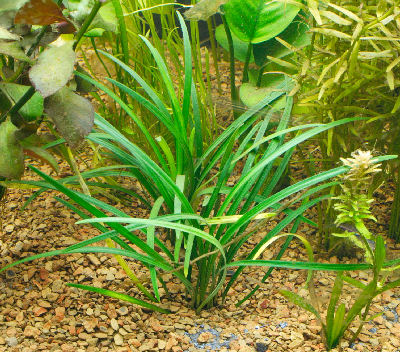
Developing an aquatic ‘green thumb’ will give you hours of enjoyment with your planted aquarium!
Keeping, maintaining, and ultimately propagating your aquarium plants is truly a joy, and it starts with a good substrate. The term ‘substrate’ refers to the planting medium used on the bottom of an aquarium. Similar to soil in a garden, substrates are needed by plants in order for them to root, obtain nutrients, and propagate.
In natural environments, the substrate is typically slightly warmer than the water. It is also full of nutrients and dense. These things help the plants to root better, they receive better nutrition, and the warmer root conditions help in the growth of the plants. It is important to determine which soil is best for plant growth in the
In the aquarium, maintaining the substrate once it is set is usually fairly simple. Not much is needed. This is due to the normal activity of the aquarium. The fish and plants produce and release enough organic products, that then collect in the substrate, and in turn help the plants grow.
Once you’ve determined what type or types of plants you wish to keep, you can then determine which soil is best for plant growth in your planted aquarium.
- For choosing the best types of plants for your aquascape, see:
Selecting Aquarium Plants Aquarium Design and Types of Aquatic Plants
Choosing a Substrate:
There are several things to take into consideration when choosing your planting medium. Which types of substrates to use are determined by:
- First, the needs of the plants.
- Then the type of aquarium equipment you will be using.
- And finally the overall aquarium design you are looking to achieve.
Determining what type of substrate to use is extremely important for the plants. For healthy aquatic plants, the substrate provides nutrients for normal plant growth development and plant propagation. Several substrates available in most stores include: common pea gravel, aquarium gravel, sand, nutrient-rich and soil-based substrates, clay substrates, and quartz gravel (lime-free gravel). Often, different substrates can be mixed to obtain an optimum environment for your particular types of plants.
Substrate Considerations:
There are different points to consider with each type of substrate such as the size of the particles and the depth of each substrate level.
- Size of the substrate: Usually, you don’t want substrates that have large particle size because it allows more water to pass through and also acts as a debris trap. Particle sizes should be approximately 0.04 to 0.12 inches in diameter.
- Depth of the substrate: The depth of the substrate should be considered. How deep it is mostly depends on the type of plants present. Plants with longer roots need deeper substrates than plants with shorter roots. Usually a good rule of thumb is to have a substrate depth of between 2 and 4 inches.
- Mineral and Organic Content: Another factor is the mineral and organic contents of the soil. Much of this is often provided by the aquarium water and the other organisms living in the aquarium, but nutrient-rich substrates are available if needed.
Substrate Layers:
The four main substrates layers are: base substrates, rooting substrates, nutrient-rich substrates, and top level substrates.
- Base substrates: A base substrate is usually sand. Base substrates aren’t usually necessary, except in the case of heating cables present on the bottom. In nature the substrate is usually warmer than the water, and the use of heating cables can simulate this in the planted aquarium. If you are using a heating cable, you will want a layer of sand that is about 1″ – 1 1/2″ deep to cover the cable.
- Rooting substrates: The rooting substrates are the main body of the substrate, designed to help anchor the plants. They do contain some nutrients, but are dense enough so that not too much water can be passed through. This layer is generally about 2″ deep.
Quart gravel or lime-free substrates are ideal as rooting substrates. Some of these substrates include products called flourite, acrilite, or Onyx sand (a newer product from Seachem). Soil or potting soil is not often used because it is difficult to keep from clouding the water. It can be used and then covered with a heavier top level substrate, but you may still experience a muddying of the water. - Nutrient-rich substrates: Nutrient-rich substrates contain high levels of nutrients and only a thin layer of them should be used. This layer is used solely for the benefit of the plants and are designed to be used in limited quantities. Some nutrient-rich substrates include laterite and soil or potting soil. Laterite is too rich in nutrients for a rooting substrate and should be used sparingly. It can be added by rolling it up into little balls and placing the balls next to the plant roots.
- Top level substrates: The top level substrate is the one that is visible to viewers and does not serve any other major function. This is a good place for coarser gravels and can be quite decorative, depending on the type of aquarium scene you are creating.
Substrate Types:
- Common Pea Gravel: This gravel is very similar to what you would see in a natural environment. Used alone the normal common pea gravel sold in stores is generally not ideal for plants. Pea gravel is fairly loose thereby making it easy for water to flow through it, thus cooling the roots, oxygenating the gravel, and removing nutrients.
You can however use the smallest grade for a rooting medium though a lime-free quartz gravel is a better alternative. This gravel does work well as a top layer over finer substrates, or combined with other substrates to obtain a more realistic ‘river’ type display. - Quartz Gravel (lime-free substrate): Quartz gravel or a lime-free substrate is ideal as a rooting medium for plants. You can get it in a golden brown, black or white.
- Colored (aquarium) Gravel: This is much like the common pea gravel and is also not ideal for plants. Again it is fairly loose and allows for easy water flow through it.
It can be mixed with other substrates for a visual variation, and will work well as a top layer over finer substrates. Light gray gravel is not a good choice however, as it causes distress in the fish due to how strongly the light is reflected off of it. - Calcius gravels: Crushed coral and other calcius sands or gravels that are offered for saltwater aquariums are high in calcium. They should be avoided unless you need a high pH and water hardness, few plants want this. These gravels work well in freshwater fish aquariums that are designed for African cichlids that need these high levels.
- Sand: Sand is very fine, often even dusty. The ‘silver sand’ sold in aquarium shops is totally inert. Sand will compact and prevent any water movement resulting in a lack of oxygen.
Though sand can be used in a thin layer as a rooting medium for some plants, you will want to stir it occasionally to keep it from compacting. It is generally used as a base layer over heating cables. - Soil, Potting Soil: This substrate can be tricky to use as it can have too many nutrients and it may encourage algae growth. Also it is difficult to keep it from clouding the water.
Potting Soil is sometimes used as a thin nutrient-rich substrate layer and covered with a heavier top substrate. It has also been effectively used in permanent pots that are covered with a heavier top substrates. The potted method can be used in aquariums with undergravel filters. - Nutrient-rich Substrates: These are a long term source of nutrients that are vital to the plants. They should be used in limited quantities of either very thin layers between other substrate layers or as small pellets placed by the roots of plants. See the Nutrient rich layer described above for some of these products.