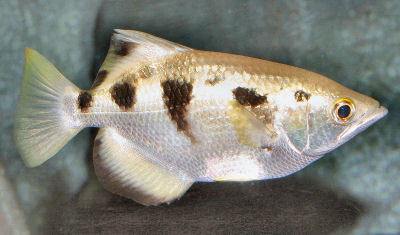
The Archer Fish is a fish renowned for its ability to “shoot†down its prey with a forceful stream of water, …definitely one of Mother Nature’s wonders!
The Banded Archerfish Toxotes jaculatrix are brackish water fish. They are a very common coastal species in many parts of tropical Asia and northern Australia. They live mainly in salty mangrove swamps where they spend their time cruising the shallows looking for food. They will also move into rivers and streams. The more solitary adults may swim out to coral reefs. This fish is also known as Archer Fish or Spinner Fish.
The Archer Fish have developed the ability to “shoot” their food by forcing a stream of water through a groove in the roof of their mouths. This jet of water is strong enough to knock insects and spiders out of low lying branches into the water where they are quickly gobbled up. They seem to have an uncanny knowledge of exactly where the food will land, and are headed to retrieve it before the stream of water has even hits its mark. These fish can also leap out of the water, similar to salmon fish, to grab insects out of the air. They will generally only leap, however, if the prey is a body length or more above the surface of the water. They will also feed on small fish and crustaceans.
The Banded Archerfish will generally reach only about 6 inches (15 cm) in the aquarium, though they can get about twice that size in the wild. They are typically a bright silvery or white color withfive to six (sometimes seven) black vertical bands. Juveniles will have a some irregular yellow patches, mostly on top between the bands. Their body is flattened and rather elongated, with a pointed head. There is also a very pretty yellow color morph (see below). It is extremely rare, but a real treasure if you can find one.
The Banded Archers are a good community as long they are kept with fish too big for them to eat. They basically have no concerns with other fish as long as the tank mates are not overly aggressive and don’t dwell in the upper portions of the tank. Though getting them to feed can be difficult, once they get accustomed to the aquarium they are quite hardy, and can even be trained to spit. This is fun, but just be careful to not overfeed.
Their distinctive looks along with their interesting behaviors make Banded Archers fascinating fish to keep. Yet even without their unusual ability to shoot prey, they would still be a popular aquarium fish. They are not quite as flashy as some of the other brackish water perches, like Mono fish and Scats, but they have a very interesting behaviors, body shape, and banded patterning.
For Information on keeping freshwater fish, see:
Freshwater Aquarium Guide: Aquarium Setup and Care
From the video description: “The Banded Archer fish from our Mangroves Exhibit, being fed crickets as part of our enrichment programme. Narrated by Jodie Peers, Marine Biologist at Living Coasts.”
- Kingdom: Animalia
- Phylum: Chordata
- Class: Actinopterygii
- Order: Perciformes
- Family: Toxotidae
- Genus: Toxotes
- Species: jaculatrix
- Aquarist Experience Level: Advanced
- Size of fish – inches: 11.8 inches (29.97 cm)
- Minimum Tank Size: 55 gal (208 L)
- Temperament: Semi-aggressive
- Aquarium Hardiness: Moderately hardy
- Temperature: 77.0 to 86.0° F (25.0 to 30.0° C)
- My Aquarium – Enter your aquarium to see if this fish is compatible!
- Beginner Fish – Freshwater fish for beginners
- Community Fish – Peaceful Freshwater fish
- Hardy Fish – Hardy Freshwater fish
- Similar size fish – Fish that are 1 inch bigger or smaller
- Coldwater Fish – Looking for cold water fish? (65 °)
Habitat: Distribution / Background
The Banded Archerfish Toxotes jaculatrix was described by Pallas in 1767. They are found in most of tropical Asia, Papua New Guinea, and northern Australia. Toxotes jaculatrix is not on the IUCN Red List. Other common names these fish are known by are Archer Fish, Spinner Fish, Archerfish, and Archers.
This is one of just 7 species in the Toxotes genus. Only three species are common imports, though occasionally others will show up. This species,Toxotes jaculatrix, and the very similar looking Largescale Archerfish Toxotes chatareus are regular imports, withthe Smallscale Archerfish Toxotes microlepis becoming more common. The Primitive Archerfish Toxotes lorentzi is a very rare import. These fish get their common name “archerfish”in reference to the mythological archer Sagittarius, due to their amazing ability to shoot down their prey.
The Archer Fish habitat is primarily estuaries and brackish waters among mangroves, but they will also enter rivers and streams, sometimes swimming far inland. These fish migrate from brackish water to freshwater and saltwater, but not for breeding like many fish do.
Archerfish feed during the day on floating surface food such as insects and spiders. They will also eat underwater prey such as small fish and crustaceans. These fish have a unique hunting method, they can shoot water out of their mouth and hit insects, knocking them into the water so they can eat them. They actually have at least a 5 foot range, if not 6 to 9 feet, that they can accurately hit their targets.
- Scientific Name: Toxotes jaculatrix
- Social Grouping: Groups
- IUCN Red List: NE – Not Evaluated or not listed
Description
The Archer Fish is a fairly deep bodied, butelongated fish with its head slanting into a sharply pointed, v- shaped snout. It has large eyes that are positioned for binocular vision giving it the ability to see what’s above it and accurately hit its target with jets of water. They can reach up to 12 inches (30 cm) in the wild. In the aquarium they will generally not get much bigger than about 6 inches (15 cm) with a life span of about 10 years.
The Banded Archer has a bright silver body with a golden tinting running along its back. There are five to seven black vertical, triangular shaped bands running halfway down the sides, with no markings below that. The first band usually runs through the eye and another is located on the caudal peduncle. The outer edges of the anal and dorsal fin are also black. The Banded Archer have four dorsal spines, 3 anal spines and around seventeen anal rays. There is also a very pretty yellow color morph, as seen in the picture to the lower right, but it is extremely rare.
Banded Archer differs only slightly in appearance from its two close relatives, the Largescale Archerfish Toxotes chatareus and Smallscale Archerfish Toxotes microlepis. All three are almost identical in color, however the Largescale Archerfish T. chatareus will have seven bands, and will have spots and blotches between the bands, and there may be markings below the halfway point of the body.
WFPeA_Ap4AM.jpg) Archer Fish – Gold color form Photo © Animal-World: Courtesy Ken Childs |
The Smallscale Archerfish Toxotes microlepis. is a slightly smaller fish, only growing to about 5 inches (12.5 cm) in length. It has the same bands, but will also have small black spots on the edge of the dorsal fin.
- Size of fish – inches: 11.8 inches (29.97 cm) – In the aquarium they will generally not get much bigger than about 6″ (15 cm).
- Lifespan: 10 years
Fish Keeping Difficulty
The Banded Archerfish is suggested for a more experienced fish keeper. These fish move through all different types of water conditions, and that can make it hard to get the home aquarium right. They also need extremely pristine water. These fish can be difficult to feed because they have a natural inclination shoottheir food with wateroutside of the tank. Once they become acclimated feeding gets easier as they will learn to accept aquarium fare. A proper tank canopy is also hard to make, Archer’s like to jump to get food so a tall tank with an open area for them to jump and not injure themselves is needed.
- Aquarium Hardiness: Moderately hardy
- Aquarist Experience Level: Advanced – These fish need extremely pristine water, their water requirements change to brackish as they mature, and feeding can be difficult as well.
Foods and Feeding
Banded Archerfish are primarily carnivores. In the wild they feed on insects and spiders that they shoot down onto the surface by spitting water at them, and they also feed on small fish and crustaceans. In the aquarium they will prefer live invertebrates, small live insects, and small fish. But they will take good quality large flakes, pellets, and freeze dried foods. They will also eat frozen foods such as brine shrimp and bloodworms.
These fish will only eat of the surface and will ignore anything that falls past it. It is sometimes hard to get them to feed when they want to actually hunt and do what they are made to do; jump and squirt to get their food. If this can be accomplished you will have a spectacular Archer fish. They can be trained to spit down foods in the aquarium. This can be done by sticking small pieces of moistened prawn to the aquarium glass. Start by sticking the food at the water line. After they learn to accept it and go for it, you can start raising the pieces slightly higher. At first they will most likely jump, but eventually they will begin to spit to get their reward.
- Diet Type: Carnivore
- Flake Food: Yes
- Tablet / Pellet: Yes
- Live foods (fishes, shrimps, worms): Half of Diet
- Meaty Food: Most of Diet
- Feeding Frequency: Daily
Aquarium Care
The Banded Archerfish needs quality water conditions. The environment will need to be regularly monitored and weekly water testing is necessary. Their tank should be cleaned weekly and have at least a 30% water change done. Cleaning the bottom of the tank needs to be done often because these fish will rarely eat anything that falls past them.
- Water Changes: Weekly – Do at least a 30% water change weekly.
Aquarium Setup
The minimum sized tank for these fish should be 55 gallons and the taller the tank the better. The more open space from the waterline to the top of tank the better, these fish like to jump. An aquarium that is 18 inches (45 cm) deep, filled two thirds with water is about the minimum for adults. That provides several inches above the water level for these fish to spit down morsels of foods stuck on the glass. These fish are use to very clean water sogood filtration is very important to ensure their health.
They live mainly in brackish mangrove swamps so their tank water should also be brackish. Adults will require a specific gravity around 1.010. Juveniles can handle freshwater but for long term heath, a salinity near 2% is needed. Moderate lighting is preferred by this fish. Plants that protrude above the water makes a good touch to replicate their natural environment. Make sure to have hiding places like driftwood and different twisted roots. The substrate should consist of sand or fine gravel.
- Minimum Tank Size: 55 gal (208 L) – A 55 gallon aquarium, 18″ (45 cm) deep, and filled 2/3’s with water is about the minimum for adults.
- Suitable for Nano Tank: No
- Substrate Type: Sand
- Lighting Needs: Moderate – normal lighting
- Temperature: 77.0 to 86.0° F (25.0 to 30.0° C)
- Range ph: 7.0-8.0 – They need a fairly hard pH, neutral to slightly alkaline.
- Hardness Range: 20 – 30 dGH
- Brackish: Yes
- Water Movement: Moderate
- Water Region: Top – The Banded Archerfish will spend most of their time in the middle or top on the aquarium.
Social Behaviors
These fish are schooling fish in nature and should have at least 4 or more in the tank. However they can get aggressive with others of their own kind if they differ in size. It best tojust keep a single specimen or avoid combining Archer Fish of different sizes. They will do well in a brackish water community tank. They are predators that will eat smaller fish, but are generally non-aggressive with other types of fish as long as the tank mates are not aggressive and do not try to compete too much in the upper regions of the tank. Other brackish fish such as Four Eye Fish, Mudskippers or large Mollies can make good tank mates, as can Monos, Scats, and Puffers.
- Venomous: No
- Temperament: Semi-aggressive – They will eat smaller fish.
- Compatible with:
- Same species – conspecifics: Yes – They can be kept singly, but they are schooling fish and do best in groups of 4 or more. In groups they must be same sized, as they can get aggressive with others of their own kind if they differ.
- Peaceful fish (): Monitor
- Semi-Aggressive (): Monitor
- Aggressive (): Threat
- Large Semi-Aggressive (): Threat
- Large Aggressive, Predatory (): Threat
- Monitor
- Shrimps, Crabs, Snails: May be aggressive – In the wild, crustaceans are a natural part of their diet.
- Plants: Safe
Sex: Sexual differences
Sexual differences are unknown.
Breeding / Reproduction
The Archer Fish has been bred in captivity by a commercial fish farm, Ausyfish Pty Ltd, according to Bruce Sambell as seen in the reader comments below. For the fascinating details check Breeding Freshwater Fish – Archerfish or read the comment on bleow from Bruce.
Since there is no way of sexing these fish they need to be kept in large groups if you want to even try to breed them, which has only been done a few times in aquariums and mostly by accident. These fish will spawn at the surface and will release almost 3000 floating eggs. For best chances of hatching, transfer to another tank. Eggs hatch in about 12 hours. Fry will eat things floating on the surface like insects and flake food. If introduced to prepared food as fry they won’t be as determined to have live food as they age.
- Ease of Breeding: Difficult
Fish Diseases
Archers are often obtain when young as a freshwater fish, but for long term care brackish water is recommended. Pet stores sometimes fail in educating their customers on this or just assume that they know this. Not moving them to a brackish environment will lead to many different fish diseases.
With the Banded Archerfish, disease is not usually a problem in a well maintained aquarium. That being said there is no guarantee that you won’t have to deal with health problems or disease. Anything you add to your tank can bring disease to your tank. Not only other fish but plants, substrate, and decorations can harbor bacteria. Take great care and make sure to properly clean or quarantine anything that you add to an established tank so not to upset the balance. Banded Archer are very resilient once established in a tank.
A good thing about the Banded Archer is that due to their resilience, an outbreak of disease can often be limited to just one or a few fishes if you deal with it at an early stage. When keeping more sensitive types of fish, it is common for all fishes to be infected even before the first warning signs can be noticed. The best way to proactively prevent disease is to give your Archer the proper environment and give them a well balanced diet. The closer to their natural habitat the less stress the fish will have, making them healthier and happy. A stressed fish will is more likely to acquire disease.
Banded Archer Fish are fairly hardy fish when mature, but are subject to the same diseases as other tropical fish. One of the most common freshwater fish ailments is ich. It is recommended to read up on the common tank diseases. Knowing the signs and catching and treating them early makes a huge difference. For information about freshwater fish diseases and illnesses, see Aquarium Fish Diseases and Treatments.
Availability
The Banded Archerfish, also called Archer Fish, is commonly available.
References
- Animal-World References: Freshwater Fish and Plants
- Dr. Rüdiger Riehl and Hans A. Baensch, Aquarium Atlas Vol. 1, Publisher Hans A. Baensch, 1991
- Joseph S. Nelson, Fishes of the World, Wiley, 2006.
- Neale Monks, Brackish Water Fishes: An Aquarist’s Guide to Identification, Care & Husbandry, TFH Publications, 2006
- Dr. Herbert R. Axelrod, Aquarium Fishes of the World, TFH Publications, 1998
- Toxotes jaculatrix (Pallas, 1767) Banded archerfish, Fishbase.org