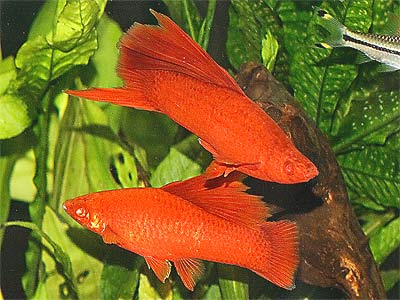
The most popular aquarium fish next to the Guppy is most certainly the Swordtail!
The Swordtail Xiphophorus hellerii is extremely popular. It is one of the prettiest aquariam fish and very hardy. In the wild, it has an olive green body with red and yellow along the sides and sometimes colorful speckles on its fins. With this coloration, it is most commonly called the Green Swordtail or the Red Swordtail. However, in captivity, it has been bred into the fabulous colors that make it so highly prized today.
The Green Swordtail is similar in shape to both the Platy fish and the Guppy. It has a bulkier body than either of those two, though, and also has a “sword” extending from the bottom of the male’s tail fin. It is often thought to be named for the “sword” shaped extension of its tail fin, but the Swordtail was actually named for the sword-like appearance of the male’s anal fin. This specialized anal fin develops as the male fish matures. The middle rays of the anal fin are modified into a narrow copulatory organ called a gonopodium.
Indeed, the beautiful male’s “sword” tail is one of the most striking physical characteristics possible in any aquarium fish. Even though this dramatic tail fin has no apparent purpose, it accounts for anywhere from 1/4 to 1/3 of the total length of the fish! The wild species have an even more majestic tail, with swords up to 6 inches (15 cm) in length. The sword is shorter in tank-bred specimens but complemented by the wonderful colors that are now available.
| What’s in the name? | ||
|---|---|---|
| Xiphophorous | means | “bearing a sword” |
| hellerii | named for | Carl Heller |
Like the Platy fish, Swordtails have been interbred to produce all kinds of interesting colors and different types of finnage. Some of the more common varieties of the Swordtail are Red, Red Wag, Red Tux, Painted, Neon Green, Marigold (and wag), Pineapple, Black, Red Twin bar, Sunset, and Gold Tuxedo.
Some other types of Swordtail fish that are occasionally available are the Montezuma Swordtail (Spotted Swordtail) Xiphophorus montezumae, Delicate Swordtail Xiphophorus cortezi, and Mountain Swordtail Xiphophorus nezahualcoyotl. A couple of dwarf species, the Pygmy Swordtail Xiphophorus pygmaeus and Panuco Swordtail Xiphophorus nigrensis, are sometimes available. These dwarves are similar to the others but smaller and not quite as hardy.
Swordtail fish are not only pretty but easy to breed and fast-growing. They are quite hardy and thus make wonderful fish for the beginner. They are generally peaceful, lively fish that swim in loosely grouped schools and thrive in a community. They do best in a well-planted tank with lots of room to swim around. Provide floating plants to protect the young as the parents often eat their fry. Like all livebearers, they do like a bit of salt, though it is not necessary.
For Information on keeping freshwater fish, see:
Freshwater Aquarium Guide: Aquarium Setup and Care
Beautiful Swordtail types in a nicely planted community tank with tetras and neons as companions.
- Kingdom: Animalia
- Phylum: Chordata
- Class: Actinopterygii
- Order: Cyprinodontiformes
- Family: Poeciliidae
- Genus: Xiphophorous
- Species: hellerii
- Aquarist Experience Level: Beginner
- Size of fish – inches: 6.3 inches (16.00 cm)
- Minimum Tank Size: 20 gal (76 L)
- Temperament: Peaceful
- Aquarium Hardiness: Very Hardy
- Temperature: 64.0 to 82.0° F (17.8 to 27.8° C)
- My Aquarium – Enter your aquarium to see if this fish is compatible!
- Beginner Fish – Freshwater fish for beginners
- Community Fish – Peaceful Freshwater fish
- Hardy Fish – Hardy Freshwater fish
- Similar size fish – Fish that are 1 inch bigger or smaller
- Coldwater Fish – Looking for cold water fish? (65 °)
Habitat: Distribution / Background
The Green Swordtail Xiphophorus hellerii was described by Heckel in 1848. They are found in North and Central America, where they range from the Atlantic slopes of southern Mexico (Rio Nantla, Veracruz) to northwestern Honduras. They have been introduced to, and become established in, a number of countries in southern Africa and along the eastern coast of Australia.
Wild strains exist in many color variations of the Green Swordtail X. hellerii. These fish are not endangered nor are they listed on the IUCN Red list of Threatened Species. Other common names this species is known by are Swordtail and Red Swordtail.
There are a variety of other Swordtails species that are occasionally available. These include the Montezuma Swordtail (Spotted Swordtail) Xiphophorus montezumae, Delicate Swordtail Xiphophorus cortezi, and Mountain Swordtail Xiphophorus nezahualcoyotl. A couple of dwarf species, the Pygmy Swordtail Xiphophorus pygmaeus and Panuco Swordtail Xiphophorus nigrensis, are sometimes available.
The Spotted Swordtail Xiphophorus montezumae was introduced into the aquarium hobby as early as 1864, while the popular Green Swordtail was first introduced in 1909. The Green Swordtail X. hellerii is the most available. The other species, though similar, are not always as large and are often more delicate.
The Green Swordtail are found in all types of waters, and prefer heavily-vegetated areas. They are mostly found in rivers and streams, but are also found in warm springs, canals, and ponds. Though not a schooling fish, they enjoy the company of other swordtails and will often shoal. They feed on plant matter, worms, crustaceans, and insects.
- Scientific Name: Xiphophorous hellerii
- Social Grouping: Groups – Enjoys being with other Swordtails even though it is not a schooling fish.
- IUCN Red List: NE – Not Evaluated or not listed
Description
The Green Swordtail is moderate in size with a sturdy, elongated body. Females are larger, reaching up to 6.3 inches (16 cm) in length while the males are somewhat smaller at 5.5 inches (14 cm). Along with Mollies, Guppies, and Platy fish, the Swordtail is a member of the Poeciliidae family of Live-bearing Toothcarps, which are distinguished by having teeth in both their upper and lower jaws.
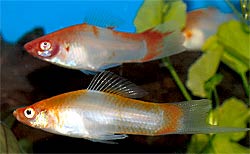
Koi Swordtail (male & female) Photo © Animal-World: David Brough
Swordtail males are smaller and slimmer than females and have a “sword” on the caudal fin (tail fin). As the male fish matures, the middle rays of its anal fin modify into a narrow copulatory organ called a gonopodium.
The wild Swordtail has an olive green body with red, yellow, or brownish stripes along the lateral line of the sides. They can also have speckles on the dorsal fin and sometimes on the caudal fin. The “sword” on the caudal fin is yellow with a lower black edge. In nature, mutations occur frequently, so wild strains also have many color variations.
Selectively bred variations of the Green Swordtail come in many colors and mixtures of colors. These variations include colors such as red, green, black and albino, though red is the most well known.
WFLi_Acf110_med.jpg)
Marigold Swordtail (male) Photo © Animal-World: Courtesy Coryator
Males have also been developed with exaggerated finnage, and there are now high-fin varieties and lyretail Swordtails, the latter having two swords instead of one. Even some females now have a sword.
Most hybrids are crosses between the Swordtail Xiphophorous hellerii and the Platy fish Xiphophorous maculatus.
Early ornamental Swordtail varieties:
Some of the first popular Swordtail varieties were named after cities in Germany where they were first bred. These include:
WFLi_Acf137_med.jpg)
Blood-Red Swordtail (female) Photo © Animal-World: Courtesy Newman
- Berlin Swordtail – red with black spots.
- Frankfurt Swordtail – red on the front half of the body and black on the back half.
- Hamburg Swordtail – a mostly black body with yellowish fins; scales on the sides are shiny with a greenish or bluish metallic sheen.
- Wiesbaden Swordtail – black along the sides of the body and down into the tail with shiny scales; the back and abdomen are green or red.
Popular cross-bred types of Swordtail fish:
Varieties with black markings include fish that have a black tail and are called “Wag tail.” Varieties that have black markings on about 3/4 of the body, but not on the tail, are called “Tuxedo.”
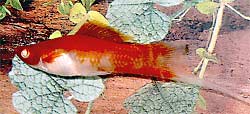
Cherry Swordtail (male) Photo © Animal-World: Courtesy Ken Childs
- Green Swordtail – green body with a red, lateral zig zag pattern.
- Green Wagtail Swordtail – Green Swordtail crossed with a Wagtail Platy.
- Green Tuxedo Wagtail Swordtail – Green Swordtail crossed with a Tuxedo Wagtail Platy.
- Red Swordtail – red ground cover overlaid with a dark red; a cross between the Green Swordtail and the Red Platy. Other red varieties are the Bloodred Swordtail, Brickred Swordtail, and Velvet Red Swordtail.
- Red Wagtail Swordtail – Green Swordtail crossed with a Red Wagtail Platy.
- Red Tuxedo Wagtail Swordtail – Green Swordtail crossed with a Red Tuxedo Wagtail Platy.
- Variegated Swordtail – a mixture of colors with no set pattern.
- Hybrid Swordtail – the same fish as the Salt-and-Pepper Platy. If they retain the “sword,” they are called a Hybrid Swordtail rather than Salt-and-Pepper Platy. No two fish are alike but all contain bits of black, red, yellow, and green blotches.
Marigold Swordtail
Black Nubian Swordtail
Pineapple Swordtail
Neon Swordtail
Koi Swordtail
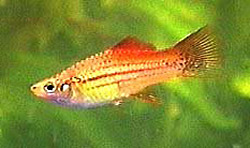
Pineapple Swordtail (female)
The average lifespan of Swordtail fish is between 3-5 years, though they can live longer with optimal care.
- Size of fish – inches: 6.3 inches (16.00 cm) – Females can get up to 6.3 inches (16 cm) in length while the males are somewhat smaller at 5.5 inches (14 cm).
- Lifespan: 5 years – On average, these fish will live about 3-5 years, but if well cared for, they can live even longer.
Fish Keeping Difficulty
The Swordtail fish is hardy and generally peaceful, making it suitable for community tanks. It is easy to care for and to breed, making it a great choice for the beginning aquarist. Make sure you select only healthy fish and provide a good tank and varied diet to offset any potential problems.
A male can demonstrate territorial aggression towards other males, however, and sometimes toward other fish, especially older males. It is best to keep only one male or to have several to divert their aggression. Also, the Swordtail is an accomplished jumper, so be sure to provide a secure cover for the aquarium.
- Aquarium Hardiness: Very Hardy
- Aquarist Experience Level: Beginner
Foods and Feeding
Since they are omnivorous, the Swordtail fish will generally eat all kinds of fresh, frozen, and flake foods. In the wild their diet consists of worms, crustaceans, insects, and some plant matter. In the aquarium, they will gladly eat most commercially-prepared fish foods as well as supplementary live and vegetable-based food. Feed brine shrimp (either live or frozen), tubifex,, or blood worms as a treat. This fish is not a picky eater but should be fed a varied diet several times daily in small amounts.
- Diet Type: Omnivore – This fish is an omnivore; however, it appreciates a high vegetable component in its diet. Supplementing processed foods with blanched lettuce is an excellent way to facilitate this need.
- Flake Food: Yes
- Tablet / Pellet: Yes
- Live foods (fishes, shrimps, worms): Some of Diet
- Vegetable Food: Some of Diet
- Meaty Food: Some of Diet
- Feeding Frequency: Several feedings per day – Feed small amounts several times a day–what the fish can consume in about 3 minutes each time.
Aquarium Care
The Swordtail fish does not require special aquarium care and is not too demanding about tank conditions. Still, the tank should have regular water changes of 25% every 2-4 weeks. The tank may need more or less frequent water changes depending how many fish there are and the condition of the water.
As with most of this family, it is also advisable to add 1-1.25 teaspoons of aquarium salt per gallon. Be sure to only replace water with salted water during water changes. Water that evaporates will leave salts behind, so there is no need to add more salt if you are topping off evaporated water.
- Water Changes: Monthly – Do water changes of 25% every 2-4 weeks, or more often with heavily-stocked tanks.
Aquarium Setup
The Swordtail fish are moderately-sized, active fish that need plenty of room for swimming. A 15 gallon tank could house a single individual with some tankmates, but this fish will be much happier in at least a 20 gallon tank with a few of its own kind for company. Generally, it is best to keep a single male with a small harem of females unless the tank is large enough to house a more evenly mixed group. Be sure the tank is covered as they are accomplished jumpers.
Most any type of gravel works fine for a substrate, but these fish will appreciate an aquarium that is well-planted. They are tolerant of water conditions, but good filtration is very helpful in maintaining stable water. Filtration systems remove much of the detritus, excess foods, and waste. This, in turn, helps to keep the tank clean and maintains the general health of the fish.
- Minimum Tank Size: 20 gal (76 L) – Fifteen gallons could house a single individual, but a small group needs at least a 20 gallon tank.
- Suitable for Nano Tank: Yes
- Substrate Type: Any
- Lighting Needs: Moderate – normal lighting
- Temperature: 64.0 to 82.0° F (17.8 to 27.8° C)
- Range ph: 7.0-8.3
- Hardness Range: 12 – 30 dGH
- Brackish: No – This is not a brackish water fish, but it does appreciate a little salt in the water of about 1-1.25 teaspoon per gallon of water.
- Water Movement: Moderate
- Water Region: Middle – These fish will swim in all areas of the aquarium, but mostly in the middle.
Social Behaviors
Swordtail fish are generally peaceful, lively fish that swim in loosely-grouped schools. They are generally considered a good community fish though sometimes they will eat their own, and other fishes’, fry. Males get aggressive with each other, so a ratio of one male to several females works best. Aside from that, individual fish vary from being peaceful, harmonious tankmates to being bullies. Older males especially can tend toward aggressiveness with each other and other species.
This fish combines well with most other good natured fish of similar size. However, the Swordtail’s extensive fins can be too tempting for fin nippers to resist, so it is best to avoid combining them. Fishes such as Mollies, Platy fish, Angelfish, armored catfish (Corydoras) and plecostomus, and larger Characins such as the Black Skirt, Red Serpae, and Silver Tip make good tankmates.
- Venomous: No
- Temperament: Peaceful – This is generally a peaceful community fish, but males can sometimes get aggressive, especially older males.
- Compatible with:
- Same species – conspecifics: Yes – Males can get aggressive with each other, so it’s best to keep one with a few females, or keep several males to divert aggression. They will chase and eat their fry.
- Peaceful fish (): Safe – Because of the Swordtail’s long fins, mixing it with fin nippers should be avoided.
- Semi-Aggressive (): Threat
- Aggressive (): Threat
- Large Semi-Aggressive (): Threat
- Large Aggressive, Predatory (): Threat
- Safe
- Shrimps, Crabs, Snails: Safe – not aggressive
- Plants: Safe
Sex: Sexual differences
Only the male has the “sword” extension on the bottom of the tail fin. The male is also slimmer and has a “sword” shaped anal fin called a gonopodium. The female has a fan shaped anal fin, is rounder of body, and will have a spawning patch at breeding time.
There is an occasional tendency for a female Swordtail to change sex and develop a “sword” on her tail, especially when old or affected by parasites. She may even attempt courtship with another female, though the majority of the time they are infertile.
Breeding / Reproduction
This live-bearing fish breeds readily in the home aquarium without special attention if well fed and cared for. In fact, they can quickly overpopulate an aquarium. To breed Swordtails, little more is required than to introduce both sexes into the aquarium. Although they generally attain sexual maturity at about 8 to 12 months, they have been known to start breeding as young as 3 months of age.
On occasion, with certain environmental conditions, a female of this species has a tendency to undergo sex reversal. She may develop a “sword” on her tail and may attempt to spawn with another female, though most of the time this female will be infertile.
To selectively breed Swordtails, provide a breeding tank that is 10 to 20 gallons in size with gentle filtration. You will notice a female is pregnant when she develops a gravid spot, a dark mark on her abdomen. The gestation period is about 24 to 30 days.
Monitor the fish closely when she is close to giving live birth. Swordtails will chase their fry and may eat them if given a chance. The young will be consumed unless they are removed, isolated with a breeding trap, or simply given enough hiding spaces, such as densely rooted or floating plants. The female Swordtail can have between 20 and 200 fry, but they commonly have about 80. For more information, see the guide for breeding Livebearing Fish: Breeding Freshwater Fish – Livebearers.
- Ease of Breeding: Easy
Fish Diseases
Swordtails are relatively hardy and do not have any particularly strong weaknesses for certain diseases. Still, they are subject to the same diseases as other tropical fish. One of the most common freshwater fish ailments is Ich. The best way to proactively prevent disease is to give them the proper environment and a well balanced diet. The more closely their aquarium resembles their natural habitat, the less stress the fish will have, making them healthier and happier. A stressed fish is more likely to acquire disease.
Anything you add to your tank can introduce disease. Not only other fish but plants, substrate, and decorations can harbor bacteria. Take great care and make sure to properly clean or quarantine anything that you add to an established tank so as not to upset the balance. For information about fish diseases and illnesses, see Aquarium Fish Diseases and Treatments.
Availability
The Swordtail fish is among the most commonly available and is usually modest in price.
References
- Animal-World References: Freshwater Fish and Plants
- Xiphophorus hellerii (Heckel, 1848) Green swordtail, Fishbase
- H. Hieronimus, Guppies, Mollies, and Platies, Complete Pet Owners Manual Series, Barron’s, 2009
- Dr. Herbert R. Axelrod, A Complete Introduction to Community Aquariums , T.F.H. Publications, Inc., 2009
- Glen S. Axelrod, et al, Encyclopedia Of Exotic Tropical Fishes For Freshwater Aquariums, TFH Publications, 2005
- David Alderton, Encyclopedia of Aquarium and Pond Fish , DK Publishing, Inc., 2005.
- David Goodwin, The Practical Aquarium Fish Handbook , Sterling Publishing Company, 2003.
- Dick Mills, Derek Lambert, Aquarium Fish Handbook, Quatro Inc., 2004.
- Marc Ladonne, Aquarium Fish , Barnes Noble, 1999 (1996).
- Harro Hieronimus, Guppies, Mollies, Platies, A Complete Pet Owners Manual, Barron’s, 1993
- John Gilbert, Raymond Legge, The Complete Aquarist’s Guide to Freshwater Tropical Fishes, Golden Press, 1970