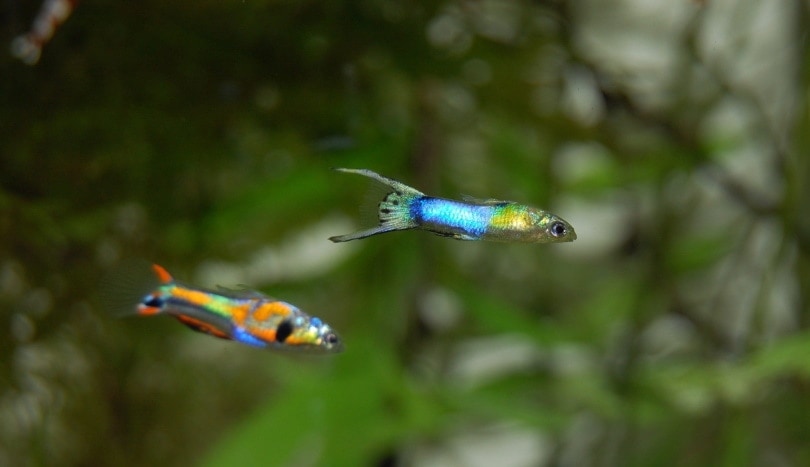
Live-bearing fish are some of the most popular aquarium residents ever!
Guppies, mollies, platies, and swordtails are some of the most popular aquarium fishes. Almost everyone’s first-time experience with aquariums has included one or more of these beautiful and interesting fish!
Livebearers are all very hardy and considered a good fish for beginners. They will readily breed in captivity and it’s hard to resist the chance to watch fish being born that are almost fully developed. These aquarium gems are a lot of fun and even many experienced fish keepers continue to delight in keeping them.
There are primarily four families of Live-bearing fish. Three of these groups originated in the Americas but some were introduced into Asia and from there spread to almost all tropical and sub-tropical areas including southern Europe. The familiar guppy, molly, platy and swordtail are members of the largest group, the Live-bearing Toothcarps (Poeciliidae). Then there are the Splitfins or Mexican Topminnows (Goodeidae) and the Four-eyed Fish (Anablepidae). The LIve-bearing Halfbeaks (Hemiramphidae) originate from Asia.
Most make great community fish that aren’t aggressive among themselves and will get along with a variety of other peaceful tankmates. In nature, many of these fish live in shoals, swimming in schools of five or more. In the aquarium a group will generally establish a hierarchy with a dominant, alpha male showing the most vivid colors. Male Swordtails however, are highly aggressive towards each. A school of these should consist of only one male with several females or have at least 5 males with many females to help dissipate aggression. There are also a few species, like the Pike Topminnow Belonesox belizanus, that are peaceful but predatory and will snack on smaller tankmates.
Many livebearers are tankbred and readily available. There are lots of different varieties with all sorts of colors. Rare species and wild-caught species, however, are usually only available through aquarists’ societies such as the American Livebearers Association.
- For information on keeping freshwater fish, see: Freshwater Aquarium Guide: Aquarium Setup and Care


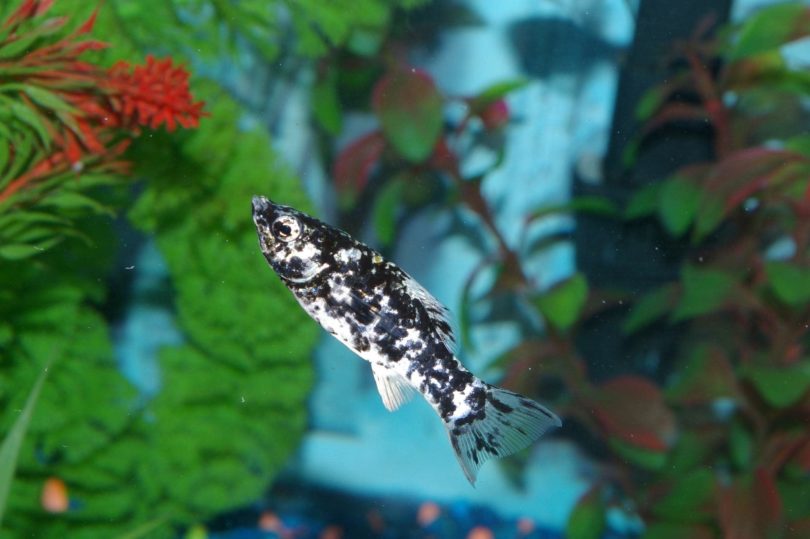

Livebearer Facts
The livebearers appeared late in the evolutionary process about 44-38 million years ago during the Oligocene and Miocene periods. They did not originate on all continents, only on the Americas and in Asia. Because they feed on mosquitoes and their larvae, some like the Guppies and Mosquito Fish, were introduced into swampy areas of Southeast Asia and the Philippines to help control malaria mosquitoes. From those locations they spread to just about all tropical and sub-tropical waters, even into southern Europe.
These fish have been in the aquarium hobby for a very long time. They were first introduced into Europe in the 1890’s and were quite expensive. But these live-bearing fish readily reproduced in the aquarium quickly and became very available, so prices soon dropped. Rarer species, however, have only been imported as recently as the 1960’s.
There are visual clues to identify them, just as there are with other types of fish. While a visual clue to identify a Characin is having an adipose fin, the small fin just behind the dorsal fin, a visual clue to a livebearer is the specialized anal fins of the male livebearer. As the male fish mature, the middle rays of the anal fin are modified into a narrow copulatory organ called a gonopodium or andropodium, depending on the family.
The shape of the gonopodium or andropodium differs among genera and even species. On Live-bearing Toothcarps (Poeciliidae) the gonopodium has a hook or claw on the end and on the Four-eyed Fish (Anablepidae) it is pipe-shaped, greatly elongated and fused into a tube. On the Splitfins or Mexican Topminnows (Goodeidae) and the LIve-bearing Halfbeaks (Goodeidae) only part of the fin is modified.
Livebearers have an advantage over the egg laying fish. The young can immediately hide from predators from the moment of birth. The young of these fish are born live and almost fully developed, but watch the parents as they will eat their fry. There is also an advantage to breeding them in the aquarium. Because they don’t lay eggs, the aquarist doesn’t have to be concerned with loosing the hatch due to the eggs succumbing to fungus.
Types of Livebearer Fish
Livebearers In the aquarium world consist primarily of four families:
- Live-bearing Toothcarp – Poeciliidae
The Guppy, Molly, Swordtail, and Platy are all members of the Poeciliidae family.
This family is commonly called the Live-bearing Toothcarps as they have teeth in both their upper and lower jaw, thus the name “Toothcarp” or “Toothed Carp”. They contrast with the Egg-laying Toothcarps, such as the Killifish, because these fish don’t have an external sex organ and they don’t give live birth.
This is the largest family of Livebearers with close to 200 species. They originated in the Americas, but were then introduced into Asia and the Philippines to control malaria mosquitoes. They are now found in all tropical and subtropical areas.
- Splitfins or Mexican Topminnow – Goodeidae
The Goodeidae family, named after the ichthyologist George Brown Goode, are known as Splitfins or Mexican Topminnows. The name “splitfin” comes from the males modified anal fin, where the anterior rays are partly separated from rest of the fin.
This family includes 40 species in about 18 genera. They are found on the Mexican plateau and the waters that descend from there into the Pacific ocean.
- Four-eyed Fish – Anablepidae
The Anablepidae family is often called the Four-eyed Fish.
This family includes 16 recognized species in 3 genera. The Anableps genus has the actual Four-eyed Fish with 3 species, the Jenynsia genus contains the Onesided Livebearers with 16 species, and the Oxyzygonectes genus contains a single member, the White-eye Oxyzygonectes dovii. The modified anal fin of the males is pipe shaped, with the gonopodium being greatly elongated and fused into a tube.The White-eye is a live-bearing species of Killifish, but unique in that it has no gonopodium.
These fish come from the coastal areas of Central and South America. They are most often found in brackish water though sometimes will also occur in freshwater.
- LIve-bearing Halfbeak – Hemiramphidae
The Hemiramphidae family is known as the LIve-bearing Halfbeaks. They sport a straight pike-type body shape and have a beak-type mouth. The name “halfbeak” comes from a distinctive jaws, where the lower jaw is significantly longer than the upper jaw. Only part of the anal fin is modified on these fish, and this copulatory organ is called an andropodium. It is very hard to detect unless you look very closely.
There are currently around 60 Halfbeak species contained in 8 genera. The Halfbeaks are closely related to three other families of streamlined fishes; Flyingfishes, Needlefishes, and Sauries. All four families were originally grouped together in the order Beloniformes, with the Halfbeaks and Flyingfishes put in the superfamily Exocoetoidea and the Needlefishes and Sauries put in the superfamily Scomberesocoidea. More recently, molecular evidence is bringing this traditional scientific grouping under scrutiny, so there may be some changes to their lineage in the future.
Halfbeaks are found all over Asia in both brackish and fresh waters, and some species are fully marine.
Livebearer Care
Many Livebearers are fresh or brackish water fish, though some are fully marine. They can thrive in a variety of water conditions with a lifespan of 5 to 7 years. They also like plants in the aquarium to simulate their natural home and provide them with places for retreat.
Most generally enjoy harder water and will benefit from some non-iodized salt being added to the aquarium water at 1 to 1.25 teaspoons per gallon. Indeed, the molly is often kept in saltwater aquariums!
Some of these fish are also cold water fish and so can be kept without heaters. These include the Platies, the Short-finned Mollies, and the Swordtails.
Livebearer Breeding
One of the greatest joys of keeping these fish is the ease of breeding. Seeing the birth of almost fully formed newborn babies is also a really thrilling experience. Because the young can immediately hide from predators from the moment of birth, they don’t need to be as prolific as egg layers. Egg-laying fish have the additional responsibility of caring for their eggs before they hatch, and often loosing some to predators or fungus.
The females of the Livebearing Toothcarps ( Guppies, Mollies, Swordtails, and Platys), Four-eyed Fishes, and Halfbeaks, have an amazing ability to store unused sperm in their bodies for several months. This process is called “superfetation.” The female is then able to have young several times after just one mating!
Livebearers will commonly produce only 20-40 young at a time, though a few may drop as many as 150. A female Mosquito Fish was noted to give birth 11 times from just one pairing. Only the Mexican Topminnows do not have this capability and so must re-spawn with a male each time.
For more information about livebearer breeding, see Breeding Freshwater Fish: Livebearers. Or see the breeding section in the care guide for each individual Live-bearing fish above.
Featured Image Credit: Piqsels