
The beautiful Ryukin Goldfish are a Japanese version of the Fantail Goldfish. They were developed from the common Fantail Goldfish. Like their Fantail counterpart, they are one of the more rounded or egg-shaped fancy goldfish.
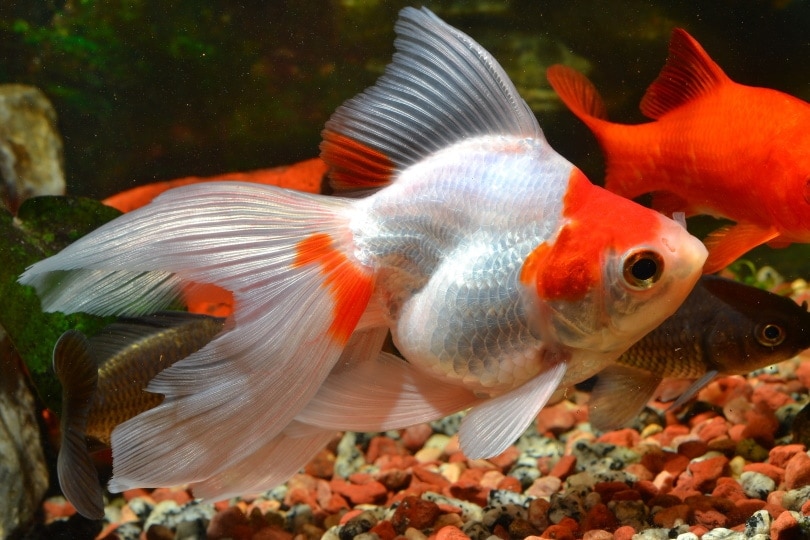
The Ryukin Goldfish are easily differentiated from the Fantail by their extremely high back, which is often described as a dorsal hump. The hump starts in the neck region and gives a more pointed appearance to the Ryukin’s head, They also have a wider caudal fin than the Fantail. A distinguishing feature common to both the Fantail and the Ryukin Goldfish is their split or double caudal (tail) fin.
Red and White Ryukin Goldfish
A long-tailed version of this fish is called the Fringe-tail or Ribbon-tail Ryukin. This fish comes in a variety of colors: red, red and white, tri-color, calico, white, and chocolate.
Both Fantail Goldfish and Ryukin Goldfish are recommended for the beginner, but like all the goldfish with this rounded body shape, they can be susceptible to swim bladder problems. Other good beginner fancy goldfish are Common Goldfish, Comet Goldfish, the Shubunkin, and the Black Moor.
These beginner goldfish can tolerate temperatures a few degrees above freezing as long as the cooling drops only a few degrees a day. Their hardiness and ability to live at colder temperatures make them ideal for outdoor ponds. The Black Moor is the only possible exception to this, not because it lacks hardiness but because of its telescopic eyes. These eyes cause it to have poor vision, so it is not a good competitor for food. The eyes are also subject to injury and infection.
- For more goldfish information, see: Goldfish Care: Fancy Goldfish and Goldfish Diseases
Scientific Classification
| Kingdom: | Animalia |
| Phylum: | Chordata |
| Class: | Actinopterygii |
| Order: | Cypriniformes |
| Family: | Cyprinidae |
| Genus: | Carassius |
| Species: | auratus auratus |
Ryukin Goldfish – Quick Aquarium Care
| Aquarist Experience Level: | Beginner |
| Aquarium Hardiness: | Very hardy |
| Minimum Tank Size: | 30 gal (114 L) |
| Size of fish – inches | 10.0 inches (25.40 cm) |
| Temperament: | Semi-aggressive |
| Temperature: | 65.0 to 72.0° F (18.3 to 22.2° C) |
Habitat: Distribution / Background
The goldfish of today are descendants of a species of wild carp known as the Prussian Carp, Silver Prussian carp, or Gibel Carp Carassius gibelio (syn: Carassius auratus gibelio), which was described by Bloch in 1782. These wild carp originated in Asia; Central Asia (Siberia). They inhabit the slow moving and stagnant waters of rivers, lakes, ponds, and ditches feeding on plants, detritus, small crustaceans, and insects.
For many years, it was believed that goldfish had originated from the Crucian Carp Carassius carassius described by Linnaeus in 1758. This fish has a wide range across the waters of the European continent, running west to east from England to Russia, north to Scandinavian countries in the Arctic Circle and as far south as the central France and the Black Sea. However, recent genetic research points to C. gibelio as a more likely ancestor.
Goldfish were originally developed in China. By the 1500s, goldfish were traded to Japan, arriving in Europe in the 1600s and America in the 1800s. The majority of the fancy goldfish were developed by Asian breeders. We can see the results of this centuries-long endeavor in the wonderful colors and shapes of goldfish today.
Today domesticated goldfish are distributed world-wide. The Ryukin Goldfish is one of more than 125 captive-bred fancy goldfish varieties.
- Scientific Name: Carassius auratus auratus
- Social Grouping: Groups – Can be kept singly or in groups.
- IUCN Red List: NE – Not Evaluated or not listed – There are no wild populations of this captive-bred variety.
Description
The Ryukin Goldfish is an egg-shaped variety of goldfish. The body is short and stubby. Their extremely high back, which is often described as a dorsal hump, starts in the neck region and gives the Ryukin’s head a pointed appearance.
The Ryukin is a Japanese version of the Fantail Goldfish. Both of these goldfish will generally reach about 6 inches (15 cm), though some hobbyists report their Ryukins reaching up to a whopping 10″ (25 cm). The average goldfish lifespan is 10 – 15 years, though living 20 years or more is not uncommon in well-maintained goldfish aquariums and ponds.
A distinguishing feature common to both the Ryukin Goldfish and the Fantail Goldfish is the split or double caudal (tail) fin. A long-tailed version of the Ryukin is called the Fringe-tail or Ribbon-tail Ryukin. The Ryukin Goldfish are available in red, red and white, tri-color, calico, white, and chocolate.
- Size of fish – inches: 10.0 inches (25.40 cm) – Average size is 6″ (15 cm), but they have been reported to reach 10″ (25 cm) in an exceedingly well-maintained tank or pond.
- Lifespan: 15 years – The average goldfish lifespan is 10 – 15 years, but they have been known to live 20 years or more when well maintained.
Fish Keeping Difficulty
Ryukin Goldfish are among the hardier species of goldfish.
They are very undemanding of water quality and temperature and recommended for the beginner. They can do well in goldfish aquariums or even ponds as long as the environment is safe and their tankmates are not competitive.
Many people will keep goldfish in an aquarium with no heater or filtration. But for the best success in keeping these goldfish, provide them the same filtration, especially biological filtration, that other aquarium residents enjoy.
- Aquarium Hardiness: Very Hardy
- Aquarist Experience Level: Beginner
Foods and Feeding
Since they are omnivorous, the Ryukin Goldfish will generally eat all kinds of fresh, frozen, and flake foods.
To care for your Ryukin goldfish, keep a good balance by giving them a high quality flake food everyday. Feed brine shrimp (either live or frozen), blood worms, Daphnia, or tubifex worms as a treat. It is usually better to feed freeze-dried foods as opposed to live foods to avoid parasites and bacterial infections that could be present in live foods.
- Diet Type: Omnivore
- Flake Food: Yes
- Tablet / Pellet: Yes
- Live foods (fishes, shrimps, worms): Some of Diet
- Vegetable Food: Some of Diet
- Meaty Food: Some of Diet
- Feeding Frequency: Several feedings per day
Aquarium Care
These goldfish are hardy and easy to keep in a well-maintained tank. Minimum tank size is 10 gallons, so make sure water changes are frequent in such a small tank. Regular weekly water changes of 1/4 to 1/3 are strongly recommended to keep these fish healthy. Snails can be added as they reduce the algae in the tank, helping to keep it clean.
- Water Changes: Weekly – Goldfish produce more waste than most other freshwater fish and benefit greatly from more frequent water changes.
Aquarium Setup
Setting up a goldfish aquarium in a manner that will keep your fish happy and healthy is the first step to success. The shape and size of the aquarium is important and depends upon the number of goldfish you are going to keep. These fish need a lot of oxygen and produce a lot of waste. Good filtration, especially biological filtration, is very helpful in maintaining the water quality of the aquarium. A filtration system will remove much of the detritus, excess foods, and waste, which keeps the tank clean and maintains the general health of the goldfish.
- Tank parameters to consider when choosing a goldfish aquarium:
- Tank size
Ten gallons is the absolute minimum required to house a Ryukin Goldfish. It’s best to start with a 20 – 30 gallon tank for your first goldfish and then increase the size of the tank by 10 gallons for each additional goldfish. Providing a large amount of water per fish will help dilute the amount of waste and reduce the number of water changes needed. - Tank Shape
Always provide the maximum amount of surface area. A large surface area minimizes the possibility that the goldfish will suffer from an oxygen shortage. Surface area is determined by the shape of the tank. For example an elongated tank offers more surface area (and oxygen) than a tall tank. Oval or round tanks that are wide in the middle and narrower toward the top might be filled less than full to maximize the surface area. - Number of fish
For juveniles a general rule of thumb is 1 inch of fish (2.54 cm) per 1 gallon of water. However, this rule only applies to young fish. Larger gold fish consume much more oxygen than young fish so maintaining this formula for growing fish will stunt them and could contribute to disease and even death. - Fish size and growth
To allow for proper growth, either buy fewer fish than the maximum number or be prepared to get a larger tank. To prevent stunted growth and other health problems, don’t overstock the aquarium.
- Tank size
Goldfish are a cold water fish and will do best at temperatures between 65 – 72° F (18°- 22° C). The Ryukin Goldfish are one of the hardiest varieties of goldfish and can tolerate temperatures a few degrees above freezing, as long as the cooling drops only a few degrees a day. A quick temperature drop can kill them, so if you live in a very cold climate a heater is advisable.
Provide a gravel substrate to help create a natural and comfortable environment for your fish. You can add some decor, but make sure that all ornamentation is smooth with no protruding points or sharp edges. Smooth rocks or driftwood, should be used sparingly if at all. Aquarium plants would be the best choice of aquarium decor for goldfish, but unfortunately these fish are diggers. Consequently live plants may be uprooted. Artificial plants make a good substitute and silk plants are safer than plastic ones.
Most aquariums come with a cover that includes lighting. A cover for the tank is desirable as it reduces evaporation and though they are not prone to jumping, on occasion some gold fish will jump out. Lighting is not essential for goldfish, but does make the aquarium a nice showpiecem and lighting will help if you have live plants.
Goldfish are freshwater fish, but they have some tolerance for slightly brackish water. The salinity level for C. auratus must be kept low, below 10% with a specific gravity of less than 1.002.
- Minimum Tank Size: 30 gal (114 L) – Ten gallons is the absolute minimum required to house this fish. It has high oxygen requirements, and produces a lot of waste. It will have very stunted growth if it is kept in a smaller aquarium.
- Suitable for Nano Tank: Sometimes
- Substrate Type: Any – A medium-sized gravel works best.
- Lighting Needs: Moderate – normal lighting
- Temperature: 65.0 to 72.0° F (18.3 to 22.2° C)
- Breeding Temperature: – In the wild, goldfish spawn in the spring when water temperatures reach about 68° F (20° C).
- Range ph: 6.0-8.0
- Hardness Range: 5 – 19 dGH
- Brackish: Sometimes – The salinity for C. auratus must be kept below 10%, a specific gravity of less than 1.002.
- Water Movement: Moderate
- Water Region: All – These fish will swim in all areas of the aquarium.
Social Behaviors
Goldfish are very social animals and thrive in a community. Not only are they a great community fish, but they are great scavengers as well. It is really not necessary to add other scavengers or other bottom feeders to the aquarium when you have goldfish.
The Ryukin Goldfish, along with the Fantails, are some of the only egg-shaped goldfish that can readily compete for food with elongated goldfish, such as the Common or Shubunkin Goldfish. LIke most fancy goldfish, they will thrive in both freshwater and tropical aquariums as long as there are no aggressive or territorial fish in the tank. Other good tankmates for the Ryukin are the Chinese Blue Bitterling and the Northern Redbelly Dace.
- Venomous: No
- Temperament: Semi-aggressive – This fish tends to be more aggressive than other Fancy Goldfish.
- Compatible with:
- Same species – conspecifics: Yes
- Peaceful fish (): Monitor
- Semi-Aggressive (): Threat
- Shrimps, Crabs, Snails: Safe – not aggressive
- Plants: Threat – Goldfish will eat many kinds of aquatic plants. In their constant search for food, they can end up uprooting plants that they don’t eat.

Sexual differences
During the breeding season, the male has white prickles, called breeding tubercles, on its gill covers and head. Seen from above, a female will have a fatter appearance when she is carrying eggs. It is impossible to sex Goldfish when they are young and not in breeding season, but generally the male is smaller and more slender than the female.
Breeding / Reproduction
Ryukin Goldfish are egg layers that spawn readily in the right conditions. They can be bred in groups as small as five individuals, but they are very social animals and likely to breed in larger groups as well. The only time Goldfish will spawn in the wild is when spring arrives. To spawn them in the aquarium, you will need to mimic the conditions found in nature.
Provide an aquarium that is at least 20 gallons and make sure the fish are healthy and disease free. Some breeders suggest you treat them for parasites. Many breeders will also separate the males and females for a few weeks prior to breeding to help increase their interest in spawning. Introduce the fish into the breeding tank at the same time. The tank will need a lush environment with solid surfaces for the spawning process and for the eggs to adhere to. Bushy, oxygenating plants, such as Anacharis, work well for this, though artificial plants or fibrous spawning mops can also be used.
To induce spawning, the temperature can be slowly dropped to around 60° F (11° C) and then slowly warmed at a rate of 3° F (2° C) per day until they spawn. Spawning generally begins when the temperatures are between 68° and 74° F (20°-23° C). Feeding lots of high protein food such live brine shrimp and worms during this time will also induce spawning. Feed small amounts three times a day, but don’t overfeed. Uneaten scraps will sink to the bottom and foul the water. Maintain the breeding tank with partial water changes of up to about 20% per day.
Before spawning, as the temperature increases, the male will chase the female around the aquarium in a non-aggressive way. This can go on for several days, and the fish will intensify in color. During the spawn, the fish will gyrate from side to side, and the male will push the female against the plants. This stimulates the female to drop tiny eggs which the male will then fertilize. The eggs will adhere by sticky threads to the plants or spawn mop. Spawning can last two or three hours and can produce up to 10,000 eggs.
At this point the parents will start to eat as many eggs as they can find. For this reason, it is best to remove the parents after spawning is complete. The fertilized eggs will hatch in 4 to 7 days, depending on the temperature. You can feed the newly hatched goldfish specialty fry foods until they become big enough to eat flake or brine shrimp, or you can offer the same food as you feed the parents as long as it is crushed very small. At first, the fry are a dark brown or black color in order to better hide and not be eaten by larger fish. They gain their adult color after several months and can be put in with larger fish once they reach about 1 inch long. See Breeding Freshwater Fish – Goldfish for more information on breeding Goldfish.
- Ease of Breeding: Moderate
Fish Diseases
In properly maintained goldfish aquariums or ponds, goldfish illness is largely preventable. Even so, goldfish illnesses can occur, and if left untreated, may prove fatal. Goldfish are hardy, though, and if treated in a timely manner, most will make a full recovery.
When treating individuals, it is usually best to move the afflicted fish into a separate tank with no gravel or plants and do regular partial water changes. However, if the disease is apparent throughout the main tank, it may be best to do the treatments there. Whether treating in a hospital tank or your main tank, read and follow the manufacturer’s instructions for any medication. Some medications can adversely affect the water quality by destroying beneficial bacteria. You may also need to remove the carbon from the filtration system, as carbon will absorb many medications, making the treatment ineffective.
Goldfish diseases are mostly the same as those that afflict other freshwater fish, and the symptoms and treatment of goldfish are also similar. The main types of fish diseases include bacterial infections, fungal infections, parasites, and protozoa. There are also other ailments caused by injury, poor nutrition, or bad water conditions.
One of the more common problems is Ich, which is a protozoan disease. Ich is easy to identify because your fish looks like it is sprinkled with salt. Though Ich is easily treated, like other protozoan diseases, it can be fatal if not caught quickly. Some other protozoan diseases are Costia, which causes a cloudiness of the skin, and Chilodonella, which will cause a blue-white cloudiness on the skin.
External parasites are fairly common, too, but pretty easy to treat and usually not fatal when treated. These include flukes, which are flatworms about 1 mm long with hooks around their mouths. They infest the gills or body of the fish. Another type of parasite is fish lice (Argulus), flattened, mite-like crustaceans about 5 mm long that attach themselves to the body of the goldfish. Lastly, anchor worms look like threads coming out of the fish.
Some bacterial infections include Dropsy, an infection in the kidneys that can be fatal if not treated quickly. Fish Tuberculosis is indicated by the fish becoming emaciated (having a hollow belly). For this illness, there is no absolute treatment, and it can be fatal. Tail/Fin Rot may also be bacterial, though the reduced tail or fins can be caused by a number of factors as well. There is also fungus, a fungal infection, and Black Spot or Black Ich, which is a parasitic infection.
SSwim Bladder Disease is an ailment indicated by fish swimming in abnormal patterns and having difficulty maintaining their balance. This can be caused by a number of things: constipation, poor nutrition, a physical deformity, or a parasitic infection. Feeding frozen peas (defrosted) has been noted to help alleviate the symptoms and correct the problem in some cases.
Other miscellaneous ailments include Cloudy Eye, which can be caused by a variety of things ranging from poor nutrition, bad water quality, and rough handling. It can also be the result of other illnesses, such as bacterial infections. Constipation is indicated by a loss of appetite and swelling of the body, and the cause is almost always diet. Then there are wounds and ulcers. Wounds can become infected, creating ulcers. Wounds can develop either bacterial or fungal infections, or both, and must be treated. There are treatments for each of these diseases individually and treatments that handle both. For more in-depth information about goldfish diseases and illnesses, see Goldfish Care; Fancy Goldfish and Goldfish Diseases.
Availability
The Ryukin Goldfish are readily available in fish stores and online, but cost more than other fancy goldfish. They come in red, red and white, calico, tri-color, white, and chocolate. The red and white variety is the least expensive. The long-tail variety is more rare.
Featured Image Credit: Sergey Lavrentev, Shutterstock