WFCy_C2528.jpg)
The lively Rosy Barb is truly “color in motion” with its metallic rosy cast and continuous swimming!
The Rosy Barb Puntius conchonius (previously Barbus conchonius) is one of the most beautiful freshwater fish. This barb has a silvery or coppery-pink color with a green cast along the back, and the males will have more pink on their underbellies. These fish are hardy, undemanding, and fun to watch because they are constantly on the move. These qualities make them one of the most desirable starter fish.
Though always attractive, the coloration of this fish is most impressive during spawning. The male’s silvery color intensifies to a deep, rosy or purplish red, and the fins get pink and black. Rosy Barbs are also sometimes called Red Barbs, and several ornamental varieties have also been developed. Some of these include the Neon Rosy Barb, Long Fin Rosy Barb, Red Glass Rosy Barb, and Gold Neon Rosy Barb.
These barbs are a delightful choice for a beginning fish keeper, but they make a dynamic display in any tank. They are peaceful and will do well in a community aquarium, with only an occasional nip on a tankmate’s fins. They prefer cooler water than many tropical fish, needing temperatures between 64-72° F (18-22° C), so be sure to select tankmates that will also thrive in a cooler tank.
Depending on the region they are from, these fish vary some in appearance and size. They are one of the larger barb species and need at least a 20-gallon tank. In the wild, they can reach up to 6 inches (15 cm), but in the aquarium, they typically only reach about 4 inches (10 cm). These very active fish are also great jumpers, so keep the aquarium covered.
When kept in a school, the males display an interesting behavior. They will continually swim around each other with their fins spread out, showing off their best colors. These fish are very prolific breeders, but they need a breeding tank with shallow water. They will happily spawn in water that is just a couple of inches deep.
For Information on keeping freshwater fish, see:
Freshwater Aquarium Guide: Aquarium Setup and Care
- Kingdom: Animalia
- Phylum: Chordata
- Class: Actinopterygii
- Order: Cypriniformes
- Family: Cyprinidae
- Genus: Puntius
- Species: conchonius
- Aquarist Experience Level: Beginner
- Size of fish – inches: 5.9 inches (15.01 cm)
- Minimum Tank Size: 20 gal (76 L)
- Temperament: Peaceful
- Aquarium Hardiness: Very Hardy
- Temperature: 64.0 to 73.0° F (17.8 to 22.8° C)
- My Aquarium – Enter your aquarium to see if this fish is compatible!
- Beginner Fish – Freshwater fish for beginners
- Community Fish – Peaceful Freshwater fish
- Hardy Fish – Hardy Freshwater fish
- Similar size fish – Fish that are 1 inch bigger or smaller
- Coldwater Fish – Looking for cold water fish? (65 °)
Habitat: Distribution / Background
The Rosy Barb Puntius conchonius (previously Barbus conchonius) was described by Hamilton in 1822. They are found in northern India, Bangal, and Assam. Feral populations are also found in Singapore, Australia, Mexico, Puerto Rico, and Colombia. This species is listed on the IUCN Red List as Least Concern (LC). They are widespread and common in their range with no major identified threats. The Rosy Barb is also known as the Red Barb.
Depending on the region they are from, these fish vary in appearance and size. The fish from West Bengal are more intensely colored with reflective scales. These barbs occur in a variety of habitats, from flowing hill streams and tributaries to very still waters like lakes, ponds, and swamps. They are omnivorous and feed on insects, diatoms, algae, small invertebrates, and detritus.
- Scientific Name: Puntius conchonius
- Social Grouping: Groups
- IUCN Red List: LC – Least Concern
Description
The Rosy Barb has a torpedo-shaped body and a forked tail. It has only one dorsal fin. Lacking an adipose fin, a second dorsal fin to the rear of the first, is a characteristic of all the Cyprinid fishes. This good-sized fish reaches lengths of up to 6 inches (15 cm) in the wild, though they generally only reach about 4 inches (10 cm) in the aquarium. They are mature at 2.5 inches (6 cm) and have an average lifespan of about 5 years.
The general coloration is silvery or coppery-pink with a greenish cast along the back. Males are a more reddish color, especially on the underbelly and sides. There is a black spot just in front of the caudal peduncle, and there may be some black along the top margins of the anal and dorsal fins. These fish will vary some in appearance and size, depending on the region they are from. The fish from West Bengal are more intensely colored with reflective scales.
- Size of fish – inches: 5.9 inches (15.01 cm) – In the wild, these fish can reach up to 6 inches (15 cm), but in captivity, they generally only reach about 4 inches (10 cm).
- Lifespan: 5 years
Fish Keeping Difficulty
The Rosy Barb is a great addition to most tanks and a great choice for beginning aquarists. They handle changes in water conditions very well and are usually great eaters.They do need a cooler aquarium, so take care when picking their tankmates. These barbs will nip the fins of slow-swimming and long-finned fish, so they need active companions.
- Aquarium Hardiness: Very Hardy
- Aquarist Experience Level: Beginner
Foods and Feeding
Since they are omnivorous, the Rosy Barb will generally eat all kinds of live, fresh, and flake foods. To keep a good balance, give them a high quality flake food every day. Feed brine shrimp (either live or frozen) or blood worms as a treat. Supplement with color foods for best results in appearance. When offering food just once a day, provide what they can eat in about 5 minutes. When offering food several times a day, offer only what they can consume in 3 minutes or less at each feeding.
- Diet Type: Omnivore
- Flake Food: Yes
- Tablet / Pellet: Yes
- Live foods (fishes, shrimps, worms): Some of Diet
- Vegetable Food: Some of Diet
- Meaty Food: Some of Diet
- Feeding Frequency: Several feedings per day – Offer only what they can consume in 3 minutes or less with multiple feedings per day.
Aquarium Care
Rosy Barbs are easy to care for provided their water is kept clean and at the proper temperature. Aquariums are closed systems, and regardless of size, all need some maintenance. Over time, decomposing organic matter, nitrates, and phosphate build up and water hardness increases due to evaporation. Replace 25 to 50% of the tank water at least once a month. If the tank is densely stocked, 20 to 25% should be replaced weekly or every other week.
- Water Changes: Monthly – If the tank is densely stocked, water changes should be done every other week.
Aquarium Setup
The Rosy Barb are good-sized fish that will swim in all parts of the tank. They can reach up to 4 inches in length. A school will need at least a 20-gallon aquarium, but as they are very active swimmers, a tank that is 30 inches long and 30 gallons or more is ideal. They prefer cooler water, between 64 and 72° F (18-22° C). Additionally, the tank should be securely covered as these fish are skilled jumpers and will probably do so if given the opportunity.
As with most barb species, an aquarium best suited to them will provide plenty of swimming room, a soft bottom, and plants around the edges. They will do best and are most effectively displayed in tanks that simulate their natural habitat. A sandy substrate, dense vegetation, and drift wood will echo their natural environment. Try to plan for one or two hours of sunlight hitting the tank as the illumination will make the fish even more stunning. An efficient filter and good water movement are needed for the male fishes to develop their best coloration.
- Minimum Tank Size: 20 gal (76 L)
- Suitable for Nano Tank: Yes
- Substrate Type: Any
- Lighting Needs: Moderate – normal lighting
- Temperature: 64.0 to 73.0° F (17.8 to 22.8° C)
- Breeding Temperature: – Breeding temperatures between 73 and 77° F (22 – 25° C).
- Range ph: 6.5-7.0
- Hardness Range: 2 – 10 dGH
- Brackish: No
- Water Movement: Moderate
- Water Region: All
Social Behaviors
These fish are lively and fun to watch. They are peaceful and a very good community fish, and they will only occasionally nip a tankmate’s fins. These schooling fish will do well when kept in a group of 4 to 6 of their own kind. Make sure to select lively tankmates that also like cooler water.
- Temperament: Peaceful – This fish is fairly peaceful, though some may be a bit more dominant than others, and they are known to nip fins occasionally.
- Compatible with:
- Same species – conspecifics: Yes – They do well when kept in groups of 4 to 6.
- Peaceful fish (): Safe
- Semi-Aggressive (): Monitor
- Aggressive (): Threat
- Large Semi-Aggressive (): Threat
- Large Aggressive, Predatory (): Threat
- Monitor – These aggressive feeders can make it difficult for slower or more timid fish to eat.
- Shrimps, Crabs, Snails: Safe – not aggressive
- Plants: Safe
Sex: Sexual differences
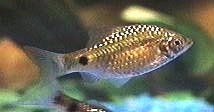 Rosy Barb – female Rosy Barb – female |
These fish are difficult to sex when they are young. As they get older, the male becomes redder and more slender. The female remains smaller in general.
Breeding / Reproduction
The Rosy Barb is moderately easy to breed and become sexually mature when they have attained a size of 2.5 inches (6 cm). Select breeding pairs from the school that have excellent markings and strong color. These egg layers scatter their eggs rather than using a specific breeding site. The eggs are adhesive and will fall to the substrate.
These fish can spawn in a 5 to 10-gallon breeding tank with shallow water that is just a few inches deep and a temperature between 73 and 77° F (22 and 25° C). Use a coarse gravel on the bottom or a divider that allows the eggs to pass through to protect them. Put one male and two females in the breeding tank. The spawn is preceded with mock matings and courting, and then several hundred eggs will be laid. After the spawn, remove the parents as they will eat the eggs if they can reach them.
The eggs will hatch in about 30 hours. Free-swimming fry should be fed infusoria, a liquid fry food, or newly hatched baby brine at least 3 times a day. Pay close attention when feeding as uneaten foods can quickly foul the water, and the fry require clean water to survive. See the description of breeding techniques in Breeding Freshwater Fish: Barbs. Also, see Fish Food for Fry for information about types of foods for raising the young.
- Ease of Breeding: Easy
Fish Diseases
Rosy Barbs are extremely hardy, so disease is not usually a problem in a well-maintained aquarium. They are primarily susceptible to Ich if good water quality is not provided. Anything you add to your tank can also bring disease. Not only other fish but plants, substrate, and decorations can harbor bacteria. Take great care and make sure to properly clean or quarantine anything that you add to an established tank so as not to upset the balance.
A good thing about these barbs is that due to their resilience, an outbreak of disease can often be limited to just one or a few fishes if dealt with at an early stage. The best way to proactively prevent disease is to give your Barb the proper environment and a well-balanced diet. The more closely their environment resembles their natural habitat, the less stress the fish will have, making them healthier and happier. A stressed fish is more likely to acquire disease.
These fish are very resilient, but aquarists should read up on common tank diseases. Knowing the signs and catching and treating them early makes a huge difference. For information about freshwater fish diseases and illnesses, see Aquarium Fish Diseases and Treatments.
Availability
The Rosy Barb is reasonably affordable and readily available in pet stores and online. Females are generally less expensive than males.
References
- Animal-World References: Freshwater Fish and Plants
- Dr. Rudiger Riehl and Hans A. Baensch, Aquarium Atlas Vol. 1, Publisher Hans A. Baensch, 1991
- Joseph S. Nelson, Fishes of the World, Wiley, 2006.
- Glen S. Axelrod, Brian M. Scott, Neal Pronek, Encyclopedia Of Exotic Tropical Fishes For Freshwater Aquariums, TFH Publications, 2005
- David Alderton, Encyclopedia of Aquarium and Pond Fish , DK Publishing, Inc., 2005.
- Dick Mills, Aquarium Fish (101 Essential Tips), DK (Dorian Kinglsey) Adult, 2004.
- Dr. Herbert R. Axelrod, Aquarium Fishes of the World, TFH Publications, 1998
- Puntius conchonius (Hamilton, 1822) Rosy barb, Fishbase.org
- Puntius conchonius, The IUCN Red List of Threatened Species