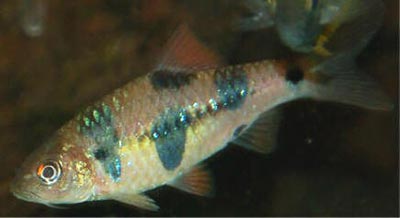
As its name suggests, the Clown Barb looks rather clownish with its big polka dots and reddish gold body!
The handsome Clown Barb Puntius everetti (previously Barbus everetti) is definitely one of the most interesting looking barbs. Its body has a reddish gold sheen, colorful red fins, and spotted “bands” that add a clownish polka dot effect. It reaches up to about 4 inches (10 cm) in the aquarium, though it can get much bigger in the wild where it grows to about 6 inches (15 cm). Another common name it is known by is the Everett’s Barb.
A nice group of these colorful barbs will make for a very interesting and attractive aquarium. This lively, hardy fish will do well when kept in groups of 6 or more. When kept with its own kind, it will tend to school. Because of its size, the recommended tank size is at least 25 gallons. However, because of its very active nature, a tank that is at least 30 inches long and 30 gallons or more would be ideal.
This fish is best kept by fish keepers with some experience and maybe in a species tank. Although this very durable fish is moderately easy to keep, it does need the proper tank conditions and the right tankmates.
These Cyprinids will usually do well in a community aquarium, but they can be fin nippers and may terrorize other fish with their liveliness. Some aquarists have reported that they may actually eat other fish, especially fish that are smaller. This barb also prefers warmer water than many freshwater fish, needing temperatures between 79 and 82° F (26-28° C). Tankmates must be of a similar size and temperament and also be able to thrive at higher temperatures.
The Clown barb likes a well planted aquarium. This fish will nibble on plants, though, so be sure to use hardy varieties and only include those that can thrive in warmer water. Place them around the inside perimeter, along of the sides and back of the tank, leaving plenty of open space for swimming in the middle. Rocks and wood for hiding places make a good central decor.
For Information on keeping freshwater fish, see:
Freshwater Aquarium Guide: Aquarium Setup and Care
- Kingdom: Animalia
- Phylum: Chordata
- Class: Actinopterygii
- Order: Cypriniformes
- Family: Cyprinidae
- Genus: Puntius
- Species: everetti
- Aquarist Experience Level: Intermediate
- Size of fish – inches: 5.9 inches (15.01 cm)
- Minimum Tank Size: 25 gal (95 L)
- Temperament: Semi-aggressive
- Aquarium Hardiness: Moderately hardy
- Temperature: 79.0 to 82.0° F (26.1 to 27.8° C)
- My Aquarium – Enter your aquarium to see if this fish is compatible!
- Beginner Fish – Freshwater fish for beginners
- Community Fish – Peaceful Freshwater fish
- Hardy Fish – Hardy Freshwater fish
- Similar size fish – Fish that are 1 inch bigger or smaller
- Coldwater Fish – Looking for cold water fish? (65 °)
Habitat: Distribution / Background
The Clown Barb Puntius everetti (previously Barbus everetti) was described by Boulenger in 1894. They are found in Southeast Asia, Singapore, Borneo, and the Bungarian Islands. They are not endangered, and this species is not listed on the IUCN Red List. Other common names they are known by are Everett’s Barb and Barbus Everetti, which was its previous scientific name.
They inhabit quiet forest streams, tributaries, and forest pools in the foothills. These waters are normally clear with variable currents. These fish show a preference for shallow areas of the water, around 6 inches deep. They are foraging omnivores and feed on worms, insect, crustaceans, plants, and other organic debris.
- Scientific Name: Puntius everetti
- Social Grouping: Groups
- IUCN Red List: NE – Not Evaluated or not listed
Description
The Clown Barb has a torpedo-shaped body, a forked tail, and only one dorsal fin. Lacking an adipose fin, a second dorsal fin to the rear of the first, is a characteristic of all the Cyprinid fishes. This good-sized fish reaches a length of up to 6 inches (15 cm) in the wild, though they generally only reach about 4 inches (10 cm) in the aquarium. They have a lifespan of 4 to 8 years with proper care.
This fish sports a body color pattern that is true to its name. The Clown Barb is an orangish brown on its upper body and orangish red on its sides with a yellow to whitish belly. Overall, this combination gives it a reddish gold sheen. Several (usually about four) dark, spotted band-type markings adorn its sides. It has red fins and sometimes a touch of red in the iris of the eye. All of these elements give this fish a rather ‘clownish’ appearance.
- Size of fish – inches: 5.9 inches (15.01 cm) – In the wild, these fish can reach up to 6 inches (15 cm), but in captivity, they generally only get about 4 inches (10 cm).
- Lifespan: 8 years – They have an average lifespan of between 4 and 8 years.
Fish Keeping Difficulty
Clown Barbs are hardy, durable fish, but they are suggested for an aquarium keeper with some experience. They require an aquarium that is at least 25 gallons or more and warmer water than most tropical fish. Although they are considered to be a good community fish, they can get nippy and may even snack on smaller species.
- Aquarium Hardiness: Moderately hardy
- Aquarist Experience Level: Intermediate
Foods and Feeding
Since they are omnivorous, the Clown Barb will generally eat all kinds of live, fresh, and flake foods. To keep a good balance, give them a high quality flake food every day. Feed brine shrimp (either live or frozen) or blood worms as a treat. This fish will eat as much as you feed them, so the aquarist should determine a reasonable amount of food. The rule of thumb when offering food several times a day is to offer only what they can consume in 3 minutes or less at each feeding. When offering food just once a day, provide what they can eat in about 5 minutes.
- Diet Type: Omnivore
- Flake Food: Yes
- Tablet / Pellet: Yes
- Live foods (fishes, shrimps, worms): Some of Diet
- Vegetable Food: Some of Diet
- Meaty Food: Some of Diet
- Feeding Frequency: Several feedings per day – Offer only what they can consume in 3 minutes or less with multiple feedings per day.
Aquarium Care
Clown Barbs are not exceptionally difficult to care for provided their water is kept clean and at the proper temperature. Aquariums are closed systems, and regardless of size, all need some maintenance. Over time, decomposing organic matter, nitrates, and phosphate build up and water hardness increases due to evaporation. Replace 25 to 50% of the tank water at least once a month. If the tank is densely stocked, 20 to 25% should be replaced weekly or every other week.
- Water Changes: Monthly – If the tank is densely stocked, water changes should be done every other week.
Aquarium Setup
The Clown Barb will swim in all parts of the tank but prefers open areas in the middle. They can reach up to 4 inches in length, so a school will need at least a 25-gallon aquarium. However, because they are very active swimmers, it is better to have a tank that is 30 inches long and 30 gallons or more. Provide good filtration and do regular water changes. Additionally, the tank should be covered as they may jump.
These fish will do best and are most effectively displayed in tanks that simulate their natural habitat. Provide a sandy substrate, some rocks and wood for hiding places, and some plants. They will nibble on plants, so use hardy varieties. Placing the plants around the inside perimeter of the tank, along the sides and back, will leave lots of open swimming space. An efficient filter and good water movement are needed for the male fishes to develop their coloration.
- Minimum Tank Size: 25 gal (95 L)
- Suitable for Nano Tank: Yes – A Nano tank needs to be 25 gallons or more.
- Substrate Type: Any
- Lighting Needs: Moderate – normal lighting
- Temperature: 79.0 to 82.0° F (26.1 to 27.8° C)
- Breeding Temperature: – Temperature between 79 and 82° F (26 – 28° C).
- Range ph: 6.5-7.0
- Hardness Range: 8 – 12 dGH
- Brackish: No
- Water Movement: Moderate
- Water Region: All – These fish will swim in all areas of the aquarium, but they prefer the middle.
Social Behaviors
These fish are commonly listed as a lively, peaceful species that make an excellent community fish. Although this is mostly true, they can be fin nippers and may terrorize other fish because of their liveliness. However, some individual fish are worse than others, so they should be watched as closely as possible. Some aquarists claim that they may eat other fish, especially fish that are smaller or even similar in size.
These barbs should be kept in a school of at least 6 or more fish with a good mix of males and females. This will make the Clown Barb less skittish and will help keep aggression within the school. Other tankmates need to be of a similar size and temperament and be able to thrive at the higher temperatures required by this species.
The personality of this fish is not neutral enough to fit the casual description of a community fish. It is usually not too aggressive, particularly when kept in a group of its own kind, but it is a skilled hunter and may eat fish of a smaller, and even similar, size.
- Temperament: Semi-aggressive – The personality of this fish is not neutral enough to fit the casual description of a community fish. It is usually not too aggressive, particularly if kept in a group of its own kind, but it is a skilled hunter and may eat fish of a smaller or similar size.
- Compatible with:
- Same species – conspecifics: Yes – It is best kept in groups of 6 or 7, with a mix of males and females.
- Peaceful fish (): Monitor – Clown Barbs are fin nippers and may even eat smaller or similar-sized fish.
- Semi-Aggressive (): Monitor
- Aggressive (): Threat
- Large Semi-Aggressive (): Threat
- Large Aggressive, Predatory (): Threat
- Monitor – This fish may nip fins, especially if not kept in a large group of its own kind.
- Shrimps, Crabs, Snails: Safe – not aggressive
- Plants: Monitor – The Clown Barb will nibble at plants. Make sure to pick very hardy plants.
Sex: Sexual differences
The female is heavier, especially during the spawning season. The males are more brightly colored and slender.
Breeding / Reproduction
Clown barbs do not spawn easily in captivity, and successes have only been had in very large aquariums. The age of the fish will have an impact on a successful spawning. Most problems arise from mismatched pairings: Either the male is too young to breed, or the male is ready to breed, but the female is unable to produce. Males do not mature until it 1 1/2 years of age, while females mature at 1 year.
To attempt to breed them, use a large aquarium with shallow water at about 4 to 6 inches deep. The tank must be dimly lit and have clumps of Java moss or spawning mops. The water should have a hardness between 6 and 12° dGH, be slightly acidic with a pH of about 7, and have a temperature between 79 and 82° F (26 – 28° C).
 These fish are egg layers that scatter their eggs. The eggs are adhesive and will fall to the substrate. The sexes need to be separated for two to three weeks prior to breeding and conditioned with a variety of live foods like brine shrimp. Once eggs are laid, they will hatch in 20 to 30 days. The free-swimming fry can be fed infusoria, a liquid fry food, or newly hatched baby brine. For a general description of breeding Cyprinids, see Breeding Freshwater Fish: Barbs. Also see Fish Food for Fry for information about types of foods for raising the young.
- Ease of Breeding: Difficult – Spawning is not easy to induce.
Fish Diseases
Clown barbs are hardy, so disease is not usually a problem in a well-maintained aquarium. They are susceptible to Ich if good water quality is not provided. Remember that anything you add to your tank can introduce disease. Not only other fish but plants, substrate, and decorations can harbor bacteria. Take great care and make sure to properly clean or quarantine anything that you add to an established tank so as not to upset the balance.
A good thing about these barbs is that due to their resilience, an outbreak of disease can often be limited to just one or a few fishes if dealt with at an early stage. The best way to proactively prevent disease is to give your Clown Barb the proper environment and a well-balanced diet. The more closely their environment resembles their natural habitat, the less stress the fish will have, making them healthier and happier. A stressed fish will is more likely to acquire disease.
These fish are very resilient, but aquarists should read up on common tank diseases. Knowing the signs and catching and treating them early makes a huge difference. For information about freshwater fish diseases and illnesses, see Aquarium Fish Diseases and Treatments.
Availability
The Clown Barb is readily available, basically anywhere, both in stores and online, and is reasonably priced.
References
- Animal-World References: Freshwater Fish and Plants
- Dr. Rudiger Riehl and Hans A. Baensch, Aquarium Atlas Vol. 1, Publisher Hans A. Baensch, 1991
- Joseph S. Nelson, Fishes of the World, Wiley, 2006.
- David Alderton, Encyclopedia of Aquarium and Pond Fish , DK Publishing, Inc., 2005.
- Dr. Herbert R. Axelrod, Aquarium Fishes of the World, TFH Publications, 1998
- Puntius everetti (Boulenger, 1894) Clown barb, Fishbase.org