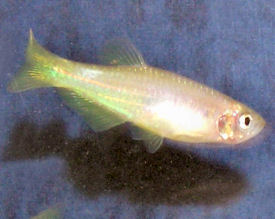
The Hikari Danio is quite a novelty in the hobby as this danio species can be either blue or yellow!
The Hikari Danio is truly a sensation, though it has risen out of obscurity only in the past few years after being introduced in 2002/2003. This newer species of danio was discovered in Burma (Myanmar) and is still awaiting its scientific name. It appears very similar to the Blue Danio Danio kerri and was first thought to be a subspecies. However, recent DNA testing in the United States has shown them to be genetically distinct, so this species is currently known simply as Danio sp. “hikari.”
Perhaps the crowning achievement of the Hikari Danio is that it is one of few freshwater fish whose sexes have distinctly different colors. In fact, the colors are so different that the sexes are often erroneously referred to as separate species. Though they are sometimes referred to as the Hikari Yellow Danio and the Hikari Blue Danio, these two fish are actually the same species.
The Hikari Yellow Danio is the male of this species and has a yellow tinge to the fins and body. The Hikari Blue Danio is the female and will be noticeably bluer in color. These small fish grow to just about 2 inches (5 cm) in an aquarium. These danios are not overly flashy but can be just as impressive as the next fish. They make a fun and lively display with the added benefit of having the mix of colors.
Like all danios, they are robust, fairly easy to keep, and prolific breeders. They can adapt to a reasonable range of water temperatures and conditions. These qualities make them an excellent choice for both beginning and more experienced aquarists. These schooling fish should be kept in groups of 6 or more. A school of these small, lively fish is well suited to a smaller aquarium but will do best in about a 20-gallon size.
These cyprinids are a generally pleasant community fish. They can be housed with most similarly sized community fish that have similar behaviors. They will do well with other lively tankmates. Just make sure that the danio will not be eaten and that the other fish aren’t startled by swift movement. They can also jump with surprising gusto, so keep a tight covering on your aquarium.
For Information on keeping freshwater fish, see:
Freshwater Aquarium Guide: Aquarium Setup and Care
- Aquarist Experience Level: Beginner
- Size of fish – inches: 2.0 inches (5.00 cm)
- Minimum Tank Size: 15 gal (57 L)
- Temperament: Peaceful
- Aquarium Hardiness: Very Hardy
- Temperature: 68.0 to 80.0° F (20.0 to 26.7° C)
- My Aquarium – Enter your aquarium to see if this fish is compatible!
- Beginner Fish – Freshwater fish for beginners
- Community Fish – Peaceful Freshwater fish
- Hardy Fish – Hardy Freshwater fish
- Similar size fish – Fish that are 1 inch bigger or smaller
- Coldwater Fish – Looking for cold water fish? (65 °)
Habitat: Distribution / Background
The Hikari Danio Danio sp. “hikari” is native to Burma (Myanmar), Asia. These cyprinids are a fairly recent discovery and were introduced into the hobby in 2002/2003. They were first collected from the Tanintharyi River drainage, which is a tributary of the Tenasserim River system in southern Myanmar.
This fish doesn’t have a scientific name at this time. It is currently known simply as Danio sp. “hikari.” It was initially thought to be a subspecies of the Blue Danio Danio kerri. However, recent DNA testing in the United States has shown them to be genetically distinct. It is not yet evaluated or listed on the IUCN Red List of Endangered Species.
Not a lot is known about this fish, but in nature, they are thought to inhabit the marginal zones of streams and small rivers where the water is quiet and slow. Their main diet in the wild probably consists of small insects, worms, and crustaceans.
- Scientific Name: Danio sp. hikari
- Social Grouping: Groups
- IUCN Red List: NE – Not Evaluated or not listed
Description
The attractive Hikari Danio has a rather compact body and a barbel at the end of each lip. These small fish reach lengths of about 2 inches (5 cm) in an aquarium. A typical lifespan is about 3 to 5 years with proper care, and possibly longer.
These are one of the few freshwater fish whose sexes have distinctly different colors. This leads to the sexes often being erroneously referred to as separate species. The Hikari Yellow Danio, the male of this species, has a yellowish green tinge to the body and fins. The Hikari Blue Danio, the female, is noticeably bluer.
- Size of fish – inches: 2.0 inches (5.00 cm)
- Lifespan: 5 years – An average lifespan is about 3 – 5 years, though they can live longer with proper care.
Fish Keeping Difficulty
The Hikari Danios are fairly hardy fish and recommended for beginning aquarists. They readily accept many foods and adapt to most tank conditions. They will feed on just about anything that is offered, as long as it floats at the surface where they can readily consume it.
- Aquarium Hardiness: Very Hardy
- Aquarist Experience Level: Beginner
Foods and Feeding
Since they are omnivorous, these fish will eat most prepared or live aquarium fare, though the food does need to float at the surface. A good balance of food is necessary to keep this fish’s coloration strong. As with all danios, these fish are quite active and have high nutrient requirements, so select a flake food that will provide for their needs. These fish will do best when offered food several times a day, but offer what they can eat in 3 minutes or less at each feeding. If you feed only once per day, provide what they can eat in about 5 minutes.
- Diet Type: Omnivore
- Flake Food: Yes
- Tablet / Pellet: Yes
- Live foods (fishes, shrimps, worms): Some of Diet
- Vegetable Food: Some of Diet
- Meaty Food: Some of Diet
- Feeding Frequency: Several feedings per day – Offer only what they can consume in 3 minutes or less with multiple feedings per day.
Aquarium Care
These fish are not exceptionally difficult to care for provided their water is kept clean. At least 25 to 50% of the tank water should be replaced once a month. If the tank is densely stocked, 20 to 25% should be replaced weekly or every other week. Aquariums are closed systems, and regardless of size, all need some maintenance. Over time, decomposing organic matter, nitrates, and phosphate build up and water hardness increases due to evaporation. Be mindful during maintenance that these fish will jump, so keep a close eye on them.
- Water Changes: Monthly – If the tank is densely stocked, water changes should be done every other week.
Aquarium Setup
Hikari Danios are good survivors and will readily adapt to most aquarium conditions, within reason. Though a school of danios can be kept in a smaller aquarium, they will do best in about a 20-gallon size. Provide good filtration and some current. Also, these fish can swim and jump with surprising gusto, so keep a tight covering on the tank.
These fish are most effectively displayed in tanks with subdued lighting and a dark, fine gravel or sand substrate. They like a well-planted aquarium, so keep a variety of plants to help these danios feel safe. Dense, tall plantings around the sides and back are great, but leave plenty of open water in the middle of the tank for swimming.
- Minimum Tank Size: 15 gal (57 L) – Though a school can be kept in a smaller aquarium, they appreciate ample swimming space and will do best in about a 20-gallon size.
- Suitable for Nano Tank: Yes
- Substrate Type: Any
- Lighting Needs: Moderate – normal lighting
- Temperature: 68.0 to 80.0° F (20.0 to 26.7° C)
- Range ph: 6.0-8.0
- Hardness Range: 2 – 18 dGH
- Brackish: No
- Water Movement: Moderate
- Water Region: All – They will move about the tank a lot but will usually swim in the middle.
Social Behaviors
These fish have a good temperament, but they will sometimes go looking for trouble. Although generally peaceful, these danios will engage in small squabbles amongst themselves or even involving other tankmates. Hikari Danios will play actively and often wrongly assume that other fish want to join in. Larger fish may be irritated by them and smaller fish may be frightened. This fish is very lively, so don’t keep them with any fish that prefer a calm environment. Danios create an inherently fast-paced environment which many fish may not tolerate, so select tankmates well. The best companions are other similarly sized, lively fish and bottom-dwellers like plecostomus and loaches.
- Temperament: Peaceful – They are generally peaceful fish, but don’t be surprised to witness small squabbles amongst these danios, possibly involving other tankmates.
- Compatible with:
- Same species – conspecifics: Yes – They must be kept in a school of at least 6, though 8 to 10 is even better.
- Peaceful fish (): Safe – This fish is very lively and active, which might irritate fish that prefer a calm environment.
- Semi-Aggressive (): Threat
- Aggressive (): Threat
- Large Semi-Aggressive (): Threat
- Large Aggressive, Predatory (): Threat
- Safe – This fish is very lively and active, which can stress fish with a calmer nature.
- Shrimps, Crabs, Snails: Safe – not aggressive
- Plants: Safe
Sex: Sexual differences
Hikari Danios are among the easiest fish to sex. The males are distinctly yellow in color with turquoise patches. Females are silvery blue with turquoise patches.
Breeding / Reproduction
Breeding the Hikari Danio is not difficult. They are egg scatterers and exhibit no parental care for the young. Two fish will form a breeding pair, which they often keep for life. If you wish to retain the young, the breeding tank should be empty except for a 2 inch layer of large glass marbles, 1/2 to 1 inch in diameter. Add the female to the tank and let her settle for about a day before adding the male.
After they are both in the tank, if conditions are favorable, the female will release her eggs in open water, and the male will fertilize them. The eggs will sink to the bottom and fall through the marbles, out of their parents’ reach. Fry will emerge after about 7 days. At that time or before, the parents should either be removed or kept constantly well fed. See the description of breeding techniques in Breeding Freshwater Fish: Barbs. Also, see Fish Food for Fry for information about types of foods for raising the young.
- Ease of Breeding: Easy
Fish Diseases
Hikari Danios are fairly hardy, and disease is not usually a problem in a well-maintained aquarium. They are primarily susceptible to Ich if good water quality is not provided. With any additions to a tank, such as new fish, plants, substrates, and decorations, there is a risk of introducing disease. Properly clean or quarantine anything you want add to an established tank so as not to upset the balance.
These fish are very resilient, but knowing the signs of illness, and catching and treating them early, makes a huge difference. An outbreak of disease can often be limited to just one or a few fishes if dealt with at an early stage. The best way to proactively prevent disease is to give your fish the proper environment and a well-balanced diet. The more closely their environment resembles their natural habitat, the less stress the fish will have, making them healthier and happier. A stressed fish is more likely to acquire disease. For information about freshwater fish diseases and illnesses, see Aquarium Fish Diseases and Treatments.
Availability
The Hikari Danio is increasingly available but still rather uncommon. It is moderately inexpensive and can be purchsed in pet stores, on the internet, or through mail order.
References
- Animal-World References: Freshwater Fish and Plants.
- Dick Mills, Aquarium Fish (101 Essential Tips), DK (Dorian Kinglsey) Adult, 2004.
- Dick Mills, Derek Lambert, Aquarium Fish Handbook, Quatro Inc., 2004.