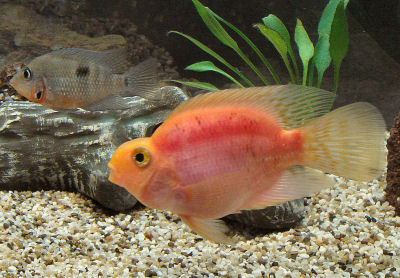
The Blood Parrot is just about the most curious result of cichlids interbreeding, and has created quite a stir in the aquarium hobby!
The Blood Parrot is a fascinating looking fish that has been developed in captivity and does not appear in the wild. They have a roundish ‘balloon’ shaped body and a very small mouth. They are also known as the Bloody Parrot, Blood Parrot Cichlid, and Blood Parrotfish. Perhaps they are called Parrotfish because their nose looks like a ‘parrot’s’ beak.
It is not uncommon for cichlids in captivity to interbreed among themselves. When they are in spawning mode, they will often respond to a fish of the opposite sex whether it is the same species or another fish of a closely related species. While the Blood Parrot’s exact geneology is unknown, it is likely the result of such interbreeding between a combination of types of Central American and South American cichlids.
These fish can be solid in color or have a “calico” patterning or blotching. They come in a variety of colors. ranging from basic pale or bright yellows, to oranges and reds. Dyed fish are often available in purples, pinks, blues, and other colors. These are generally sold as the ‘Jellybean Parrot’ and ‘Bumble Gum Parrot’. There are also other names that describe them by their color such as ‘Purple Parrot’. In addition, there are Blood Parrots described by their physical appearance such as the tailfin-less ‘Love Heart Parrot’ which resembles a heart.
The Blood Parrot will make a wonderful addition to the aquarium of both the beginner and more experienced aquarist. They are a shy and fish and should not be kept with aggressive tank mates. However, if you keep them in a community aquarium with similar sized fish, be aware that they can be territorial. They like an aquarium with lots of rock formations and caves for retreating and hiding. Plants are not essential though they do not harm them.
These fish should not be confused with the Parrot Cichlid Hoplarchus psittacus which is another freshwater cichlid from South America that is quite aggressive. They also have no relation to the saltwater Rivulated Parrotfish Scarus rivulatus (previously Callyodon fasciatus). There is also another popular cichlid hybrid called the Flowerhorn Cichlid. It too is very attractive but much difference in appearance than these Parrotfish.
For Information on keeping freshwater fish, see:
Freshwater Aquarium Guide: Aquarium Setup and Care
Quite a few beautiful Blood Parrots swimming around the entrance to a cave. Shows the natural awkwardness of the Parrot’s swimming style and also a little bit of aggression by a few of the group towards the others.
- Aquarist Experience Level: Beginner
- Size of fish – inches: 8.0 inches (20.32 cm)
- Minimum Tank Size: 30 gal (114 L)
- Temperament: Peaceful
- Aquarium Hardiness: Moderately hardy
- Temperature: 70.0 to 82.0° F (21.1 to 27.8° C)
- My Aquarium – Enter your aquarium to see if this fish is compatible!
- Beginner Fish – Freshwater fish for beginners
- Community Fish – Peaceful Freshwater fish
- Hardy Fish – Hardy Freshwater fish
- Similar size fish – Fish that are 1 inch bigger or smaller
- Coldwater Fish – Looking for cold water fish? (65 °)
Habitat: Distribution / Background
The Blood Parrots are fish developed by breeders and hobbyists. Since they are a hybrid, they are domestic and only found in aquariums. There are no wild populations. They are also called the Bloody Parrot and Blood Parrotfish. Some varieties are described by their physical appearance such as the Love Heart Parrot, which has no tail fin.
Dyed specimens are known as the Jellybean Parrot or Bubble Gum Parrot. These are albino or light colored Blood Parrots dyed to produce pinks, purples, blues, and other colors. Others are given names that describe them by their color such as Purple Parrot. Obtaining dyed specimens is not recommended and these fish often having a blotchy appearance. One reported method of coloring is done by injecting dye under the skin which then fades within a few months. Colorized fish in general are said to have health problems and often early deaths.
Dr. Jungle asks…”Who’s your daddy?”
The Blood Parrot is said to have been bred in Taiwan and the suggested parents are Central and South American cichlids. But it is up to speculation which parents actually produced the Blood Parrot. There are two different sets of parents suggested as the cross which created these hybrids:
First generation:
- One commonly suggested crossis between two Central American cichlids:
Midus Cichlid Amphilophus citrinellus (previously Cichlasoma citrinellum) and the Redheaded Cichlid Paraneetroplus synspilus (previously Cichlasoma synspilum) - The second commonly suggested crossis between a Central American cichlidand one oftwo South American Cichlids:
the Red Devil Cichlid Amphilophus labiatus (previously Cichlasoma labiatum) and one ofeither the Severum Heros severus(also called the Banded Cichlid) or the Blue-eye cichlid Cryptoheros spilurus (previously Cichlasoma spilurum).
The behavior of the Blood Parrot hybrids is peaceful and shy. This is a characteristic only found in the Severums from South America. The other three Central American cichlids are quite aggressive.
Second generation:
- A further developed variety is the “Convict Parrot Cichlid”. They are a cross between a female hybrid Blood Parrot and a pink male Convict Cichlid Amatitlania nigrofasciata (previously Archocentrus nigrofasciatus and Cichlosoma nigrofasciatum). Some of these fish have been dyed as well, and they are also called the ‘Jellybean’ Parrot’ or ‘Bubble Gum’ Parrot’.
- Blood Parrots have reportedly been crossed with other cichlid species such as theSeverumHeros severus and the Texas Cichlid Herichthys cyanoguttatus (previously Cichlasoma cyanoguttatum).
There may be other new varieties showing up down the road. In their book “Encyclopedia Of Exotic Tropical Fishes For Freshwater Aquariums”, authors Glen S. Axelrod, Brian M. Scott, and Neal Pronek share the views of different hobbyists. They share that “some breeders argue that cross-breeding contributes to scientific knowledge of fish and their reproductive strategies, others believe it is arrogant and unethcal for humans to think they can improve on nature” and “there are over 20,000 known fish species already… so there is no need to create new ones”. They also point out that problems can be created by exaggerating physical traits.
- Scientific Name:
- Social Grouping: Groups – Not found in the wild.
- IUCN Red List: NE – Not Evaluated or not listed – This fish is not found in the wild.
Description
The Blood Parrot has a roundish ‘balloon’ shaped body. They have a very small mouth and perhaps they are called Parrotfish because their nose looks like a parrot’s beak. They also have some other distinctions such as their deformed spines which gives them their unique shape and their overly large iris. Because they have exaggerated physical traits sometimes their small mouths do not close normally, making it more difficult for them to eat. Also their egg-shaped bodies make it difficult for them to swim naturally, and so they are awkward and lacking in grace.
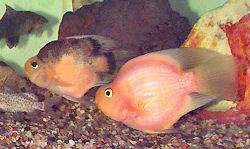 Hybrid Photo © Animal-World: Courtesy David Brough |
They can be solid or have a ‘calico’ patterning or blotching and are available in a variety of colors from basic pale or bright yellows to oranges and reds. There are also color varieties which are dyed albinos or dyed light colored Blood Parrots. These are generally referred to as the ‘Jellybean Parrot’ and ‘Bumble Gum Parrot’, though their names can describe them by color such as the ‘Purple Parrot’. Then there are Blood Parrots described by their physical appearance such as the ‘Love Heart Parrot’, which has no tail fin.
A further developed variety is the Convict Parrot Cichlid, which is also called the ‘Jellybean’ Parrot or ‘Bubble Gum’ Parrot’. This is actually a ‘double hybrid’ fish between a female hybrid Blood Parrot and a pink male Convict Cichlid. Blood Parrots have reportedly been crossed with other cichlid species such as theSeverumand theTexas Cichlid. So there may be other new varieties showing up in the future.
All cichlids, along with some saltwater fish such as wrasses and parrotfish, share a common trait of a well-developed pharyngeal set of teeth located in the throat, along with their regular teeth. Cichlids have spiny rays in the back parts of the anal, dorsal, pectoral, and pelvic fins to help discourage predators. The front part of these fins are soft and perfect for precise positions and effortless movements in the water as opposed to fast swimming.
Cichlids have one nostril on each side while other fish have 2 sets. To sense “smells” in the water, they suck water in and expel the water right back out after being “sampled” for a short or longer time, depending on how much the cichlid needs to “smell” the water. This feature is shared by saltwater damselfish and cichlids are thought to be closely related.
- Size of fish – inches: 8.0 inches (20.32 cm)
- Lifespan: 10 years
Fish Keeping Difficulty
The Blood Parrot is a hardy fish and good for the beginner cichlid keeper. Because of the shape of the mouth feeding can be difficult at times, but there are commerical foods designed for this fish. These fish are messy feeders, so be prepared to perform a good deal of cleaning.
- Aquarium Hardiness: Moderately hardy
- Aquarist Experience Level: Beginner
Foods and Feeding
Since they are omnivorous the Blood Parrot will generally eat all kinds of live, fresh, and flake foods. To keep a good balance give them a high quality flake food or pellet everyday. Feed brine shrimp (either live or frozen) or blood worms as a treat. Live guppies and goldfish will suffice when they get bigger. Proteins high in B-carotene will promote good coloring.
- Diet Type: Omnivore
- Flake Food: Yes
- Tablet / Pellet: Yes – Sinking pellets work best.
- Live foods (fishes, shrimps, worms): Some of Diet – Make sure to quarantine feeders prior introducing them to the main tank as food.
- Vegetable Food: Some of Diet
- Meaty Food: Some of Diet
- Feeding Frequency: Several feedings per day
Aquarium Care
Perform water changes of 20 – 25% weekly, more or less depending on stocking numbers. If water quality is ignored, as with all cichlids, disease and death can occur. The viewing panes should be cleaned with a sponge or algae magnet, once algae settles use a siphon vacuum to clean all the debris from the substrate. Make sure to get up all the excess food the the Parrot leaves behind.
- Water Changes: Weekly
Aquarium Setup
A 30 gallon tank will be fine for juveniles for the first couple of years, but for adults 55 gallons is suggested. They prefer slow to moderate moving water along with good efficient filtration. Because thse fish are such messy eaters, a large canister filter will work best.The aquarium should have low to moderate lighting. Provide a substrate of fine dark sand along with rocks and roots for places to hide along with open areas for swimming.Make sure to use a fairly soft substrate as these fish enjoy digging.Plants can also be included as they will not bother them.
They can be easy to care for if water changes are performed frequently. They can have a lifespan of 10 or more years with proper care.
- Minimum Tank Size: 30 gal (114 L) – 30 for juveniles and a minimum of 55 for adults.
- Substrate Type: Sand/Gravel Mix
- Lighting Needs: Moderate – normal lighting
- Temperature: 70.0 to 82.0° F (21.1 to 27.8° C)
- Range ph: 6.5-8.0
- Hardness Range: 2 – 25 dGH
- Brackish: No
- Water Movement: Weak
- Water Region: Middle
Social Behaviors
As a cichlid with aggressive parents, they would not be considered a community fish. However with their shy peaceful nature they can be kept in aquariums with other fair sized fish. If kept with other cichlids, make sure their tank mates are not overly aggressive. They can be kept with Angelfish, peaceful catfish species such as Plecostomus, Corydoras and Glass Catfish, Kuhli Loaches, livebearers like Swordtails, and characins such as Tetras,and Silver Dollars. This being said some of these fish develop a mean streak so keep a close eye on them if kept in a community tank.
- Temperament: Peaceful – Most are peaceful but some show aggressive mood swings.
- Compatible with:
- Same species – conspecifics: Yes
- Peaceful fish (): Monitor
- Semi-Aggressive (): Monitor
- Aggressive (): Threat
- Large Semi-Aggressive (): Threat
- Large Aggressive, Predatory (): Threat
- Monitor
- Shrimps, Crabs, Snails: Safe – not aggressive
- Plants: Safe
Sex: Sexual differences
Sexing them is difficult. Males will show a pink around their gills and on the throat when they are in spawning colors.
Breeding / Reproduction
The Blood Parrot has been known to breed, but most often their eggs are infertile unless they are paired with a non-hybrid fish. See the general description of how to breed Cichlids in: Breeding Freshwater Fish: Cichlids.
- Ease of Breeding: Difficult – They can only produce viable offspring with a partner of another type of cichlid; two Blood Parrots cannot reproduce.
Fish Diseases
The Blood Parrots are susceptible to typical fish ailments, especially if water is stale and of poor quality and oxygenation. They tend to be susceptible to illness when stressed, usually caused by not providing ample hiding places. One common problem is Ich. It can be treated with the elevation of the tank temperature to 86° F (30° C) for 3 days. If that does not cure the Ich, then the fish needs to be treated with copper (remove any water conditioners). Several copper based fish medications are available for Ich. Copper use must be kept within the proper levels, so be sure to follow the manufacturers suggestions. A copper test also can be used to keep the proper levels. You can also combine increased temperature with an Ich medication treatment. Intestinal disease can be treated with metronidazol.
These fish can have Swim Bladder issues that cause them to swim swim in unusual ways, sometimes even stuck upside down! This disorder is usually caused by an inadequate diet. Because this is so common, feeding the Parrot shelled peas once a week can help prevent this. At a last resort an Epson Salt bath can be peformed for 20 minutes twice a day.
These fish also commonly get Stress Spots which resemble Black Spot Disease. Stress Spots can come and go. They tend to occur when the fish is changing homes, being bullied, is suffering from an illness, or just stressed. These spots normally go away when the stressor is identified and removed.
As with most fish they are prone to skin flukes and other parasitic infestations (protozoa, worms, etc.), fungal infections, and bacterial infections. It is recommended to read up on the common tank diseases. Knowing the signs and catching and treating them early makes a huge difference. For information about freshwater fish diseases and illnesses, see Aquarium Fish Diseases and Treatments.
Availability
The Blood Parrot or Jellybean Parrot, has become commonly available. They can often be found in fish stores and sometimes online and are moderately priced, but generally a bit more than other common cichlids. Price is dependent on size, color, and type.
The Convict Parrot Cichlid, which is also called the ‘Jellybean’ Parrot or ‘Bubble Gum’ Parrot’, is also sometimes available. They can often be found in fish stores and sometimes online and are tend to cost a bit more than the standard Blood Parrot.
References
- Animal-World References: Freshwater Fish and Plants
- George Zurlo, David Schleser, Cichlids (Complete Pet Owner’s Manual), Barron’s Edu Series, 2005
- Glen S. Axelrod, Brian M. Scott, Neal Pronek, Encyclopedia Of Exotic Tropical Fishes For Freshwater Aquariums, TFH Publications, 2005
- Richard F. Stratton, The Guide to Owning Cichlids, T.F.H. Publications, Inc., 2002