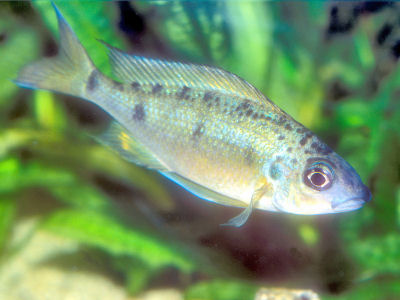
The handsome Gold Nasuta is a large eye-catching cichlid, but one that is only slightly aggressive!
A mature Gold Nasuta Ophthalmotilapia nasuta is quite an alluring African cichlid from Lake Tanganyika. It is large, reaching a length of almost 8″ (20 cm), with a very attractive appearance. It can be colored in combinations of yellow, gold, green, brown and blue, all depending upon its place of origin. But its most distinguishing feature is its ventral fins that grow quite long, stretching beyond the body of the fish.
This fish is part of a group of Lake Tanganyika cichlids called featherfins whose most distinguishing feature is the ventral fins. In total there are three genera that make up the Featherfin Cichlids. This genus Ophthalmotilapia which contains 4 species, along with the genera Cyathopharynx and Cunningtonia, both of which monotypic, meaning they contain only a single species. All three of these groups are members of the Ectodini tribe, but with similar body shapes and distinguished by having such long, extended ventral fins on the males. That’s about all they have in common though, as the three genera are quite distinct from each other in diet and aggressiveness.
The common names these fish are known by include Gold Nasuta, Tiger Nasuta, and Long-Nosed Gold-Tip Cichlid. Other names are used to refer to varieties of this fish based on the region where found or a color variation. These include names such as Chimba, Halembe, Kachese, Kala Island, Kalambo, Kambwimba, Katete, Kekese, Kipili Gold, Mabilibili, Milima, Moliro, Mzwema, and Ulwile to name most areas.
With the attractive coloration and unique look, these cichlids make great show specimens to add variety to a Lake Tanganyika aquarium. They are a more peaceful cichlid and not as aggressive as others in their genus, making for a nice addition to a community cichild tank. They can be kept with cave spawning cichlids, but will not do well with aggressive mouthbrooders from Lake Malawi or Lake Tanganyika. They also do well in a species specific tank as they are generally tolerant toward their own kind, but there does need to be more females than males.
These cichlids make a great choice for the intermediate cichlid keeper, and are appealling to the advanced aquarist as well. They are moderately easy to care for as long as regular water changes are done. Provide them with a sandy substrate for building nests along with lots of rock formations for places of retreat. This fish will breed in captivity, so to avoid cross breeding don’t house them with other color varieties of Nasuta.
For Information on keeping freshwater fish, see:
Freshwater Aquarium Guide: Aquarium Setup and Care
- Kingdom: Animalia
- Phylum: Chordata
- Class: Actinopterygii
- Order: Perciformes
- Family: Cichlidae
- Genus: Ophthalmotilapia
- Species: nasuta
- Aquarist Experience Level: Intermediate
- Size of fish – inches: 7.1 inches (17.96 cm)
- Minimum Tank Size: 100 gal (379 L)
- Temperament: Semi-aggressive
- Aquarium Hardiness: Moderately hardy
- Temperature: 75.0 to 80.0° F (23.9 to 26.7° C)
- My Aquarium – Enter your aquarium to see if this fish is compatible!
- Beginner Fish – Freshwater fish for beginners
- Community Fish – Peaceful Freshwater fish
- Hardy Fish – Hardy Freshwater fish
- Similar size fish – Fish that are 1 inch bigger or smaller
- Coldwater Fish – Looking for cold water fish? (65 °)
Habitat: Distribution / Background
A Gold Nasuta Ophthalmotilapia nasuta was described by Poll and Matthes in 1962. These fish are endemic to Lake Tanganyika, Africa. This species is listed on the IUCN Red List as Lease Concern (LC). Although it is endemic to Lake Malawi, it is widespread through out the lake and has no recognized threats at present.
Common names this fish is known by include Gold Nasuta, Tiger Nasuta, and Long-Nosed Gold-Tip Cichlid. Still other names describe it by its appearance and/or the region where it is found. These include the best known varieties Ophthalmotilapia nasuta “Kipili” or “Kipili Gold” which is also known as the Gold Nasuta; and Ophthalmotilapia nasuta “Chimba” and Ophthalmotilapia nasuta “Moliro”, both of which are also known as the Tiger Nasuta. Others include “Halembe”, “Kachese”, “Kala Island”, “Kalambo”, “Kambwimba”, “Katete”, “Kekese”, “Mabilibili”, “Milima”, “Mzwema”, and “Ulwile”, to name most areas.
The Ophthalmotilapia genus has 4 described species and a number of variants. These are a genus of “Featherfin Cichlids” from Lake Tanganyika, Africa. They are fairly large cichlids with elongated bodies bodies, though slightly deeper than the average “elongated” cichlid. They are polygamous mouthbrooders and do best in groups. They are very peaceful, though males will display to each other. In nature they feed on microorganisms residing in clouds of plankton in the water column.
This genus is a small group in the tribe Ectodini. The tribe contains 11 genera and 30 species of African Cichlids, endemic to Lake Tanganyika, with most of the genera being monotypic. The Ectodini cichlids are highly variable, actually considered the most morphologically and behaviorally diverse tribe in the lake. They are found in coastline regions living in sand, mud and rocky habitats. These cichlids are small to moderate sized, ranging from 3-10 inches (7.6-25 cm). They are widely varying in body shape but for most the head is the deepest part. They are perfectly adapted to their preferred natural habitats and feed primarily on aquatic invertebrates or plankton. All species are mouthbrooders that are either biparental or maternal.
In nature this cichlid dwells in shallower waters than many cichlids, found at depths from 6.5 to 32 feet, (2-10 m). Here they swim over a mix of rocks and sand, either solitary or in groups. Their diet includes insects and plankton, they will also eat phytoplankton (unicellular algae), detritus and some very small benthic crustaceans.
- Scientific Name: Ophthalmotilapia nasuta
- Social Grouping: Varies – They are found either solitary or sometimes in groups.
- IUCN Red List: LC – Least Concern
Description
The Gold Nasuta or Tiger Nasuta is part of a group of cichlids called featherfins. Their bodies are slightly deeper than the average “elongated” cichlid, but not excessively. They have a big nose that looks like an “overbite”, with the top part of the mouth being thicker than the bottom. Their most distinguishing feature is their pelvic fins. These fins are long, extend past the anal fin, and come to a point. The dorsal and anal fin are pointed as well and the tail fin is forked. The male can reach a lenth of almost 8″ (20 cm), with females being a bit smaller. They reportedly can live between 3 – 5 years with good care, though possibly longer as most species from Lake Tanganyica have a lifespan between 5 – 8 years.
The overall the body color can be quite variable depending on it geographic locality, ranging from a silvery gray, yellow, gold, or brown. The fins are tipped in white or a very light color. Females are a bland silver with some highlights in the fins in some localities. Based on the region where found, some varieties of this fish are:
- Ophthalmotilapia nasuta “Kipili”
This variety has is known as the Gold Nasuta and is just that, gold. The forehead is a lighter silver-gray color.
- Ophthalmotilapia nasuta “Chimba” and Ophthalmotilapia nasuta “Moliro”
These varieties are known as the Tiger Nasuta. Both have dark brown spots all over the body and tail fin. The difference is the Chimba variety has a silvery base with other fins being a light yellow. The Moliro variety has a light yellow base with the other fins being a drab grayish yellow color.
- Ophthalmotilapia nasuta “Halembe”
This variety is a rich chocolate color throughout the body and fins.
- Ophthalmotilapia nasuta “Kachese”
This is a muddied brown gold variety, with the anal and pelvic fins being gold.
- Ophthalmotilapia nasuta “Kala Island”
This variety is a black to dark brown with yellow tips at the end of the pelvic fins.
- Ophthalmotilapia nasuta “Kalambo” and Ophthalmotilapia nasuta “Milima”
These varieties are a very drab black, except the Milima has blue in the fins and the tail fin has a thick pale blue band.
- Ophthalmotilapia nasuta “Kekese”
This variety has a silvery white to gray body with the dorsal, pelvic, pectoral and anal fins being gold. The head is a light blue to light purple and it stretches across the back and about half way down the body. The tail fin is brown.
- Ophthalmotilapia nasuta “Mabilibili”
This variety is a golden brown color with dark blue fins. The head is a berry brown color on top with a light whitish blue on the chin.
- Ophthalmotilapia nasuta “Mzwema”
This variety is a lighter gold all over, with the forehead being a light silver white. The back has brown speckles on the top half of the fish and there are some faint vertical brown bars down the body.
- Ophthalmotilapia nasuta “Ulwile”
This variety is very interesting, a combination of colors. It has green for the base color with a blue forehead and yellow to yellow-green fins.
All cichlids share a common feature that some saltwater fish such as wrasses and parrotfish have and that is a well-developed pharyngeal set of teeth that are in the throat, along with their regular teeth. Cichlids have spiny rays in the back parts of the anal, dorsal, pectoral, and pelvic fins to help discourage predators. The front part of these fins are soft and perfect for precise positions and effortless movements in the water as opposed to fast swimming.
Cichlids have one nostril on each side while other fish have 2 sets. To sense “smells” in the water, they suck water in and expel the water right back out after being “sampled” for a short or longer time, depending on how much the cichlid needs to “smell” the water. This feature is shared by saltwater damselfish and cichlids are thought to be closely related.
- Size of fish – inches: 7.1 inches (17.96 cm) – Females are smaller than males.
- Lifespan: 5 years – This species is reported to generally live between 3 – 5 years, though most Lake Tanganyica species can have a lifespan of 5 – 8 years with proper care.
Fish Keeping Difficulty
This is a good fish for the intermediate and experienced cichlid keeper. It is moderately easy to care for as long it has the proper sized aquarium and the right tank mates. They are fairly peaceful, making good inhabitants for the community cichlid tank. They will eat a wide variety of aquarium foods and will breed in captivity. The aquarium does need regular water changes for optimal quality.
- Aquarium Hardiness: Moderately hardy
- Aquarist Experience Level: Intermediate
Foods and Feeding
The Gold Nasuta is an omnivore. In the wild their diet includes insects and plankton, they will also eat phytoplankton (unicellular algae), detritus and some very small benthic crustaceans. In the aquarium they can be fed Cyclops, water fleas, shrimps, Artemia, spirulina or other special food for Lake Tanganyika cichlids. They will also eat freeze-dried and flake foods, as well as fish.
Feed 2 to 5 small portions of food a several times a day instead of a large quantity once a day. Try to vary their diet and be certain that they receive enough, these are large fish. All fish benefit from vitamins and supplements added to their foods.
- Diet Type: Omnivore
- Flake Food: Occasionally
- Tablet / Pellet: Yes
- Live foods (fishes, shrimps, worms): Some of Diet
- Vegetable Food: Some of Diet
- Meaty Food: Some of Diet
- Feeding Frequency: Daily – Offer several small feedings a day rather than a single large feeding for better water quality over time.
Aquarium Care
Do normal water changes of 10% to 15% a week, depending on stocking numbers.The Lake Tanganyika cichlids cannot handle large water changes very well unless the new water chemistry closely matches the water they are in. If a large water change is needed, changing 15% every couple of days should bring water back to normal. This inability to tolerate large water changes is due to Lake Tanganyika being very deep and the water tends to stay stable.
- Water Changes: Weekly – Water changes of 10-15% weekly are suggested, only do more if the water parameters are off. Be cautious of doing more frequent changes as these fish are very sensitive to new water.
Aquarium Setup
The Gold Nasuta is active and will swim in the top and middle areas of the aquarium. Though they are fairly peaceful these fish need a lot of free swimming space, a tank that is 100 gallons or 5 feet (150 cm) in length is recommended. They do fine in either freshwater or brackish freshwater but need good water movement along with very strong and efficient filtration. Lake Tanganyika is a very oxygen rich lake so bubblers need to be going day and night, even if there are plants. Regularly check nitrates and ph, nitrates should be no more than 25 ppm and a pH less than 7 is not tolerated. In addition keep an eye on total hardness and carbonate hardness. Avoid overfeeding and overstocking.
Lake Tanganyika is the second to largest lake in the world, thus contributing to a low fluctuation in temperature and pH. All Tanganyika cichlids need stable temperatures kept within acceptable limits and lots of oxygen to survive. Temperatures under 72° F and over 86° F for too long is not tolerated by many of these fish. When treating for ich, a few days at 86° F is acceptable. The lake is also consistently alkaline with a pH of around 9, and very hard at about 12 – 14° dGH. In the aquarium most Tanganyika cichlids are fairly adaptable as long as conditions are close to these ideal ranges. Most important is that their water chemistry doesn’t change much over time. The water needs to be well buffered and maintained with small, regular water changes.
Salt is sometimes used as a buffering agent to increase the water’s carbonate hardness. An alternative buffering approach is to use a chemical filtration method, where the water passes through layers of crushed coral or coral sand. Interestingly, Tanganyikan cichlids also need iodine for the thyroid to function properly to regulate growth and development, and which can be achieved by adding iodized table salt to the water. Although rift lake cichlids need hard alkaline water they are not found in brackish waters. This cichlid has some salt tolerance so can be kept in slightly brackish water conditions. However it not suited to a full brackish water tank. It can tolerate a salinity that is about 10% of a normal saltwater tank, a specific gravity of less than 1.0002.
They seem to prefer being in the open, so a heavily decorated aquarium is not suggested. Rocks in the background that provide caves and crevices, along with a sandy or fine gravel substrate will make them feel comfortable. Plants are not necessary but can be provided. The plants should be low growing types, and because this fish will dig, those that attach to rocks such aw Java Fern are especially good.
- Minimum Tank Size: 100 gal (379 L) – A tank that is 100 gallons and 5 feet (150 cm) in length is the suggested minimum size.
- Suitable for Nano Tank: No
- Substrate Type: Sand/Gravel Mix
- Lighting Needs: Moderate – normal lighting
- Temperature: 75.0 to 80.0° F (23.9 to 26.7° C)
- Range ph: 7.8-9.5
- Hardness Range: 10 – 13 dGH
- Brackish: Sometimes – Salt is not found in their natural environment, but they do have a slight tolerance, keep levels below 10% – a specific gravity of less than 1.0002.
- Water Movement: Moderate
- Water Region: Top – These fish will swim in the top and middle areas of the aquarium.
Social Behaviors
The Gold Nasuta is relatively peaceful, only territorial during spawning. They are generally tolerant toward those of their same species. They do well in a species specific tank but there does need to be more females than males. Do not house with other color variations of Gold Nasutas to avoid cross breeding and losing pure strains. They can be kept with cave spawning cichlids such as Julidochromis species and cichlid species from the Lamprologini tribe. They do not do well with aggressive mouthbrooders from Lake Malawi or Lake Tanganyika.
- Temperament: Semi-aggressive
- Compatible with:
- Same species – conspecifics: Yes – They are generally peaceful with conspecifics, generally only when spawning do they become territorial.
- Peaceful fish (): Monitor
- Semi-Aggressive (): Safe
- Aggressive (): Threat
- Large Semi-Aggressive (): Threat
- Large Aggressive, Predatory (): Threat
- Threat
- Shrimps, Crabs, Snails: May be aggressive
- Plants: Safe
Sex: Sexual differences
Males are larger and much more colorful, but they develop their color very late in their growth period. Females are a bland silver, with some highlights in the fins in some localities. Males that are stressed or ill will take on the color of females and juveniles.
Breeding / Reproduction
In the wild, the male Gold Nasuta will gather in a group to breed. They build burrows of sand on the rocks and these are spaced about 6 feet apart. Around 20 males will display at passing females trying to catch their attention. The females will carry their fertilized eggs for around 21 days and then release them at the top of the water column, near the surface. The young will then school together with other cichlid fry and juveniles.
The Gold Nasuta has been bred in captivity, and the males will be in full color to impress any onlooker. This species is a mouth brooder with the female caring for the young. The male will not have any interest in protecting his offspring. It is suggested to place brooding females in a separate tank so they can release their young in a stress-free environment. See more about cichlid breeding in: Breeding Freshwater Fish: Cichlids.
- Ease of Breeding: Moderate
Fish Diseases
The Gold Nasuta is susceptible to typical fish ailments, especially if water is stale and of poor quality and oxygenation. An ounce of prevention is worth a pound of cure. Water changes, not overfeeding or overcrowding, and observation along with feeding your fish the proper foods (thawing frozen food and adding vitamins) will keep them in optimum health. For freshwater an optional practice is to add 1 heaping teaspoon of salt per 11 gallons of water. This is considered to be a simple and natural remedy for wounds, minor fungal infections and film over the eyes of fish in transit. Using a marine salt (used for salt water fish) will add some trace elements.
One common problem is Ich. It can be treated with the elevation of the tank temperature to 86° F (30° C) for 3 days. If that does not cure the Ich, then the fish needs to be treated with copper (remove any water conditioners). Several copper based fish medications are available for Ich. Copper use must be kept within the proper levels, so be sure to follow the manufacturers suggestions. A copper test also can be used to keep the proper levels. You can also combine increasing the temperature with an Ich medication treatment.
As with most fish they are susceptible to skin flukes and other parasitic infestations (protozoa, worms, etc.), fungal infections, and bacterial infections. It is recommended to read up on the common tank diseases. Knowing the signs and catching and treating them early makes a huge difference. For information about freshwater fish diseases and illnesses, see Aquarium Fish Diseases and Treatments.
Availability
The Gold Nasuta or Tiger Nasuta is sometimes available both online and in fish stores, ranging from moderate in price to moderately high. Purchase from a reputable dealer, due to hybridization it takes a trained eye to choose the correct color strain that has not been crossed. You may special order, but you must be willing to wait.
References
- Animal-World References: Freshwater Fish and Plants
- Dr. Rudiger Riehl and Hans A. Baensch, Aquarium Atlas Vol. 2, Publisher Hans A. Baensch, 1993
- Mark Phillip Smith, Lake Tanganyika Cichlids, A Complete Pet Owners Manual, 2nd Edition, Barron’s Educational Series, Inc. 2007
- George Zurlo, David Schleser, Cichlids (Complete Pet Owner’s Manual), Barron’s Education Series, 2005
- Glen S. Axelrod, Brian M. Scott, Neal Pronek, Encyclopedia Of Exotic Tropical Fishes For Freshwater Aquariums, TFH Publications, 2005
- Peter Bredell, Frank Schneidewind, Lake Tanganyika Cichlids, How to keep successfully and enjoy these exceptional fish, Interpet Publishing , 2002
- Ophthalmotilapia nasuta (Poll & Matthes, 1962), Fishbase.org
- Cyprichromis leptosoma, The IUCN Red List of Threatened Species
- Rhett Butler, “Cichlids – Lake Tanganyika”, Mongabay.com, Referenced online, 2007
- Juan Miguel Artigas Azas, “Ophthalmotilapia nasuta (Poll & Matthes, 1962)”, The Cichlid Room Companion, Ohio Cichlid Association, Referenced online, 2007
- Glen S. Axelrod, Rift Lake Cichlids, T.F.H. Publications, Inc., 1979