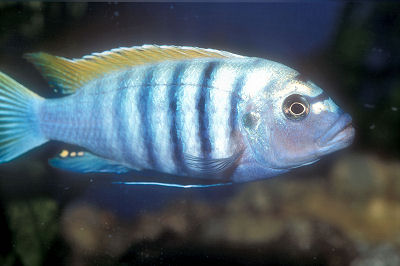
What’s special about the Dogtooth Cichlid? It’s a small colorful Mbuna… but with unique teeth!
The Dogtooth Cichlid Cynotilapia afra (previously Paratilapia afra) is a favorite for many cichlid aquarists because of their beautiful color patterns. They come in a variety of natural variations, depending on where they originate from, and can also change color depending on mood. The “excited” spawning colors of these Mbunas are very intense and make quite an interesting display.
This fish has many of the same wonderful qualities found in other African cichlids, but as its name suggests it is identified and distinguished because of its teeth. Its teeth are unicuspid rather than the bicuspid teeth seen in many cichlids of this size. The common name “dogtooth cichlid” is derived from its distinctive teeth. This is unique to just this genus and is a distinction sets it apart from all the other Lake Malawi Mbunas. In fact, in the genus name Cynotilapia the term ‘Cyno’ means ‘dog’ in latin. From its species name are derived the common names Afra Cichlid, Red Top Afra, and White Top Afra.
The Cynotilapia fish have a velvet richness to their coloration, and are very much like a the Melanochromis genus in both size and appearance. Though not really dwarf cichlids, these are all small sized African cichlids with attractive patternings. Some of these closely related Mbunas include the Auratus CichlidM. auratus, Electric Blue JohanniM. johannii, and the MainganoM. cyaneorhabdos. Except for its teeth, he Dogtooth Cichlidalso very much like a smaller version of the Pseudotropheus and Maylandia zebra type cichlids. Some good examples are the Kenyi CichlidM. lombardoi, Red Zebra CichlidM. estherae, Bumblebee MouthbrooderP. crabro, and Demanson’s CichlidP. demasoni.
The basic coloration of the male C. afra is a light blue with 7 strong black crossbands and eggspots on the anal fin, with the female being more of a blue-gray to slate gray. There are also many different color morphs and varieties in lavender, blue, light blue, yellow and everything in between. They can also have different coloring on the top band of their dorsal fin and some will have more bars than others. Interestingly, their vertical bars come and go depending on mood. Most males can turn their head and back coloring into an intense yellow gold as well, but even that depends on mood too.
This cichlid is generally easy to care for as long as its housing and dietary needs are met. A minimum 26 gallons would be needed for a pair. This fish is actually best kept in a small group however, and 55 gallon tank is necessary for harems consisting of one male and 3 females. An even larger aquarium will be needed if keeping it in a mixed cichlid community.
This is a robust species but it is territorial and will become quite quarrelsome, usually during spawning time. They can be kept with other Mbuna cichlids that are a little bigger, yet peaceful. Provide lots of passageways and caves formed with piles of rocks and robust vegetation. They will not bother tough plants. They eat a wide variety of foods and are typically easy to breed. Avoid cross breeding with similar cichlids to keep the strains pure. It is thought that even in the wild these fish hybridize.
For Information on keeping freshwater fish, see:
Freshwater Aquarium Guide: Aquarium Setup and Care
- Kingdom: Animalia
- Phylum: Chordata
- Class: Actinopterygii
- Order: Perciformes
- Family: Cichlidae
- Genus: Cynotilapia
- Species: afra
- Aquarist Experience Level: Intermediate
- Size of fish – inches: 4.0 inches (10.03 cm)
- Minimum Tank Size: 26 gal (98 L)
- Temperament: Semi-aggressive
- Aquarium Hardiness: Moderately hardy
- Temperature: 73.0 to 82.0° F (22.8 to 27.8° C)
- My Aquarium – Enter your aquarium to see if this fish is compatible!
- Beginner Fish – Freshwater fish for beginners
- Community Fish – Peaceful Freshwater fish
- Hardy Fish – Hardy Freshwater fish
- Similar size fish – Fish that are 1 inch bigger or smaller
- Coldwater Fish – Looking for cold water fish? (65 °)
Habitat: Distribution / Background
The Dogtooth Cichlid Cynotilapia afra (previously Paratilapia afra) was described by Günther in 1894. They occur in the Africa rift lake area and are endemic to Lake Malawi. They are found in the northern and north central parts of the lake along the rocky coastline. This species is listed on the IUCN Red List as Lease Concern (LC). It is endemic to Lake Malawi but is widespread throughout its range and there are no recognized threats at present.
Other common names it is known by include Afra Cichlid, Red Top Afra, White Top Afra, Mbuna, and Utaka (even though it is a Mbuna). Color varieties are known by Blue 14, Edwardi Afra, and Orangeback Mozambique. Because their different coloring is dependant on the location where they are found, there are also names related to location including Blue Reef, Chewere, Chisumulu, Chitendi, Cobue, Hal Reef, Kajindo, Llkoma, Lions Cove, Luhuchi, Lumbila, Lundo, Lupingu, Magunga, Mara, Mbamba, Mbweca, Ndumbi, Pombo Rocks, and Undo.
This Mbuna cichlid inhabits the upper parts of the waters in rocky areas away from the substrate. They occur in shallow waters down to depths of 131 feet (40 m), but are most abundant at depths of 6 – 65 feet (5 – 20 m).
In the wild females are solitary or live in groups in more open water areas where they feed primarily on plankton. Males on the other hand, are found defending a rock front or crevice territory, and feeding mostly on “aufwuchs”. Aufwuchs refers to tough stringy algae that is attached to rocks. “Loose” Aufwuchs can contain insect larvae, nymphs, crustaceans, snails, mites and zooplankton. Males tend to feed mostly from the rocks near their home.
- Scientific Name: Cynotilapia afra
- Social Grouping: Varies – Females are solitary or live in groups while the males maintain territories to attract a harem.
- IUCN Red List: LC – Least Concern
Description
The Dogtooth Cichlid is a small, elongated but muscular fish. This cichlid grows to almost 4 inches (10 cm) in length in the wild, but can grow a bit larger in the aquarium. They are very similar to the Melanochromis species, except for their teeth. The Dogtooth Cichlid’s teeth are unicuspid while the Melanochromis have bicuspid teeth, thus setting them apart. ‘ ‘Cyno’ means ‘dog’ in latin, as well as the Greek term ‘kyon’, also meaning ‘dog’ is what refers to their teeth. Lake Malawi fish live an average of 7 to 10 years.
There are many color varieties and basically they can be lavender, blue, light blue, yellow and everything in between. They have different coloring on the top band of their dorsal, depending on the color morph. Their vertical bars come and go depending on mood and some variations of color have more bars than others. The males of most color morphs have the ability to turn their head and back an intense yellow gold coloring, but even then the amount of gold coloring that appears depends on mood.
Females are drabber and also have the ability to lose or show their vertical bars. Some Dogtooth Cichlid females in certain color morphs are just as spectacular as the males, such as the ‘Mbweca’ female. Juveniles are similar to females.
All cichlids share a common feature that some saltwater fish such as wrasses and parrotfish have and that is a well-developed pharyngeal set of teeth that are in the throat, along with their regular teeth. Cichlids have spiny rays in the back parts of the anal, dorsal, pectoral, and pelvic fins to help discourage predators. The front part of these fins are soft and perfect for precise positions and effortless movements in the water as opposed to fast swimming.
Cichlids have one nostril on each side while other fish have 2 sets. To sense “smells” in the water, they suck water in and expel the water right back out after being “sampled” for a short or longer time, depending on how much the cichlid needs to “smell” the water. This feature is shared by saltwater damselfish and cichlids are thought to be closely related.
- Size of fish – inches: 4.0 inches (10.03 cm) – These fish grow to a length of almost 4″ (10 cm) in the wild, but are sometimes larger in home aquaria.
- Lifespan: 7 years – They have a lifespan of about 7 to 10 years with proper care.
Fish Keeping Difficulty
This is a great fish for both the intermediate and experienced aquarists. It can be moderate to easy in care, depending on the aquarists willingness to do frequent water changes and provide appropriate tank mates. It is a moderately aggressive cichlid, but not a community tank specimen that can be kept with fish other than cichlids. It is susceptible to Malawi bloat as well as the typical diseases that effect all freshwater fish if the tank is not maintained. In the proper setup it will easily adapt to prepared foods, breed readily, and the juveniles are easy to raise as well.
- Aquarium Hardiness: Moderately hardy
- Aquarist Experience Level: Intermediate
Foods and Feeding
The Dogtooth Cichlid is an omnivore that feeds mostly on aufwuchs in the wild. Aufwuchs is a tough stringy algae attached to rocks that can contain insect larvae, nymphs, crustaceans, snails, mites and zooplankton. In the aquarium they will accept frozen or live brine shrimp, mysis, high quality flake, pellets, spirulina, and other preparations for omnivore cichlids. Of course, all fish benefit from added vitamins and supplements to their foods.
They will eat to the point of their stomach being distended, so be very careful to not overfeed. It is always better to feed them small amounts several times a day instead of one large feeding. This keeps the water quality higher for a longer period of time.
- Diet Type: Omnivore
- Flake Food: Yes
- Tablet / Pellet: Yes
- Live foods (fishes, shrimps, worms): Some of Diet
- Vegetable Food: Most of Diet
- Meaty Food: Some of Diet
- Feeding Frequency: Daily – Offer several small feedings a day, what they can eat in about 3 minutes or less, rather than a single large feeding.
Aquarium Care
Malawi Cichlids will deteriorate under poor water conditions. Do water changes of 10% to 20% a week depending on bio load. Malawi bloat is a typical disease especially if their dietary needs are not met with quality foods. It is caused by too much protein matter.
- Water Changes: Weekly – Water changes of 10-20% weekly are suggested, depending on the bio load.
Aquarium Setup
The streams that flow into Lake Malawi have a high mineral content. This along with evaporation has resulted in alkaline water that is highly mineralized. Lake Malawi is known for its clarity and stability as far as pH and other water chemistries. It is easy to see why it is important to watch tank parameters with all Lake Malawi fish.
Rift lake cichlids need hard alkaline water but are not found in brackish waters. Salt is sometimes used as a buffering agent to increase the water’s carbonate hardness. This cichlid has some salt tolerance so can be kept in slightly brackish water conditions. However it not suited to a full brackish water tank. It can tolerate a salinity that is about 10% of a normal saltwater tank, a specific gravity of less than 1.0002.
A minimum 26 gallons is recommended for a pair and 55 gallons or more for a harem. A larger tank will be needed if kept with other compatible African cichlids. They do fine in either freshwater or brackish freshwater but need good water movement along with very strong and efficient filtration. Keeping the ph above neutral is important. Sand used for saltwater fish or freshwater can be used and if keeping them with a higher ph, the saltwater sand can help keep the ph up. Crushed coral or aragonite sand can also increase the water’s carbonate hardness, and tend to dissolves easier than salts. Keeping a higher pH however, means that ammonia is more lethal, so regular water changes are a must for these fish.
Provide lots of passageways and caves formed with piles of rocks, but be sure to stabilized the rocks on the bottom glass of the tank. Some open space is appreciated as well, and also robust plants.They will not bother tough plants.
- Minimum Tank Size: 26 gal (98 L) – A minimum 26 gallons is suggested for a pair, 55 gallons or more for a harem, and a larger tank if mixed with other African cichlids.
- Suitable for Nano Tank: Sometimes – They can be kept in a large Nano Tank, one that’s 26 gallons or more.
- Substrate Type: Sand/Gravel Mix
- Lighting Needs: Moderate – normal lighting
- Temperature: 73.0 to 82.0° F (22.8 to 27.8° C)
- Range ph: 7.7-8.6
- Hardness Range: 6 – 10 dGH
- Brackish: Sometimes – Salt is not found in their natural environment, but they do have a slight tolerance, keep levels below 10% – a specific gravity of less than 1.0002.
- Water Movement: Moderate
- Water Region: All – These fish will swim in all areas of the aquarium.
Social Behaviors
This fish is not considered to be a community fish. The Dogtooth Cichlid is not overly aggressive if it has plenty of room. It can be kept with Malawi Cichlids of similar size or larger, though larger fish shouldn’t be aggressive. It can also be kept with other less aggressive cichlids from Malawi that are not similar in coloring/shape. Aggressive large cichlids will cause the colors to be faded with the Dogtooth Cichlid.
The Dogtooth Cichlid is best kept in groups of one male and 3 females. If overstocking is used as a form of aggression reduction, care should be taken to do several partial water changes a week. They are also aggressive towards similar looking males of a different species. To avoid hybridization, do not mix species.
- Temperament: Semi-aggressive
- Compatible with:
- Same species – conspecifics: Yes – They are best kept in groups of 1 male with 3 females, 2 males will fight.
- Peaceful fish (): Threat
- Semi-Aggressive (): Safe
- Aggressive (): Threat
- Large Semi-Aggressive (): Threat
- Large Aggressive, Predatory (): Threat
- Threat
- Shrimps, Crabs, Snails: May be aggressive
- Plants: Monitor
Sex: Sexual differences
Females are usually more drab. Males are much more colorful with egg spots on the anal fin.
Breeding / Reproduction
The Dogtooth Cichlid has been bred in captivity. The male is ready to breed at 6 to 8 months. The Dogtooth Cichlid females lay 10 to 20 eggs and then immediately take them into their mouths before they are fertilized. The male flares out his anal fin, which has “egg spot patterning” so the female mistakes the eggs spots on the male’s anal fin as her own eggs and tries to take them in her mouth as well. In doing so, she then stimulates the male to discharge sperm (milt cloud) and inhales the cloud of “milt” which then fertilize the eggs in her mouth.
In 14 to 21 days at about 82° F, the eggs are developed. The released fry can eat finely powdered dry foods and brine shrimp nauplii. The female will guard her young for a few days, even taking them into her mouth if there is a perceived threat. As long as you have plenty of hiding places, your young will have an easier time surviving until they are too big to eat. See the description of how cichlids breed in Breeding Freshwater Fish: Cichlids.
- Ease of Breeding: Easy
Fish Diseases
Malawi bloat is a typical disease for the Dogtooth Cichlid, especially if their dietary needs are not met with quality foods. They are susceptible to typical fish ailments, especially if water is stale and of poor quality and oxygenation. One common problem is Ich. It can be treated with the elevation of the tank temperature to 86° F (30° C) for 3 days. If that does not cure the Ich, then the fish needs to be treated with copper (remove any water conditioners). Several copper based fish medications are available for Ich. Copper use must be kept within the proper levels, so be sure to follow the manufacturers suggestions. A copper test also can be used to keep the proper levels. You can also combine increasing the temperature with an Ich medication treatment.
As with most fish they are susceptible to skin flukes and other parasitic infestations (protozoa, worms, etc.), fungal infections, and bacterial infections. It is recommended to read up on the common tank diseases. Knowing the signs and catching and treating them early makes a huge difference. For information about freshwater fish diseases and illnesses, see Aquarium Fish Diseases and Treatments.
Availability
The Dogtooth Cichlids are sometimes found online for a moderate to more costly price. Prices vary depending on whether they are male, female, or juvenile, and on location. They are sometimes found in fish stores, though may be special ordered if you are willing to wait for them if they are out of season.
References
- Animal-World References: Freshwater Fish and Plants
- Dr. Rüdiger Riehl and Hans A. Baensch, Aquarium Atlas Vol. 2, Publisher Hans A. Baensch, 1993
- George Zurlo, David Schleser, Cichlids (Complete Pet Owner’s Manual), Barron’s Edu Series, 2005
- Glen S. Axelrod, Brian M. Scott, Neal Pronek, Encyclopedia Of Exotic Tropical Fishes For Freshwater Aquariums, TFH Publications, 2005
- Richard F. Stratton, The Guide to Owning Cichlids, T.F.H. Publications, Inc., 2002
- David E. Boruchowitz, The Guide to Owning Malawi Cichlids, T.F.H. Publications, Inc., 2003
- Mark Phillip Smith, Lake Malawi Cichlids, A Complete Pet Owners Manual, Barron’s Educ Series, Inc. 2000
- Cynotilapia afra (Günther, 1894), Fishbase.org
- Cynotilapia afra, The IUCN Red List of Threatened Species
- Nick Andreola, “Cynotilapia afra “Mbweca”, Cichlid-Forum.com