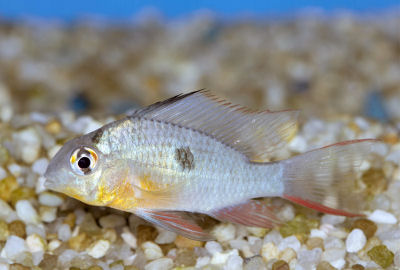
The pretty Bolivian Ram is one of the most popular dwarf cichlids due to its ease of maintenance and peaceful demeanor!
The Bolivian Ram Mikrogeophagus altispinosus (previously Paplilochromis altispinosus) is a very beautiful, small, and peaceful cichlid. This is a dwarf cichlid, only reaching up to about 3 1/2 inches (8.9 cm) in length. It has a delicate elongated oval shape adorned with long pointed fins and tail. Adult males have longer filaments off the tail fin as well.
The body color is solid overall, ranging from a light brown to a grayish blue with orange or red on the lower fins and edging the dorsal and tail fin. Often they are accented with a yellowish front half, a black spot in the center and a black crescent running through the eye. The subtle yet pretty coloring along with its long fluttery finnage has led to some other descriptive common names including the Bolivian Butterfly Cichlid, Butterfly Ram, Ruby Cichlid, Red Cichlid, and Ruby Clown Cichlid.
The Bolivian Ram is one of the easiest of the dwarf cichlids to care for and can be a good choice for a community aquarium. They are just slightly more aggressive than their popular Venezuelan cousin, the Ram Cichlid, but are not at all aggressive by cichlid standards. This dwarf cichlid is ‘more bark than bite’. In addition, like other cichlids, they have a friendly and intelligent manner. They are smart enough to recognize one person as their owner and will begin to beg for food everytime you walk by!
These fish will not do well in an aggressive tank but will get along well with other non-cichlid fish and other peaceful dwarf cichlids.They can be kept in a community tank with fish of a similar temperament. They are easier to keep and breed than the Ram Cichlid and many other dwarf cichlids and are also inexpensive and commonly available.
Provide an environment with rocks, driftwood, and flowerpots for hiding to make them feel comfortable. They will also enjoy several dense plant clusters, but leave some open space for swimming. They can be easy to care for if water changes are performed frequently. If water quality is ignored, as with all cichlids, disease and death can occur. Just a little dedication will reap pleasurable results from this little fish.
For Information on keeping freshwater fish, see:
Freshwater Aquarium Guide: Aquarium Setup and Care
The video features close up views of four Bolivian Rams during feeding time. One Ram in particular seems to be aggressively guarding a partially cleaned cave and nips and lip-locks with the other three.
- Kingdom: Animalia
- Phylum: Chordata
- Class: Actinopterygii
- Order: Perciformes
- Family: Cichlidae
- Genus: Mikrogeophagus
- Species: altispinosus
- Aquarist Experience Level: Beginner
- Size of fish – inches: 3.5 inches (8.89 cm)
- Minimum Tank Size: 20 gal (76 L)
- Temperament: Peaceful
- Aquarium Hardiness: Very Hardy
- Temperature: 74.0 to 78.0° F (23.3 to 25.6° C)
- My Aquarium – Enter your aquarium to see if this fish is compatible!
- Beginner Fish – Freshwater fish for beginners
- Community Fish – Peaceful Freshwater fish
- Hardy Fish – Hardy Freshwater fish
- Similar size fish – Fish that are 1 inch bigger or smaller
- Coldwater Fish – Looking for cold water fish? (65 °)
Habitat: Distribution / Background
The Bolivian Ram Mikrogeophagus altispinosus was described by Haseman in 1911. The species is currently correctly identified as Mikrogeophagus altispinosus, thoughpreviously it was described as Paplilochromis altispinosus (1977) and was originally described as Crenicara altispinosa (1911). Alternative accepted spellings include Microgeophagus andaltispinosa.This species is not listed on the IUCN Red List. Other common names they are known by include Bolivian Butterfly Cichlid, Butterfly Ram, Ruby Cichlid, Red Cichlid, and Ruby Clown Cichlid
The Bolivian Ram originates in the South American countries of Bolivia and Brazil. The first cataloged specimen was collected from a shallow pond in Bolivia, hence the name Bolivian Ram. They inhabit the Rio Mamore near the mouth of the Rio Guarpore river at Trinidad, the Guarpore Basin at San Ramone, the mouth of the Igarape river at Guarjara-Mirim, and in Flood plains below Todos Santos.
They occur in streams, pools, and lagoons with dense vegetation and submerged branches and roots that offers shaded areas and plenty of hiding places. They mostly inhabit the mid and bottom regions and feed by sifting the fine substrate for plant material and small organisms. They will also feed on organisms in the water and sometimes at the surface.
- Scientific Name: Mikrogeophagus altispinosus
- Social Grouping: Pairs
- IUCN Red List: NE – Not Evaluated or not listed
Description
The Bolivian Ram is a small colorful fish with an elongated oval shaped body and pointed fins and tail. Mature males have a more pointed dorsal fin and longer filaments on the tail fin than the females. The males are also larger, growing to about 3 1/2 inches (8.9 cm) in length while females only reach about 2 1/2 inches (6 cm). They have a lifespan of about 4 years.
The body has an overall solid color that ranges from a dull brown to a grayish blue. They can be yellow on the front half and have a whitish yellow belly. They may have a black spot in the middle of their body below the middle area of the dorsal fin, and may or may not have a crescent vertical black line that runs through their eyes (their eyes are not red like the Ram Cichlid). The tips of the dorsal fin and the edges of the tail fin are orange, and the anal and pectoral fins are orange as well.
All cichlids, along with some saltwater fish such as wrasses and parrotfish, share a common trait of a well-developed pharyngeal set of teeth located in the throat, along with their regular teeth. Cichlids have spiny rays in the back parts of the anal, dorsal, pectoral, and pelvic fins to help discourage predators. The front part of these fins are soft and perfect for precise positions and effortless movements in the water as opposed to fast swimming.
Cichlids have one nostril on each side while other fish have 2 sets. To sense “smells” in the water, they suck water in and expel the water right back out after being “sampled” for a short or longer time, depending on how much the cichlid needs to “smell” the water. This feature is shared by saltwater damselfish and cichlids are thought to be closely related.
- Size of fish – inches: 3.5 inches (8.89 cm)
- Lifespan: 4 years
Fish Keeping Difficulty
This Bolivian Ram is a good fish for beginner aquarists wanting to keep cichlids. Their maintenance and tank requirments are minimal and they are adaptable to a wide variety of environments. They tend to be easy feeders and will enjoy a wide variety of food. Plus, they will quickly become attached to their feeder and greet them in a similar fashion as other, hairer companions greet their owners!
- Aquarium Hardiness: Very Hardy
- Aquarist Experience Level: Beginner
Foods and Feeding
The Bolivian Ram is an omnivore with a diet in the wild that consists of benthic detritus containing seeds and fruits, along with aquatic and land plants. It can be fed flakes and pellets along with meaty foods that are live or frozen; such as brine shrimp, blood worms, white worms, chopped earthworms, cyclopeeze, and artemia. Feed 2 to 5 small pinches of food a day in smaller amounts instead of a large quantity once a day. This will keep the water quality higher over a longer time. All fish benefit from vitamins and supplements added to their foods.
- Diet Type: Omnivore
- Flake Food: Yes
- Tablet / Pellet: Yes
- Live foods (fishes, shrimps, worms): Some of Diet
- Vegetable Food: Some of Diet
- Meaty Food: Some of Diet
- Feeding Frequency: Several feedings per day
Aquarium Care
Water changes should be perfomred weekly and should replace around 30% of the water in the aquarium. Change slightly more or less water depending upon the stock numbers of the tank and the relative condition of the water. As with all cichlids, tank maintenance is important and should be on a strict schedule. If water quality is ignored, disease and death can occur.Clean all viewing panes of algae and vacuum the substrate once the debris has settled. Make sure to thoroughly vacuum all waste from the substrate.
- Water Changes: Weekly
Aquarium Setup
Minimum tank size should be at least 20 gallons. They prefer slow to moderate moving water along with good efficient filtration. A mature tank with a pH of acidic to neutral water is best. Keep track of nitrate levels and maintain consistent oxygen levels for best color and health. The aquarium should have a cover and low to moderate lighting.
Provide a substrate of fine sand with some granite pebbles mixed in and strewn across the top of the sand. An environment with rocks, driftwood, and flowerpots for hiding is appreciated. They also enjoy dense groupings of plants with open space inbetween for swimming . Some good aquatic plants include Java Fern, Rosette plants like the Amazon Sword, Vallisneria, and Anubias Nana, as well as stem plants like Wisteria, and other acid tolerate plants.
The Bolivian Ram prefers to breed in subdued and mellow light, so providing some floating plants to help diffuse lighting will encourage them to spawn. Granite pebbles or plants with wide leaves are good for spawning too. Java Moss is also great as it contains micro organisms such as Infusoria to provide a good beginning food for the fry.
When using substrate or rocks, be sure they do not leach into the water and affect the pH. Substrates such as limestone can increase the pH level. You would not use sand that is for marine tanks, but some have suggested pool filter sand. Driftwood is a big help in keeping pH low and contributes to the “tea stained” coloring of the Amazon River. Using Java Moss helps with keeping the pH down too.
The Bolivian Ram is a rewarding specimen for the aquarist. They can be easy to care for if water changes are performed frequently to keep the nitrate levels low.
- Minimum Tank Size: 20 gal (76 L)
- Substrate Type: Sand/Gravel Mix – Mostly sand with granite pebbles mixed in and strewn across the top of the sand.
- Lighting Needs: Low – subdued lighting
- Temperature: 74.0 to 78.0° F (23.3 to 25.6° C)
- Breeding Temperature: 82.0° F – preferred to be 72-82.4.
- Range ph: 6.0-7.4
- Hardness Range: 6 – 14 dGH
- Brackish: No
- Water Movement: Weak
- Water Region: Middle
Social Behaviors
This is a community fish that can be kept with non-cichlid fish and other peaceful dwarf cichlids. The Bolivian Ram will not do well in an aggressive tank. It is a cichlid, but is ‘more bark than bite’. They are slightly more aggressive than their popular cousin, the Ram Cichlid, but not at all aggressive by cichlid standards. Some acceptable peaceful tank mates include the Silver Dollar, Dwarf Gourami, Dwarf (Neon) Rainbowfish, Synodontis catfish and plecostomus,to name a few. Be aware they do tend to harrass and eat tetras.
They can be kept alone or in pairs. More than one male may be kept together if kept in a large aquarium.The bonding process between a male and female isn’t aboslute and may be difficult to initiate between any particular two fish. Thus, if you are looking to ensure at least one bonded pair, it is a good idea to get a group of juveniles and allow a pair to bond. Once you notice a pair consistently swimming near each other, you can put them in their own tank.
- Temperament: Peaceful
- Compatible with:
- Same species – conspecifics: Sometimes – Males will fight among themselves unless kept in a large enough aquarium.
- Peaceful fish (): Safe
- Semi-Aggressive (): Monitor
- Aggressive (): Threat
- Large Semi-Aggressive (): Threat
- Large Aggressive, Predatory (): Threat
- Safe
- Shrimps, Crabs, Snails: May be aggressive
- Plants: Safe
Sex: Sexual differences
Males are slimmer and less stocky than females. Males have a more pointed dorsal fin and longer filaments on their lyre-shaped tail fin than the females. Unlike the Ram Cichlid, females do not have a pink belly.
Breeding / Reproduction
The Bolivian Rams are open spawners that will form a family group and lay up to 200 eggs in the wild. In the aquarium, starting out with about 6 juveniles and allowing a pair to bond, then isolating that pair in their own tank is your best bet. If your fish are in a community tank it will be necessary to grow out the fry in their own tank so they don’t get eaten.
The female will appreciate smooth pebbles or wide leaves on which to spawn, a temperature of 77 – 82.4° F (25 – 28° C), and low light. The bonded pair will spend a lot of time cleaning the top of pebbles before they spawn. The female will pass over the spawning site several times, laying eggs each time while the male stands guard. The female will lay 75 to 100 gray oval eggs. Then the male will pass over them several times to externally fertilize them. The female will fan the eggs with the male guarding the area. The male will fan the eggs at times too, though the female does most of the work.
Within about 60 hours the eggs will hatch. The parents will move the “wigglers” to a pit in a different area of the tank. In about 7 more days the fry will be free swimming. The parents will continue to move the fry by mouth to several locations for the next few weeks. Do water changes of 30% daily in the fry tank as they are very sensitive to nitrates. Do not crowd the fry as they will not grow out as much if there are too many in one tank. See more about cichlid breeding in: Breeding Freshwater Fish: Cichlids.
- Ease of Breeding: Easy
Fish Diseases
The Bolivian Rams are susceptible to typical fish ailments, especially if water is stale and of poor quality and oxygenation. One common problem is Ich. It can be treated by elevating the temperature of the to 86° F (30° C) for 3 days. If the Ich persists after applying this remedy, you may need to consider medicinal treatments such as copper. Be sure to follow the manufacturer’s warnings and directions when treating your fish.
As with most fish the Butterfly Rams are prone to skin flukes and other parasitic infestations (protozoa, worms, etc.), fungal infections, and bacterial infections. It is recommended to read up on the common tank diseases. Knowing the signs and catching and treating them early makes a huge difference. For information about freshwater fish diseases and illnesses, see Aquarium Fish Diseases and Treatments.
Any new element which is introduced to the tank, alive or not, may potentially carry disease causing parasites or bacteria. To avoid such issues, be sure to quarantine any new live additions to the tank and disinfect any non-living additions.
Availability
The Bolivian Ram is readily available both online and in fish stores and is moderate in price. For a viable female, you may need to acquire them from a breeder or obtain wild caught specimens.
References
- Animal-World References: Freshwater Fish and Plants
- Dr. Rüdiger Riehl and Hans A. Baensch, Aquarium Atlas Vol. 3 , Voyageur Press, 1996
- Jorg Vierke, Dwarf Cichlids, T.F.H Publications, Inc., 1979
- George Zurlo, David Schleser, Cichlids (Complete Pet Owner’s Manual), Barron’s Edu Series, 2005
- Richard F. Stratton, The Guide to Owning Cichlids, T.F.H. Publications, Inc., 2002
- Mikrogeophagus altispinosus (Haseman, 1911), Fishbase.org
- Kaycy Ruffer, “Microgeophagus altispinosa”, Cichlid-Forum.com, Referenced online, 2007
- “Golden, Blue German Ram Information“, Tim’s Tropicals, Referenced online, 2007,
- Lee Newman, “Keeping and Breeding the Bolivian Ram, Microgeophagus altispinosa (Haseman, 1911)”, The Cichlid Room Companion (1995), Referenced online, 2007
- Max Galladé, “Breeding tanks, Rediscovering the German Blue Ram – Mikrogeophagus”, The Cichlid Room Companion ( 2001), Referenced online, 2007
- Rich Grenfell, “Keeping and Breeding Microgeophagus altispinosa (The Bolivian Ram)“, Wet Pet Gazette, Norwalk Aquarium Society, Referenced online, 2007, http://www.aquarticles.com/articles/breeding/Grenfell_M_altispinosa.html
- Paul Loiselle, “Bolivian Rams“, AquariumFish.com, Referenced online, 2007
http://www.aquariumfish.com/aquariumfish/detail.aspx?aid=9358&cid=3780&search= - “Practical information on keeping, breeding and buying dwarf cichlids“, Dwarfcichlid.com, Referenced online, 2007, http://dwarfcichlid.com/transvestitus.html