
The Blue-Eyed Tropheus is one of the more popular fish from Lake Tanganyika!
The Blue-Eyed Tropheus Tropheus brichardi is a favorite cichlid as it has many different color varieties. Brichardi Cichlids were called ‘Blue-Eyed Tropheus’ by hobbyists well before they were scientifically described. True to this name, the iris of their eyes can become blue colored if they are kept in optimal conditions.
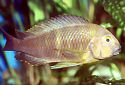
There are several varieties/races of this species and their coloring is dependent on where the fish are collected. The Skunkback Tropeus pictured above is from the Nyanza area of Lake Tanganyika, Africa. The main characteristic of these fish are their vertical stripes, which are very colorful on some varieties. However the stripes are primarily seen on juveniles and females as the males loose them over time.
A colony of 12 to 30 of these pretty cichlids can make an amazing display and their personality is a definite plus. The Tropheus have a really interesting social structure that is built upon a colony of consistent tank mates. They are very active and have individual behaviors, from curiously lining up to watch the goings on in the room to their ‘dolphin-like’ antics when eating. Feeding time can be very ‘wet’ for their keepers, but make this fish very fun and desirable.
The Blue-Eyed Tropheus have a reputation of being one of the most aggressive of the Tropheus species. In the wild they are very aggressive with conspecifics, but are said to be less aggressive, even shy, with other fish. In the aquarium their aggression level towards unrelated fish can vary depending on the personalities of the individual fish.
Truly a rewarding fish for the aquarist who is willing to provide the necessary care. This hearty cichlid can be easy to moderate to keep as long as attention is paid to its diet and mandatory water changes are done, and difficult if they are neglected. They are rather expensive fish, and initial attempts to keep them often met with difficulty until aquarists became familiar with their rather specific, though uncomplicated needs. They can be afflicted with the occurrence of ‘bloat’, and there seems to be no explainable rational as to its cause.
Provide a sandy substrate, strong lighting to encourage algae growth, and several rock piles along with rocks formed into caves. Having a very aggressive nature, they are best kept in a species specific tank. Do not add a new fish to an already established colony as this will cause an upset and death. They may also be kept in a larger aquarium with some other herbivorous rock dwelling African cichlids. The larger the tank and the more hiding places you have will help with aggression.
- For information on keeping freshwater fish, see: Freshwater Aquarium Guide: Aquarium Setup and Care
Scientific Classification
| Kingdom: | Animalia |
| Phylum: | Chordata |
| Class: | Actinopterygii |
| Order: | Perciformes |
| Family: | Cichlidae |
| Genus: | Tropheus |
| Species: | brichardi |
Blue-Eyed Tropheus – Quick Aquarium Care
| Aquarist Experience Level: | Advanced |
| Aquarium Hardiness: | Moderately Difficult |
| Minimum Tank Size: | 75 gal (284 L) |
| Size of fish – inches | 4.7 inches (11.99 cm) |
| Temperament: | Aggressive |
| Temperature: | 76.0 to 82.0° F (24.4 to 27.8° C) |
Habitat: Distribution / Background
The Blue-Eyed Tropheus Tropheus brichardi was described by Nelissen and Thys van den Audenaerde in 1975. It is endemic to Lake Tanganyika, Africa and was described based on a group of specimens caught near Nyanza Lac in Burundi. They were named after Pierre Brichard, a well known cichlid importer.
Though commonly called the Blue-Eye Tropheus they are also known as the Brichardi Cichlid, Saddle Moorii, and Chocolate Moorii. Some have also been mistakenly traded as the Blunthead Cichlid Tropheus Moorii, particularly those from Nyanza Lac, Malagarasi and Kavalla. Individual varieties are also named for the area from which they are collected. They may also be named for a distinct characteristic such as Tropheus brichardi “red cheek” or “canary cheek,” or sometimes a combination of color and location like Tropheus brichardi “green terror muzimu.”
The Skunkback Tropeus or Tropheus brichardi “Nyanza” pictured above is from the Nyanza area of Lake Tanganyika, Africa. It was the first of the Tropheus brichardi to be identified and exported. The Tropheus species became a big hit when first introduced in Germany in the mid 1970’s and then into the United States, and are still very popular today.
The Brichardi Cichlids are are widely distributed throughout the central parts of the lake on both the east and west coasts, but not in the extreme north or south. This species is listed on the IUCN Red list of Threatened Species as Least Concern (LC) as it is abundant across its range and there are several varieties/races of this species.
The Blue-Eyed Tropheus inhabit rocky shores at depths of 6 1/2 to 16 feet (2 – 5 m). They do not form schools, but are generally found in groups and will form nuclear families, though not prolonged pairs as often found in other open water breeders. They are found over solid rock, interlocking rubble, or sandstone slabs but do not prefer loose rubble or sandy areas.
They are specialized aufwuchs feeders, searching and pecking at algae on the rocks. Aufwuchs refers to tough stringy algae that is attached to rocks. “Loose” Aufwuchs can contain insect larvae, nymphs, crustaceans, snails, mites and zooplankton.
- Scientific Name: Tropheus brichardi
- Social Grouping: Groups – They are generally found in groups and will form nuclear families, though not prolonged pairs as often found in other open water breeders.
- IUCN Red List: LC – Least Concern
Description
The Blue-Eyed Tropheus is a stocky fish that seems to have a larger head in proportion to their body. They have an under-slung mouth and the body narrows as it forms the tail. The caudal fin is fan shaped, Cichlids have spiny rays in the back parts of the anal, dorsal, pectoral, and pelvic fins to help discourage predators. The front part of these fins are soft and perfect for precise positions and effortless movements in the water as opposed to fast swimming.
Cichlids have one nostril on each side while other fish have 2 sets. To sense “smells” in the water, they suck water in and expel the water right back out after being “sampled” for a short or longer time, depending on how much the cichlid needs to “smell” the water. This feature is shared by saltwater damselfish and cichlids are thought to be closely related. All cichlids share a common feature that some saltwater fish such as wrasses and parrotfish have; a well-developed pharyngeal set of teeth that are in the throat, along with their regular teeth.
The body of the adult male is a brownish black to a dark green color with a white or yellowish patch on the back just under the first half of the dorsal fin. There may also be a small dash of gold on the belly above the pelvic fin and the anal fin can have faint spotting. The caudal fin is fan shaped. The eye is white to golden and the iris of the eye can develop a blue color if they are kept in optimal conditions, thus the name ‘Blue-Eyed’.
There are a number of geographic variations of the Brichardi Cichlid, each with slightly different color patterning. The main characteristic of these fish are their vertical stripes. The stripes can be very colorful on some varieties or simply an alternating brownish black and yellow. These stripes are primarily seen on juveniles and females as the males loose them over time, becoming an overall brown or dark green when mature.
Several varieties are shown here:
Tropheus brichardi “Kabimba” |
Tropheus brichardi “Malagarasi” |
Tropheus brichardi “Kalemie” |
Tropheus brichardi “Mpimbwe” |
Tropheus brichardi “Karilani” Gold Fin |
Tropheus brichardi “Ujiji” |
Tropheus brichardi “Kipili” |
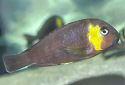
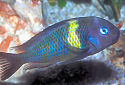
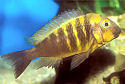
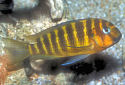
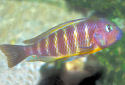
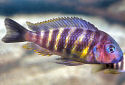
Additional varieties include:
- Tropheus brichardi “Benga” – This variety is from Benga, Congo.
- Tropheus brichardi “Bulu Point”
- Tropheus brichardi “Cape Tembwe”
- Tropheus brichardi “Isonga” – This variety is from Isonga, Tanzania.
- Tropheus brichardi “Kanyosha”
- Tropheus brichardi “Karilani” – This variety is from Karilani Island, Tanzania.
- Tropheus brichardi “Kavalla” – This variety is from Kavalla Island. The juvenile is similar to T. brichardi “Nyanza Lac”. It has narrow vertical yellow bars on an olive-brown background, bright-yellow fins and a yellow ventral surface that fades with age. Mature males loose the striping but have bluish head markings.
- Tropheus brichardi “Kigoma” – This variety is from Kigoma,Tanzania. Common name: Tiger Moorii, Striped Moorii
- Tropheus brichardi “Kipampa” – This variety is from Kipampa, Congo. Common name: Kavalla
- Tropheus brichardi “Korongwe Bay” – This variety is from Korongwe Bay. Common name: Yellow Cheek Brichardi
- Tropheus brichardi “Mikonga” – This variety is from Mikonga, Congo.
- Tropheus brichardi “Moliro”
- Tropheus brichardi “Mtosi” – This variety is from Mtosi, Tanzania.
- Tropheus brichardi “Mvuna” – This variety is from Mvuna Island, Tanzania.
- Tropheus brichardi “Namansi” – Fry striped with orange red color, adults shiny yellow with black fins.Common name: Fiery Fry
- Tropheus brichardi “Ubwari Green” – This variety is from the east side of the Ubwari. Juveniles have narrow yellowish bars on an olive green background. Adult males retain the barring on the back half, have a light gray head, a blackish tail and dorsal fin, and beautiful blue eyes. Common name: Benga
- Tropheus brichardi “Ulwile” – This variety is from Kigoma, Tanzania. Juveniles have nice yellow-orange and dark brown stripes.
- Tropheus brichardi “Yungu” – This variety is from Yungu, Congo.
- Tropheus brichardi “Zaïre I” – This variety is from Congo, Congo. Common name: Anthracite Moorii
In the aquarium, the Brichardi Cichlid will generally grow to a length of about 4 3/4 inches (12 cm), though some specimens can get closer to 5 inches They will generally live for about 5 years but have been know to live up to 8 years if well cared for.
- Size of fish – inches: 4.7 inches (11.99 cm) – This species can reach between 4 3/4″ to 5″ in length in the aquarium.
- Lifespan: 5 years – They generally have a lifespan of 5 – 8 years, but may live 10 years or more with proper care.
Fish Keeping Difficulty
The Blue-Eyed Tropheus are suggested for more experienced aquarists. They are rather demanding to keep due to their susceptibility to certain infections of the intestinal tract such as “bloat.”, They have stringent requirements with diet and habitat and they have a highly aggressive nature. They can be moderately easy to keep if it properly cared for, but difficult if not.
The aquarists must be willing to do frequent water changes and provide appropriate tank mates. They do best in a species tank, or if the aquarium is large enough they can be kept with other herbivorous types of cichlids.
- Aquarium Hardiness: Moderately Difficult
- Aquarist Experience Level: Advanced – These highly aggressive fish require attention to diet, diligent tank care, and are susceptible to “bloat” if stressed.
Foods and Feeding
The Blue-Eyed Tropheus is an omnivore, or can be referred to as a benthic herbivore. In the wild they are specialized aufwuchs feeders, picking algae from the rocks that contain microorganisms. In the aquarium they can be fed a varied diet including spirulina-based flake or pellet and supplement with a small quantity of protein They should have spinach or romaine at least once a day.
Only include foods that are high in fiber. When using pellets, holding it underwater for a few moments before the fish eat it may prevent air released from the pellet from getting trapped in the belly. Feed proteins sparingly and avoid housing them with fish that need protein. The best live protein supplements are Cyclops and Mysis, it is best to avoid soft or slimy foods as well as Tubifex, brine shrimp, beef heart, and mosquito larvae.
Some aquarists say protein may cause bloat though others report no problems with it. Some have fed their fish frozen brine and plankton will no ill effects, while according to one author brine shrimp and insect larvae should be avoided. Stick with the same varieties of food and if you do switch, do it a little at a time, again because this may cause bloat. Rick Borstein, a writer on care of many cichlid fish, suggests HBH Graze and Dainichi Veggie Deluxe brand foods for the Tropheus. The ratios of vegetable matter in these products are good.
They have a long intestinal tract and should not be over fed, as overfeeding may contribute to bloat. Feed 3 times a day with small pinches of food instead of a large quantity once a day. This will keep the water quality higher over a longer time. All fish benefit from vitamins and supplements added to their foods. (See information about African Bloat in the table below.)
- Diet Type: Omnivore – Although these fish are omnivores, their diet consists primarily of herbivorous foods.
- Flake Food: Yes
- Tablet / Pellet: Yes
- Live foods (fishes, shrimps, worms): Some of Diet – Proteins should be fed sparingly.
- Vegetable Food: Most of Diet
- Meaty Food: Some of Diet – Proteins should be fed sparingly.
- Feeding Frequency: Several feedings per day – Generally feed 2-3 small feedings a day rather than a single large feeding for better water quality.
Aquarium Care
The Brichardi Cichlids have stringent habitat requirements. Regular partial water changes are very important and removing any uneaten foods will help prevent disease. Do water changes of 15% twice a week or 30% weekly, depending on stocking numbers.
The Lake Tanganyika cichlids cannot handle large water changes very well unless the new water chemistry closely matches the water they are in. If a large water change is needed, changing 15% every couple of days should bring water back to normal. This inability to tolerate large water changes is due to Lake Tanganyika being very deep and the water tends to stay stable.
- Water Changes: Weekly – Water changes of 15% twice a week or 30% weekly are recommended.
Aquarium Setup
The Blue-Eyed Tropheus will swim in all areas of the aquarium, but are very aggressive. A minimum 4-foot long, 75-gallon tank is suggested for an established adult group of 12 to 20, larger for more. They need good water movement along with very strong and efficient filtration. Lake Tanganyika is a very oxygen-rich lake so bubblers need to be going day and night, even if there are plants. Regularly check nitrates and ph, nitrates should be no more than 25 ppm and a pH less than 7 is not tolerated. In addition, keep an eye on total hardness and carbonate hardness. Avoid overfeeding and overstocking.
For Tropheus cichlids the water needs to be well buffered and maintained with small, regular water changes. They do fine in either freshwater or brackish freshwater. Salt is sometimes used as a buffering agent to increase the water’s carbonate hardness. An alternative buffering approach is to use a chemical filtration method, where the water passes through layers of crushed coral or coral sand.
Although rift lake cichlids need hard alkaline water they are not found in brackish waters. This cichlid has some salt tolerance so can be kept in slightly brackish water conditions. However it not suited to a full brackish water tank. Salinity must be less than about 10% of a normal saltwater tank, a specific gravity of less than 1.0002.
For freshwater, an optional practice is to add 1 heaping teaspoon of salt per 11 gallons of water. This is considered to be a simple and natural remedy for wounds, minor fungal infections and film over the eyes of fish in transit. Tanganyika cichlids also need iodine for the thyroid to function properly to regulate growth and development, and which can be achieved by adding iodized table salt to the water. Be very careful to not add too much salt as this may cause bloat. Using a marine salt (used for saltwater fish) will add some trace elements.
Provide a sandy or very small-sized gravel substrate, strong lighting to encourage algae growth, and several rock piles with the rocks formed into caves. Plants may be included, which can help the fry have a higher survival rate, however these fish may eat them. Some hardy species include Swordplants that are the larger variety along with Anubias, Water Fern and Java Fern. These can be placed in the background or middle ground.
- Minimum Tank Size: 75 gal (284 L) – A tank that is 48″ long and about 75 gallons will be needed for a group.
- Suitable for Nano Tank: No
- Substrate Type: Sand/Gravel Mix
- Lighting Needs: Moderate – normal lighting – Normal lighting is okay, but stronger lighting will help with algae growth.
- Temperature: 76.0 to 82.0° F (24.4 to 27.8° C)
- Range ph: 7.0-9.0
- Hardness Range: 10 – 15 dGH
- Brackish: Sometimes – Can tolerate a low salinity, but must be less than 10% of a normal saltwater tank, a specific gravity of less than 1.0002.
- Water Movement: Moderate
- Water Region: All – These fish will swim in all areas of the aquarium.
Social Behaviors
The Blue-Eyed Tropheus is an aggressive cichlid. This fish does not always “play will with others” and is best kept in a species-specific tank. They need to be kept in groups (community) of at least 12 to 20 in a 75 gallon tank to even out the interspecies aggression they display. The larger the tank and the more hiding places you have (except when breeding), will help with aggression. If breeding them do not house with plecostomus as these fish will eat the fry at night.
They may be kept in a larger aquarium with other herbivorous rock-dwelling African cichlids. Some Sardine Cichlids Cyprichromis leptosoma are known to have a calming affect on aggressive cichlids, as well as the Eretmodus species such as the Tanganyikan Goby CichlidEretmodus cyanostictus, and Upside-Down CatfishSynodontis species. Do not keep with slow moving fish or carnivores. Tropheus are voracious eaters and will eat anything that enters the tank. They will rarely let food get to the bottom. Providing more food and in an attempt to feed the non-tropheus tank mates can cause them to overeat and can lead to bloat.
- Venomous: No
- Temperament: Aggressive
- Compatible with:
- Same species – conspecifics: Yes – Can be in groups of 12 or more, with 1 -2 males. Multiple females will help dilute the male’s aggressiveness.
- Peaceful fish (): Threat
- Semi-Aggressive (): Monitor – Other herbivorous Tanganyika cichlids fish can be kept if the tank is large enough with plenty of decor providing multiple hiding places.
- Aggressive (): Threat
- Large Semi-Aggressive (): Threat
- Large Aggressive, Predatory (): Threat
- Threat
- Shrimps, Crabs, Snails: May be aggressive
- Plants: Monitor
Sexual differences
The males and females have different coloring. Males tend to be a little larger than females, but that is not always reliable. The females do not grow as fast as the males and their coloring is less bold.
Breeding / Reproduction
The Blue-Eyed Tropheus has been bred in captivity. Get a group of 12 to 20 juveniles for a 75 gallon tank and a harem should form. Do not add new individuals to an existing colony. A large numbers of females is needed for the best success. This keeps the aggression of the males divided and you are less likely to lose females. Females can be hard to bring into breeding condition. The male will always be ready to spawn and are constantly trying to coax the females to spawn whether they are ready or not.
The dominant male of the group will court a female and they will shimmy and circle one another. The female takes fertilized eggs into her mouth. She will carry them in her mouth, and when release will be healthy, large fry ready to feed. They can be fed crushed flake since they are pretty big when they are born. New moms tend to not be so successful with their first broods, so expect to lose the first sets of fry. The fry are 1/2″ (1.27 cm) when they are born, making them easy to feed. With in a week they are already scrapping with each other.
The adults in the community leave the fry alone if there are plenty of places to hide, but if you have other types of fish in the tank you may choose to remove the fry. They will breed about once a month. Breeding a wild caught specimen with captive bred fish helps to keep the lines healthier. See more information on breeding cichlids in: Breeding Freshwater Fish: Cichlids.
- Ease of Breeding: Moderate
Fish Diseases
The Blue-Eyed Tropheus are relatively hardy as long as diligent attention is paid to maintaining their environment and diet. These fish are susceptible to typical fish ailments, especially if water is stale and of poor quality and has low oxygenation. An ounce of prevention is worth a pound of cure. Water changes, not overfeeding, providing adequate hiding places, and observation along with feeding your fish the proper foods will keep them in optimum health.
One common problem is Ich. It can be treated with the elevation of the tank temperature to 86° F (30° C) for 3 days. If that does not cure the Ich, then the fish needs to be treated with copper (remove any water conditioners). Several copper based fish medications are available for Ich. Copper use must be kept within the proper levels, so be sure to follow the manufacturers suggestions. You can also combine increasing the temperature with an Ich medication treatment. A copper test also can be used to keep the proper levels.
As with most fish they are susceptible to skin flukes and other parasitic infestations (protozoa, worms, etc.), fungal infections, and bacterial infections. It is recommended to read up on the common tank diseases. Knowing the signs and catching and treating them early makes a huge difference. For information about fish diseases and illnesses, see Aquarium Fish Diseases and Treatments.
| Dr. Jungle says…”What’s up with African Bloat or ‘Malawi Bloat’?” |
|---|
The Tropheus species are very susceptible to African Bloat, also called Malawi Bloat. There seems to be no explainable rationale as to its cause. Though It is not certain what this disease is, it is generally believed to be caused by a protozoal parasite complicated by bacterial infection. The most common cause of this disease is stress and the first sign if illness is not eating. Stress can be caused by such things as transport, netting, poor water quality, insufficient diet, over feeding, and a lack of hiding places. Other causes, that are easily remedied, are an improper diet and adding too much salt to the water. The first sign of ‘bloat’ is loss of appetite which is then followed by swelling of the abdomen, labored breathing, listlessness, reclusiveness, possible red striations on the body, and stringy white feces. A fish that is not eating must be treated immediately or it can quickly become incurable and die. Prevention is of utmost importance, and It is possibly to cure a fish if treated right away. Following are some techniques aquarists use:
|
Availability
Blue-Eyed Tropheus varieties are only occasionally in fish stores and is sometimes available online. They can be special ordered if you are willing to wait. Juveniles are moderately expensive and adults usually cost more, so make sure you examine them for spinal defects before purchase.
Featured Image Credit: Richelle Cloutier, Shutterstock