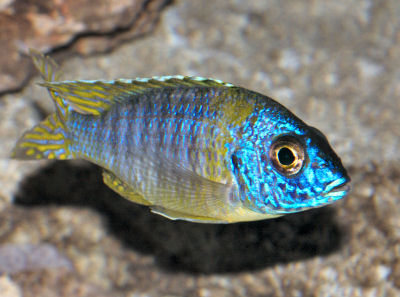
The Aulonocara Blue Goldis adazzling peacock in blues and golds, with some havingpronouncedorange shoulders!
The Aulonocara Blue Gold Aulonocara korneliae is a relatively small sized Peacock cichlid, reaching only about 4 1/3 inches (11 cm) in length. This cichlid is a member of the Aulonocara genus, a very small group of fish from Lake Malawi, Africa known as the Peacock Cichlids. This genus contains only about 23 species, but has many subspecies, and they very popular with aquarists. The brilliant color patterns in blues, reds and yellows give this group the well deserved name of “Peacock cichlids”.
The fascination andappeal of this fish is itsrich coloration.In its nominateform it has agorgeous sparkling blue head andabody with black and blue vertical bars accented withbeautifully fins of blue andgold. There is also avariety that hasan orangish cast tothe shoulder, which is called the Orange Shoulder Peacock or the Aulonocara Blue Gold Roberti. Some other common names this species is known by include Aulonocara Chizumulu, Korneliae Blue Gold, Aulonocara Korneliae Chizumulu, and Blue Gold Aulonocara.
Thefish pictured above is the Aulonocara Blue Gold Roberti or Orange Shoulder Peacock variety, notably distinguished by the orange band behind its head and having more orange on its dorsal fin. It is described as a variety of Aulonocara Korneliae but some also describe it as a separate species Aulonocara Roberti. Being a variety of A. Korneliae (a validly described species) is probably the most likely however, as the other term A. Roberti infers a separate species. Thisother designation doesn’t hold up at present as the species is unconfirmed and describingit as such issuggested to bea trivial naming.
This species of peacock cichlid is very similar to the “Red Shoulder Peacock” also called theAulonocara Fort Maguire PeacockAulonocara hansbaenschi. These two are closely related and because the color patterning of Aulonocara hansbaenschcan be extremely variable, these two can often look very much the same. This can create confusion when selecting them for the aquarium, so besides knowing the common names of these fish it helps to know the scientific names as well.
The Aulonocara, along with the Utaka Cichlids Copadichromis and other non-Mbuna’s, are members of the Haplochromis group. Haplochromis is the type genus of free-roaming browsers sometimes call “haps” or “happies”. They live in more sandy areas and open waters, and are generally larger cichlids than their Mbuna “rock-dwelling” counterparts. They also are more peaceful cichlids and should not be housed with the highly active and aggressive Mbunas.
Like all the peacock cichlids they are very handsome and easy to breed. This makes them very desirable pets for aquarists of all experience levels. But being quite hardy and easy to care for makes them an especially good fish for the beginner.
Provide them with a good sized tank. A55 gallon is the suggested minimum for one, but they will do best in 75 gallons or more when kept in a group. Have open space for swimming and a lot of caves where they can hide, sleep, or breed. A comfortable decor and regular water changes will make for a stress-free environment and healthy fish. These are some of the most carnivorous of the cichlids so they will enjoy a meaty diet. As they become comfortable with their home and routine, they can be almost puppy like and very excitable when being fed, thus adding to their appeal.
For Information on keeping freshwater fish, see:
Freshwater Aquarium Guide: Aquarium Setup and Care
- Kingdom: Animalia
- Phylum: Chordata
- Class: Actinopterygii
- Order: Perciformes
- Family: Cichlidae
- Genus: Aulonocara
- Species: korneliae
- Aquarist Experience Level: Beginner
- Size of fish – inches: 4.3 inches (11.00 cm)
- Minimum Tank Size: 55 gal (208 L)
- Temperament: Semi-aggressive
- Aquarium Hardiness: Moderately hardy
- Temperature: 74.0 to 81.0° F (23.3 to 27.2° C)
- My Aquarium – Enter your aquarium to see if this fish is compatible!
- Beginner Fish – Freshwater fish for beginners
- Community Fish – Peaceful Freshwater fish
- Hardy Fish – Hardy Freshwater fish
- Similar size fish – Fish that are 1 inch bigger or smaller
- Coldwater Fish – Looking for cold water fish? (65 °)
Habitat: Distribution / Background
The Aulonocara Blue Gold Aulonocara korneliae was described by Meyer, Riehl and Zetzsche in 1987. They are endemic to Chisumulu Island in Lake Malawi, Africa. There are currently 23 described Aulonocara species, though other subspecies exist.
This species is listed on the IUCN Red List as Vulnerable (VU) because it is endemic to Lake Malawi and occurs in only a very limited range. Other common names it is known by include Orange Shoulder Peacock, Aulonocara Chizumulu, Aulonocara Blue Gold Roberti, Korneliae Blue Gold, Aulonocara Korneliae Chizumulu, and Blue Gold Aulonocara.
They inhabit waters at depths of 29 – 39 feet (9 – 12 m) where they are often found over rocky areas. The males are often found holding territories in caves or areas where the rocks meet the sand and the females are found in large schools of around 20 individuals. These cichlids forage for food in sandy areas, feeding from the substrate on sand dwelling invertebrates. They have special sensory pores on their jaws that help them locate the crustaceans in the sand.
- Scientific Name: Aulonocara korneliae
- Social Grouping: Harems
- IUCN Red List: VU – Vulnerable
Description
The Aulonocara Blue Gold is one of the smaller species of peacock cichlids. It only grows to a length of about 4 1/3 inches (11 cm). It has a life span of 8 to 10 years with proper care.
The male is blue on the head and the back two thirds of its body are blue with dark vertical bars. There are blue and orange lines on the dorsal and caudal fin. The abdomen along with the pelvic and anal fins are orangish yellow and there are orange egg spots. There is also an orange band behind the head. The Aulonocara Blue Gold Roberti variant is very similar in coloring to the nominate form, but the nominate form does not have an apparent orange band behind the head and has less orange on the dorsal fin.
All cichlids share a common feature that some saltwater fish such as wrasses and parrotfish have and that is a well-developed pharyngeal set of teeth that are in the throat, along with their regular teeth. Cichlids have spiny rays in the back parts of the anal, dorsal, pectoral, and pelvic fins to help discourage predators. The front part of these fins are soft and perfect for precise positions and effortless movements in the water as opposed to fast swimming.
Cichlids have one nostril on each side while other fish have 2 sets. To sense “smells” in the water, they suck water in and expel the water right back out after being “sampled” for a short or longer time, depending on how much the cichlid needs to “smell” the water. This feature is shared by saltwater damselfish and cichlids are thought to be closely related.
- Size of fish – inches: 4.3 inches (11.00 cm)
- Lifespan: 8 years – They have a lifespan of 8 to 10 years with proper care.
Fish Keeping Difficulty
These cichlids make a great choice for the beginning cichlid keeper, and are appealling to the advanced aquarist as well. They are easy to care for, easy to feed, and relatively undemanding aquarium residents. They are also fairly peaceful, making good inhabitants for the community tank, and will readily breed. The aquarium does need regular water changes. They are susceptible to Malawi bloat as well as the typical diseases that effect all freshwater fish if the tank is not maintained.
- Aquarium Hardiness: Moderately hardy
- Aquarist Experience Level: Beginner
Foods and Feeding
The Aulonocara Blue Gold is carnivorous. In the wild they feed on live sand-dwelling invertebrates. In the aquarium provide them with a quality cichlid flake or pellet food as their main staple, and provide meaty supplements. Pelleted, frozen, live, and/or freeze-dried meaty foods such as daphnia, bloodworms and brine shrimp are excellent choices. Avoid tubifex worms as they contribute to a disease called “Malawi bloat.” You can also use shrimp mixes like the European Shrimp Mix, which costs less than other prepared foods and is just as nutritious.
Feed once a day when young and 5 to 6 times a week when adults unless they are breeding. Avoid the desire to feed this fish more often than it needs, as this will keep the water quality higher over a longer time.
- Diet Type: Carnivore – They are primarily carnivorous in nature, mostly seeking out meaty sand-dwelling invertebrates as food.
- Flake Food: Yes
- Tablet / Pellet: Yes
- Live foods (fishes, shrimps, worms): Some of Diet
- Meaty Food: Most of Diet
- Feeding Frequency: Daily – Juveniles should be fed daily and adults will need about 5 – 6 feedings a week.
Aquarium Care
Peacocks are hardy fish, but like all Malawi Cichlids, they will deteriorate under poor water conditions. The Malawi fish are usually kept at a higher pH, which means that ammonia is more lethal, so regular water changes are a must. They are also a messy fish because they eat mostly protein foods, which puts an additional biological load on the filtration system. The tank will need water changes of between 20 – 50% a week, depending on the bio load.
- Water Changes: Weekly – Suggested water changes of 20-50% a week, as these are messy fish producing a heavy bio load.
Aquarium Setup
The streams that flow into Lake Malawi have a high mineral content. This along with evaporation has resulted in alkaline water that is highly mineralized. Lake Malawi is known for its clarity and stability as far as pH and other water chemistries. It is easy to see why it is important to watch tank parameters with all Lake Malawi fish.
Rift lake cichlids need hard alkaline water but are not found in brackish waters. Still salt is sometimes used as a buffering agent to increase the water’s carbonate hardness. Forturnately this cichlid has some salt tolerance. It can be kept in slightly brackish water conditions, however it not suited to a full brackish water tank. It can tolerate a low salinity that is about 10% of a normal saltwater tank, which means a specific gravity of less than 1.0002.
A 55 gallon aquarium is okay for these fish, but 75 gallons is suggested. They do fine in either freshwater or slightly brackish freshwater but need good water movement along with very strong and efficient filtration. Gravel makes a good substate and the addition of crushed coral can help keep the pH up. Crushed coral or aragonite sands do tend to dissolves easier than salts. Keeping a higher pH however, means that ammonia is more lethal, so regular water changes are a must for these fish.
Some rock decor is good to create hiding places and areas of retreat, just be sure to leave open spaces along the bottom of the tank as well. These fish need plenty of swimming room on the bottom and in the mid portions of the tank. They prefer subdued lighting. A nice thing about these guys is they do not damage plants as much as other cichlids, so you can add some to your decor if desired. They prefer subdued lighting.
- Minimum Tank Size: 55 gal (208 L) – A 55 gallon tank is minimum for a single fish, 75 gallons or more is suggested for a group.
- Suitable for Nano Tank: No
- Substrate Type: Any
- Lighting Needs: Low – subdued lighting – They prefer subdued lighting.
- Temperature: 74.0 to 81.0° F (23.3 to 27.2° C)
- Range ph: 7.5-8.6
- Hardness Range: 10 – 25 dGH
- Brackish: Sometimes – Salt is not found in their natural environment, but they do have a slight tolerance, keep levels below 10% – a specific gravity of less than 1.0002.
- Water Movement: Moderate
- Water Region: Middle – These fish will swim in the bottom and middle areas of the aquarium.
Social Behaviors
The Aulonocara Blue Gold is best kept alone in a smaller 55 gallontank , or as a group of one male and 4 – 6 females in a larger tank of 75 gallons or more. They are peaceful toward those of the same species as long as it is not two males, unless tank is very large and can support different territories.
This fish is best kept with other medium sized Malawi cichlids that are not overly aggressive. They will tolerate those of a different genus as long as they are peaceful, similarly sized, though different in shape. They will get along with all other Peacock Cichlids of the same genus. Aggressive Mbunas are not good tank mates for this Orange Shoulder Peacock.
- Temperament: Semi-aggressive
- Compatible with:
- Same species – conspecifics: Yes – Can be kept in groups of 1 male with 4-6 females, 2 males will fight.
- Peaceful fish (): Monitor
- Semi-Aggressive (): Monitor
- Aggressive (): Threat
- Large Semi-Aggressive (): Threat
- Large Aggressive, Predatory (): Threat
- Threat
- Shrimps, Crabs, Snails: Threat – is aggressive
- Plants: Monitor
Sex: Sexual differences
Males are more colorful with the back part of their dorsal and anal fins being longer and sharper. Females are drabber in color with rounded anal and dorsal fins.
Breeding / Reproduction
The Aulonocara Blue Gold has been bred in captivity. Keep two females with one male for the best breeding success. The male will display an intense coloration to attract the females. All Cichlid parents tend to their young, making them easy to breed. They should have their own breeding tank. A cichlid couple guarding their babies can be a force to reckon with and this aggression is acted out on other tank mates. A 100 gallon tank is suggested.
These cichlids are mouth brooders. This is where the females will lay the eggs and then pick them up in their mouths. After that they pick at the male’s anal fin to get him to produce “milt” or sperm. The female will then take this milt into her mouth and the eggs are fertilized at that time. She will carry them in her mouth until the fry are old enough to be able to feed on their own. With other Peacocks this takes around 21 days so it is assumed the same is true for this fish. She will nibble and eat next to nothing during this time. Never house fry from different strains in the same tank, as it will be almost impossible to tell the fry and juveniles apart (until they grow).
Try and keep the different species blood lines pure. If this does not happen, pure strains can be lost permanently, unless more are wild caught, thus depleting our natural resources. See more information on breeding cichlids in Breeding Freshwater Fish: Cichlids.
- Ease of Breeding: Easy
Fish Diseases
Malawi bloat is a typical disease for African cichlids, especially if their dietary needs are not met with quality foods. They are susceptible to other typical fish ailments, especially if water is stale and of poor quality and oxygenation. One common problem is Ich. It can be treated with the elevation of the tank temperature to 86° F (30° C) for 3 days. If that does not cure the Ich, then the fish needs to be treated with copper (remove any water conditioners). Several copper based fish medications are available for Ich. Copper use must be kept within the proper levels, so be sure to follow the manufacturers suggestions. A copper test also can be used to keep the proper levels. You can also combine increasing the temperature with an Ich medication treatment.
As with most fish they are susceptible to skin flukes and other parasitic infestations (protozoa, worms, etc.), fungal infections, and bacterial infections. It is recommended to read up on the common tank diseases. Knowing the signs and catching and treating them early makes a huge difference. For information about freshwater fish diseases and illnesses, see Aquarium Fish Diseases and Treatments.
Availability
The Aulonocara Blue Gold or Orange Shoulder Peacock are sometimes found online between and are moderately expensive. They may be found in fish stores as long as you know what you are looking for. They may just be listed under “peacock” to the uneducated eye. They may also be special ordered if you are willing to wait for them if they are out of season.
References
- Animal-World References: Freshwater Fish and Plants
- Dr. Rüdiger Riehl and Hans A. Baensch, Aquarium Atlas Vol. 3 , Voyageur Press, 1996
- George Zurlo, David Schleser, Cichlids (Complete Pet Owner’s Manual), Barron’s Educational Series, 2005
- Richard F. Stratton, The Guide to Owning Cichlids, T.F.H. Publications, Inc., 2002
- David E. Boruchowitz, The Guide to Owning Malawi Cichlids, T.F.H. Publications, Inc., 2003
- Mark Phillip Smith, Lake Malawi Cichlids, A Complete Pet Owners Manual, Barron’s Educ Series, Inc. 2000
- Aulonocara korneliae (Meyer, Riehl & Zetzsche, 1987) Aulonocara chizumulu, Fishbase.org
- Aulonocara korneliae, The IUCN Red List of Threatened Species