TetraWFCh_C1250.jpg)
The Flame Tetra, as its name suggests, has a very beautiful, fiery red coloring when it’s happy!
The Flame Tetra Hyphessobrycon flammeus has a gorgeous, fiery coloring when it’s comfortable and happy in its aquarium. This tetra is generally silver in the front but becomes a fiery red on the back. The red becomes especially vibrant at the base of its fins.
When this fish is exposed to a lot of disturbances, it becomes very timid and its coloring will pale. For this reason, the Flame Tetra does not always show well in pet store aquariums where it is exposed to a lot of activity. This tetra’s otherwise vibrant coloring pales in that setting. In fact, it can even closely resemble the Black TetraGymnocorymbus ternetzi when viewed in a pet store. Consequently, the Flame Tetra is not one of the most sought-out tetras. Aquarists must know what they are looking for to experience this rewarding beauty. Some other common names for this little fish are Von Rio Tetra, Fire Tetra, Red Tetra, and a few variations of those.
Besides their coloring, the beauty of this little tetra is the ease of care. As one of the hardiest little fish, the Flame Tetra is a great choice for a new fish keeper. As an added benefit, it breeds easily when it’s comfortable. This tetra is recommended for a beginning fish keeper who wishes to experience fish breeding.
In the home aquarium, be sure to provide this fish with a pleasant environment. It is happiest in a school of 6 or more and will also do best kept with other small fish in a peaceful environment. Once Flame Tetras are established in a calm aquarium, they become very active. When acclimated, they will no longer be timid, and the aquarist is rewarded with a very happy, pretty group of fish.
For Information on keeping freshwater fish, see:
Freshwater Aquarium Guide: Aquarium Setup and Care
- Kingdom: Animalia
- Phylum: Chordata
- Class: Actinopterygii
- Order: Characiformes
- Family: Characidae
- Genus: Hyphessobrycon
- Species: flammeus
- Aquarist Experience Level: Beginner
- Size of fish – inches: 1.6 inches (3.99 cm)
- Minimum Tank Size: 10 gal (38 L)
- Temperament: Peaceful
- Aquarium Hardiness: Very Hardy
- Temperature: 73.0 to 82.0° F (22.8 to 27.8° C)
- My Aquarium – Enter your aquarium to see if this fish is compatible!
- Beginner Fish – Freshwater fish for beginners
- Community Fish – Peaceful Freshwater fish
- Hardy Fish – Hardy Freshwater fish
- Similar size fish – Fish that are 1 inch bigger or smaller
- Coldwater Fish – Looking for cold water fish? (65 °)
Habitat: Distribution / Background
The Flame Tetra Hyphessobrycon flammeus was described by Myers in 1924. This species is not listed on the IUCN Red List. They are found in South America in coastal rivers in Eastern Brazil and around Rio de Janeiro. These tetras prefer slow-flowing creeks, river tribuaries, and backwaters. Other common names for this fish include Von Rio Tetra, Fire Tetra, Red Tetra, Tetra of Rio, and Rio Tetra. They swim in schools and feed on worms, small crustaceans, and plant matter.
- Scientific Name: Hyphessobrycon flammeus
- Social Grouping: Groups
- IUCN Red List: NE – Not Evaluated or not listed
Description
The Flame Tetra is a deep-bodied fish with the typical tetra shape. This fish will generally reach about about 1 1/2 inches (4 cm) in length and has a lifespan of about 3 to 5 years.
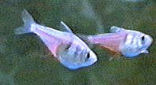
This tetra is silver in the front of its body but becomes a fiery red on the back, especially at the base of the fins. Two black stripes run up and down behind its gills, and its eyes have a blue ring. The male has a blood red anal fin while the anal fin of the female is lighter and sometimes yellow. A black tip on the pectoral fin is seen only on the female.
- Size of fish – inches: 1.6 inches (3.99 cm)
- Lifespan: 5 years – These fish have a lifespan of 3 to 5 years.
Fish Keeping Difficulty
The Von Rio Tetra is a hardy fish that is great for the beginning fish keeper. While this fish is very hardy, water cleanliness should be meticulously maintained as this fish is somewhat more susceptible to Ich and other infections. This is a great fish for beginners who want to learn fish breeding as the Flame Tetra is fairly easy to spawn.
- Aquarium Hardiness: Very Hardy – While this fish is very hardy, clean water is vital for it to thrive.
- Aquarist Experience Level: Beginner
Foods and Feeding
Since they are omnivorous, the Flame Tetra will generally eat all kinds of live, fresh, and flake foods. To keep a good balance, give them a high quality flake food every day. Feed brine shrimp (either live or frozen) or blood worms as a treat. The Flame Tetra should be fed multiple times a day and only what they can consume in 3 minutes or less.
- Diet Type: Omnivore
- Flake Food: Yes
- Tablet / Pellet: Yes
- Live foods (fishes, shrimps, worms): Some of Diet
- Vegetable Food: Some of Diet
- Meaty Food: Some of Diet
- Feeding Frequency: Several feedings per day – This fish should be fed a rich and diverse diet to promote good coloration.
Aquarium Care
Flame Tetras are not exceptionally difficult to care for provided their water is kept clean. Aquariums are closed systems, and regardless of size, all need some maintenance. Over time, decomposing organic matter, nitrates, and phosphate build up and water hardness increases due to evaporation. To combat these ever-changing conditions, water should be replaced on a regular basis, especially if the tank is densely stocked. At least 25 to 50% of the tank water should be replaced every other week.
- Water Changes: Bi-weekly
Aquarium Setup
These fish are fairly hardy, and a school of 6 will do best in an aquarium that is about 10 to 20 gallons. They are somewhat more demanding than most tetra and should have soft, peat-filtered water and open areas to swim freely. The aquarium should be heavily-planted around the sides and back and have plenty of open water for swimming in the front. A few hiding places would also be appreciated.
Flame Tetras prefer some plant cover and a darker gravel. To get the best out of this fish, set up a biotype tank. For the substrate, use a river sand with some drift wood and twisted roots. Add some dried leaves to the sand, which will stain the water a light brown, and replace the leaves every few weeks. Dim lighting will develop this tetra’s best coloring.
- Minimum Tank Size: 10 gal (38 L) – A 10-gallon aquarium is the smallest size that could house a school of this fish. This fish requires at least 6 of its kind to be comfortable.
- Suitable for Nano Tank: Yes
- Substrate Type: Any
- Lighting Needs: Moderate – normal lighting
- Temperature: 73.0 to 82.0° F (22.8 to 27.8° C)
- Breeding Temperature: 80.0° F – These fish will spawn between 80 to 84° F
- Range ph: 5.5-7.5 – A pH of 6.5 to 7.0 is preferred.
- Hardness Range: 3 – 15 dGH – A hardness of 10° dGH is preferred.
- Brackish: No
- Water Movement: Moderate
- Water Region: All – These fish will swim in all areas of the aquarium.
Social Behaviors
 |
The Flame Tetra is a good, peaceful fish recommended for all community aquariums. They are happiest in schools of 6 or more and do best if kept with other small fish in a peaceful environment. Tetras can be easily spooked into hiding, so situate the tank appropriately. Best tankmates for Flame Tetras are most livebearers, danios, rasboras, other tetras, and peaceful bottom dwellers.
- Venomous: No
- Temperament: Peaceful
- Compatible with:
- Same species – conspecifics: Yes – A minimum school of 6, but more are better.
- Peaceful fish (): Safe
- Semi-Aggressive (): Threat
- Aggressive (): Threat
- Large Semi-Aggressive (): Threat
- Large Aggressive, Predatory (): Threat
- Monitor – Tetras can out compete them for food.
- Shrimps, Crabs, Snails: Safe – not aggressive
- Plants: Safe
Sex: Sexual differences
The male has a blood-red anal fin while the female’s is lighter and sometimes yellow. The black tip on the pectoral fin is seen only on the female.
Breeding / Reproduction
Flame Tetras are egg layers, and though females are often disinterested in spawning, when receptive they are very easy to breed. These tetras mature very quickly, reaching sexual maturity in around 6 months. When spawning, they lock fins. While clasped, they perform a type of roll-over process in the vegetation. The female releases about a dozen eggs at time, and the male fertilizes them. Because of this spawning behavior, this is one tetra that must not have too dense a spawning vegetation.
The most successful way to spawn these fish is in groups of 12 with 6 males and 6 females. Feed them small, live foods, and nature should take over and spawning will begin. It is best to set up a seperate tank for breeding to get the best number of fry. Keep the tank dimly lit with clumps of spawning mops or java moss, so the female has a place to deposit the eggs. A layer of mesh also works if it is wide enough for eggs to pass through but small enough to keep parents out. The water should be soft and acidic with a pH 5.5 – 6.5 and a temperature of 80 – 84° F. A small, air-powered sponge filter is all that is really need for filtration. Filtering the water through aquarium-safe peat is a good choice.
Once a successful spawn has been achieved, remove the parents. Eggs will hatch within 24 to 36 hours, and fry will be free-swimming 3 to 4 days later. The fry are not especially robust and require extremely clean water. Fry are also light sensitive during the early stages and require an environment that is as dark as possible. For the first few days, feed the fry infusoria-type foods until they can feed on microworm or brine shrimp nauplii. The young grow rapidly and will reach maturity in about 6 months. Also see Breeding Freshwater Fish: Characins for a general description of the breeding process, and see Fish Food for Fry for information about types of foods for raising the young.
- Ease of Breeding: Moderate – Although breeding is not particularly difficult, females are often disinterested in spawning. Additionally, fry require extremely clean water and are not especially robust.
Fish Diseases
The Flame Tetras are fairly hardy and disease is not usually a problem in a well-maintained aquarium. However, they are prone to developing ick (ichthyobodo infection) and fungus if kept the tank water is not kept very clean. Also, remember that anything you add to your tank can introduce disease. Not only other fish but plants, substrate, and decorations can harbor bacteria. Take great care and make sure to properly clean or quarantine anything that you add to an established tank so as not to upset the balance.
A good thing about the Von Rio Tetra is that due to their resilience, an outbreak of disease can often be limited to just one or a few fishes if dealt with at an early stage. When keeping more sensitive types of fish, it is common for all fishes to be infected even before the first warning signs can be noticed. The best way to proactively prevent disease is to give your fish the proper environment and a well-balanced diet. The more closely their environment resembles their natural habitat, the less stress the fish will have, making them healthier and happier. A stressed fish is more likely to acquire disease.
As with most fish, Flame Tetras are prone to skin flukes, parasitic infestations (protozoa, worms, etc.), parasitic infestations (protozoa, worms, etc.), bacterial infections (general), and bacterial disease. Aquarists should read up on common tank diseases. Knowing the signs and catching and treating them early makes a huge difference. For information about freshwater fish diseases and illnesses, see Aquarium Fish Diseases and Treatments.
Availability
The Flame Tetra is readily available and inexpensive. They are also sold as Von Rio Tetra and Fire Tetra, as well as combinations of these three names.
References
- Animal-World References: Freshwater Fish and Plants
- Dr. Rüdiger Riehl and Hans A. Baensch, Aquarium Atlas Vol. 1, Publisher Hans A. Baensch, 1991
- Glen S. Axelrod, Brian M. Scott, Neal Pronek, Encyclopedia Of Exotic Tropical Fishes For Freshwater Aquariums, TFH Publications, 2005
- Joseph S. Nelson, Fishes of the World, Wiley, 2006.
- Marc Ladonne, Aquarium Fish , Barnes Noble, 1999
- Dr. Herbert R. Axelrod, Aquarium Fishes of the World, TFH Publications, 19987
- Hyphessobrycon flammeus (Myers, 1924) Flame tetra, Fishbase.org