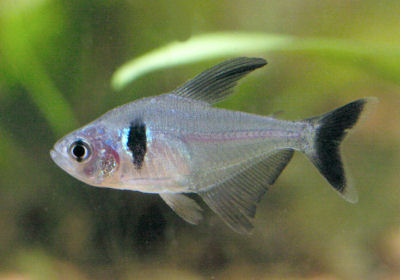
The Black Phantom Tetra is both very attractive and one of the most interesting fish to keep!
The Black Phantom Tetra Hyphessobrycon megalopterus is a very hardy and popular fish. It has been in the aquarium hobby for decades and is perhaps the most curious tetra to keep. These intriguing tetras are considered peaceful fish, yet if two males are kept together, they will have ‘mock’ battles. Fortunately, they do not typically injure each other. The Phantom Tetra does get a bit aggressive during spawning, however.
Another curiosity is that the males, though nicely patterned, are not as strikingly colored as the females. They both have the typical “tetra” shape, oval from the side view and compressed laterally. The Black Phantom Tetra has a silvery body adorned with a large black patch just behind the gills. The dorsal and tail fin create a contrast, starting out gray near the body but quickly becoming a deep black. This handsome patterning is more pronounced in the female.
This attractive tetra is one of the easiest fish to keep. The Black Phantom Tetra is very active and can be kept in pairs or in schools of at least 5 individuals. It is very peaceful with its tankmates and a prolific breeder. The Black Phantom Tetra does not require exacting water conditions in order to thrive. It is much less demanding of its environment than its cousin, the Red Phantom Tetra Hyphessobrycon sweglesi, which is similar in appearance but has a reddish tinge to its body.
For Information on keeping freshwater fish, see:
Freshwater Aquarium Guide: Aquarium Setup and Care
- Kingdom: Animalia
- Phylum: Chordata
- Class: Actinopterygii
- Order: Characiformes
- Family: Characidae
- Genus: Hyphessobrycon
- Species: megalopterus
- Aquarist Experience Level: Beginner
- Size of fish – inches: 1.8 inches (4.50 cm)
- Minimum Tank Size: 20 gal (76 L)
- Temperament: Peaceful
- Aquarium Hardiness: Moderately hardy
- Temperature: 72.0 to 82.0° F (22.2 to 27.8° C)
- My Aquarium – Enter your aquarium to see if this fish is compatible!
- Beginner Fish – Freshwater fish for beginners
- Community Fish – Peaceful Freshwater fish
- Hardy Fish – Hardy Freshwater fish
- Similar size fish – Fish that are 1 inch bigger or smaller
- Coldwater Fish – Looking for cold water fish? (65 °)
Habitat: Distribution / Background
The Black Phantom Tetra Hyphessobrycon megalopterus was described by Eigenmann in 1915. This species is listed on the IUCN Red List as Least Concern (LC) as it has a large distribution and no major widespread threats. They are found in South America in upper Paraguay and Guaporé River basins, Rio San Francisco, and central Brazil.
In Guapore and Paraguay, they inhabit the clear waters that feed the Pantanal wetlands, but in other regions can be found in murky waters with dense aquatic vegetation. They usually live in groups and feed on worms, small insects, and crustaceans.
- Scientific Name: Hyphessobrycon megalopterus
- Social Grouping: Groups
- IUCN Red List: LC – Least Concern – Assessed as Least Concern due to its very large distribution and the lack of any known major widespread threats.
Description
The Black Phantom Tetra has the typical “tetra” shape, oval from the side view and compressed laterally.This fish will generally reach about 1 3/4 inches (4.5 cm) in length and has a lifespan of about 5 to 6 years. This fish has a large black patch behind the gills, and the front of the dorsal fin and the anal fin is edged in black. The tailfin and the dorsal fins start out gray near the body, but quickly fade into large black areas.
The males are not quite as strikingly colored as the females. Females are beautifully colored with red adipose, pectoral, and anal fins. The male has a larger dorsal fin and is more of a smoky gray color.
- Size of fish – inches: 1.8 inches (4.50 cm)
- Lifespan: 6 years – These fish have a life span of 5 to 6 years.
Fish Keeping Difficulty
The Phantom Tetra is a durable fish that is great for the beginning fish keeper. They adapt very well to water condition changes and make a great addition to most community tanks.
- Aquarium Hardiness: Moderately hardy
- Aquarist Experience Level: Beginner
Foods and Feeding
The Black Phantom Tetras are omnivorous. In the wild they feed primarily on worms, small insects, and crustaceans but in the aquarium they will generally eat all kinds of live, fresh, and flake foods. To keep a good balance give them a high quality flake food everyday. Feed brine shrimp (either live or frozen) or blood worms as a treat.
- Diet Type: Omnivore
- Flake Food: Yes
- Tablet / Pellet: Yes
- Live foods (fishes, shrimps, worms): Some of Diet
- Vegetable Food: Some of Diet
- Meaty Food: Some of Diet
- Feeding Frequency: Several feedings per day
Aquarium Care
Black Phantom Tetras are not exceptionally difficult to care for provided their water is kept clean. At least 25 to 50% of the tank water should be replaced every other week, especially if the tank is densely stocked. They are very active fish so its best to to keep them in a longer tank, at least 20 inches. They like some plants but not so densely planted as to interfere with their swimming.
- Water Changes: Bi-weekly
Aquarium Setup
These fish are fairly hardy and are best kept in a school of six or more. Because they are very active swimmers, Black Phantom Tetras should be kept in a tank at least 20 inches long and ideally 20 or more gallons. These tetras should have soft, peat-filtered water. These fish need open areas to swim freely, but prefer some plant cover and a darker gravel. Use dim lighting to develop their best coloring.
The aquarium should be heavily planted around the sides and back and have plenty of open water for swimming. To get the best out of this fish, set up a biotype tank. For the substrate, use a river sand with some drift wood and twisted roots. Add some dried leaves to the sand, which will stain the water a light brown, and replace the leaves every few weeks. Additionally, the tank should be securely covered as these fish are skilled jumpers and will probably do so if given the opportunity.
- Minimum Tank Size: 20 gal (76 L) – These active, schooling fish should be kept in a tank at least 20 inches long and 20 or more gallons.
- Suitable for Nano Tank: Yes
- Substrate Type: Any
- Lighting Needs: Low – subdued lighting
- Temperature: 72.0 to 82.0° F (22.2 to 27.8° C)
- Breeding Temperature: 77.0° F
- Range ph: 6.0-7.5 – A pH of 6.5 is preferred.
- Hardness Range: 1 – 18 dGH – A hardness of 10° dGH is preferred.
- Brackish: No
- Water Movement: Moderate
- Water Region: All – These fish will swim in all areas of the aquarium.
Social Behaviors
The Black Phantom Tetra are generally a very peaceful and good community fish. They are ideal for a community aquarium with other peaceful fish. They can be kept in schools of at least 6 individuals, or in pairs. If 2 males are kept together, they will act as if they are fighting but will not actually hurt each other.
Tetras can be easily spooked into hiding, so situate the tank appropriately. These tetras are best kept with live bearers, danionins, rasboras, other tetras, peaceful bottom dwellers, most gouramis, and small cichlids.
- Venomous: No
- Temperament: Peaceful
- Compatible with:
- Same species – conspecifics: Yes – This schooling fish requires a group of at least five of its own kind. Two males will engage in “mock” fighting but will not actually hurt each other.
- Peaceful fish (): Safe
- Semi-Aggressive (): Threat
- Aggressive (): Threat
- Large Semi-Aggressive (): Threat
- Large Aggressive, Predatory (): Threat
- Threat – Tetras will out compete them for food.
- Shrimps, Crabs, Snails: Safe – not aggressive
- Plants: Safe
Sex: Sexual differences
The female is beautifully colored with red adipose, pectoral, and anal fins. The male is more of a smoky gray color has a larger dorsal fin.
Breeding / Reproduction
Black Phantom Tetras are moderately easy to breed. These egg scattering spawners exhibit no parental care. They will spawn in clusters of fine-leaved plants, with the male chasing the female through the plants. The female will scatter between 300 to 400 eggs in one spawning, and the male will fertilize them. They are best spawned in pairs, as males get aggressive with one another when breeding or defending a territory. Condition the breeders with small, live foods.
Set up a separate tank for breeding to get the best number of fry. Provide a tank no larger than 10 ten gallons, though a smaller, 3 to 5 gallon tank is adequate. The breeding tank should be dimly lit and heavily planted. Clumps of fine-leaved plants, spawning mops, or java moss provide places for the female to deposit the non-adhesive eggs, and floating plants will help keep the tank dim. A layer of mesh also works if it is wide enough for eggs to pass through but small enough to keep parents out.
The suggested breeding temperature is in the upper end of their range, at about 77° F (25° C). Lowering the pH to about 5.0 to 5.6 pH will stimulate breeding behavior. Water hardness should be below 4° dGH. A small, air-powered sponge filter is all that is really need for filtration, though filtering the water through aquarium-safe peat is a good choice.
Once a successful spawn has been achieved, remove the parents as they will eat the eggs and fry. The eggs hatch in just over a day, but are very susceptible to fungus. To help reduce fungus, make sure the eggs are exposed to very little light. Remove any infected eggs, so they don’t spread fungus to the other eggs. The fry will be free-swimming after about 5 days. For the first few days, feed the fry infusoria-type foods until they can feed on microworm or brine shrimp nauplii. See Breeding Freshwater Fish: Characins for a general description of breeding processes, and see Fish Food for Fry for information about types of foods for raising the young.
- Ease of Breeding: Moderate – A separate breeding tank is required. Although breeding is not particularly difficult, males will become aggressive towards one another.
Fish Diseases
As with most fish, the Black Phantom Tetra are prone to skin flukes, parasitic infestations (protozoa, worms, etc.), ichthyobodo infection, parasitic infestations (protozoa, worms, etc.), bacterial infections (general), and bacterial disease. The Black Phantom Tetra is extremely hardy and disease is not usually a problem in a well-maintained aquarium. That being said, there is no guarantee that you won’t have to deal with health problems or disease. Remember, anything you add to your tank can introduce disease. Not only other fish but plants, substrate, and decorations can harbor bacteria. Take great care and make sure to properly clean or quarantine anything that you add to an established tank so as not to upset the balance.
A good thing about Black Phantom Tetra is that due to their resilience, an outbreak of disease can often be limited to just one or a few fishes if dealt with at an early stage. When keeping more sensitive types of fish, it is common for all fishes to be infected even before the first warning signs can be noticed. The best way to proactively prevent disease is to give your Black Phantom Tetra the proper environment and a well-balanced diet.
The more closely their environment resembles their natural habitat, the less stress the fish will have, making them healthier and happier. It is recommended to read up on the common tank diseases. Knowing the signs of common tank diseases and treating them early makes a huge difference. For information about freshwater fish diseases and illnesses, see Aquarium Fish Diseases and Treatments.
Availability
The Black Phantom Tetra is readily available and inexpensive.
References
- Animal-World References: Freshwater Fish and Plants
- Glen S. Axelrod, Brian M. Scott, Neal Pronek, Encyclopedia Of Exotic Tropical Fishes For Freshwater Aquariums, TFH Publications, 2005
- Joseph S. Nelson, Fishes of the World, Wiley, 2006.
- Dr. Herbert R. Axelrod, Aquarium Fishes of the World, TFH Publications, 1998
- Hyphessobrycon megalopterus (Eigenmann, 1915) Black phantom tetra, Fishbase.org
- Hyphessobrycon megalopterus, The IUCN Red List of Threatened Species