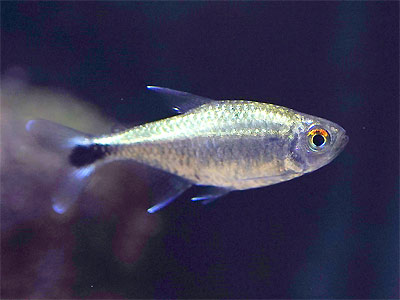
The Golden Tetra looks like it has had gold paint sprayed all over its body!
The Golden Tetra Hemigrammus rodwayi is a pretty little characin. Its gold appearance is due to a specialized layer on its skin that defends it against a trematode parasite. This fish is more prone to disease, especially skin parasites, than many tetras. The gold color comes from ‘guanin,’ which is secreted by its skin to protect it against these parasites. This makes it look like it has been covered with gold dust, thus its name. It is also known as the Gold Tetra and Brass Tetra.
These tetras are fairly hardy. Some authors feel they are a more difficult fish to keep, but we have not had any unusual problems. They are not as commonly available as other more popular and colorful tetras, such as the Neon Tetra, but if you can find them, they make a nice addition to the community tank.
This peaceful schooling fish can be kept in groups of 6 or more in a 15 to 20 gallon aquarium. Woodwork and floating plants to dim the light will help make them feel comfortable. They don’t actually need plants as an interior decor, but the aquarium can be planted around the sides and back to keep plenty of open water for swimming in the front. Twisted roots or driftwood decor that provides a few hiding places will be appreciated.
The Gold Tetras are considered a bit more difficult to breed than other characins. For some unknown reason, offspring tend to lose their gold coloring. They also may not be gold colored in pet stores. This may be because the gold color is not natural but rather a pathological condition.
For Information on keeping freshwater fish, see:
Freshwater Aquarium Guide: Aquarium Setup and Care
- Kingdom: Animalia
- Phylum: Chordata
- Class: Actinopterygii
- Order: Characiformes
- Family: Characidae
- Genus: Hemigrammus
- Species: rodwayi
- Aquarist Experience Level: Intermediate
- Size of fish – inches: 1.6 inches (3.99 cm)
- Minimum Tank Size: 15 gal (57 L)
- Temperament: Peaceful
- Aquarium Hardiness: Moderately Difficult
- Temperature: 75.0 to 82.0° F (23.9 to 27.8° C)
- My Aquarium – Enter your aquarium to see if this fish is compatible!
- Beginner Fish – Freshwater fish for beginners
- Community Fish – Peaceful Freshwater fish
- Hardy Fish – Hardy Freshwater fish
- Similar size fish – Fish that are 1 inch bigger or smaller
- Coldwater Fish – Looking for cold water fish? (65 °)
Habitat: Distribution / Background
The Golden Tetra Hemigrammus rodwayi was described by Durbin in 1909. They are found in South America in Guyana, Suriname, French Guiana, and the Amazon River basin. This species is not listed on the IUCN Red List.
They inhabit flood plains as well as coastal creeks where there can be some salinity. These fish have been successfully bred in captivity, but for some unknown reason, aquarium-bred young tend to lose their gold coloring. Other common names they are known by include Gold Tetra and Brass Tetra.
- Scientific Name: Hemigrammus rodwayi
- Social Grouping: Groups
- IUCN Red List: NE – Not Evaluated or not listed
Description
The Golden Tetra is a full-bodied tetra species. This fish will generally reach about 1 1/2 inches (4 cm) in the home aquarium and has a lifespan of about 3 to 5 years. True to its name, it looks like it has gold dust sprinkled on its body. The gold color comes from ‘guanin,’ which is secreted by its skin to protect it against skin parasites. The Golden Tetra’s tail fin is red on the top and the bottom with a black arrowhead-shaped spot in the middle. The dorsal and anal fins are golden and tipped with white, and its very small, soft ray dorsal fin is also red.
The coloration of this fish is very dependant on whether it is captive-bred or wild-caught. Wild-caught specimens will have the gold coloring as a result of the secretion of ‘guanin’ to protect the skin from parasites. In captivity, this protective cover may not be secreted if the parasites are not present, so captive-bred specimins will be silver only.
- Size of fish – inches: 1.6 inches (3.99 cm)
- Lifespan: 5 years – They have a lifespan of about 3 to 5 years.
Fish Keeping Difficulty
The Golden Tetra is a bit difficult to keep and recommended for aquarists with some fish keeping experience. Wild-caught Golden Tetras are particularly prone to disease and stress caused by changes in water conditions.
- Aquarium Hardiness: Moderately Difficult – Specimens are often wild-caught. As such, they will generally be less tolerant of fluctuating or less-than-optimal conditions.
- Aquarist Experience Level: Intermediate
Foods and Feeding
Since they are omnivorous, the Golden Tetra will generally eat all kinds of live, fresh, and flake foods. To keep a good balance, give them a high quality flake food every day. Feed brine shrimp (either live or frozen) or blood worms as a treat. When feeding, only offer what the fish can eat within a few minutes and remove any excess. These fish will overeat, so keep a close eye on them during feeding time.
- Diet Type: Omnivore
- Flake Food: Yes
- Tablet / Pellet: Yes
- Live foods (fishes, shrimps, worms): Some of Diet
- Vegetable Food: Some of Diet
- Meaty Food: Some of Diet
- Feeding Frequency: Several feedings per day – Offer only what they can consume in 3 minutes or less with multiple feedings per day.
Aquarium Care
Golden Tetras are not exceptionally difficult to care for provided their water is kept clean. Aquariums are closed systems, and regardless of size, all need some maintenance. Over time, decomposing organic matter, nitrates, and phosphate build up and water hardness increases due to evaporation. To combat these ever-changing conditions, water should be replaced on a regular basis, especially if the tank is densely stocked. At least 25 to 50% of the tank water should be replaced every other week.
- Water Changes: Weekly – Most established tanks can have a bi-weekly or even monthly water change if they are not overstocked.
Aquarium Setup
The Golden Tetra will do best in schools of 5 or more, so they need a 15 to 20 gallon aquarium or larger. They prefer soft lighting and peat-filtered water. To simulate the black waters that they come from, simply add a mesh bag of aquarium-safe peat to the filter. Dim lighting can accomplished with the addition of some floating plants.
Woodwork and floating plants will make them feel comfortable. A biotype setup is the best choice for this tetra and is very easy to put together. The substrate should be made up of river sand. A few hiding places would be appreciated, so add some driftwood branches and twisted roots. If driftwood is hard to get, an alternative is common beech that has been dried and stripped of all its bark. Some dried leaves can be added to stain the water and give the aquarium a natural feel. Leaves should be removed and replaced every few weeks.
- Minimum Tank Size: 15 gal (57 L)
- Suitable for Nano Tank: Yes
- Substrate Type: Any
- Lighting Needs: Low – subdued lighting – Lower light levels will bring out the best reflective qualities of their pigmentation.
- Temperature: 75.0 to 82.0° F (23.9 to 27.8° C)
- Breeding Temperature: 79.0° F – For breeding, it is recommended to have soft water, a pH of 6.3, 12° dGH, and a temperature between 79 and 84° F.
- Range ph: 6.0-7.5
- Hardness Range: 2 – 15 dGH
- Brackish: No
- Water Movement: Moderate
- Water Region: All – These fish will swim in all areas of the aquarium.
Social Behaviors
The Golden Tetra are ideal for a community aquarium with other peaceful fish. Be sure to keep them in groups of at least 5 or more tetras. This fish will happily school with its relatives like the Rosy Tetra, Black Widow Tetra, White Skirt Tetra, Bleeding Heart Tetra, etc. Tetras are startled by loud sounds or excessive movement outside the tank, so place their tank appropriately.
- Venomous: No
- Temperament: Peaceful
- Compatible with:
- Same species – conspecifics: Yes – These fish should be kept in a school of at least 5, though more are better.
- Peaceful fish (): Safe
- Semi-Aggressive (): Threat
- Aggressive (): Threat
- Large Semi-Aggressive (): Threat
- Large Aggressive, Predatory (): Threat
- Monitor – Tetras can out compete them for food.
- Shrimps, Crabs, Snails: Safe – not aggressive
- Plants: Safe
Sex: Sexual differences
The female has a fuller stomach area. The male’s anal fin is white, and he has more red than the female. The male is almost always more colorful.
Breeding / Reproduction
Golden Tetra are egglayers. These fish have been successfully bred in captivity, but for some unknown reason, the aquarium-bred young tend to lose their gold coloring. The most successful way to spawn these fish is in groups of 12 with 6 males and 6 females. Feed this group small live foods, and nature should take over and spawning will begin. The female will lay eggs on plants or green floss.
A separate breeding tank, about 10 gallons in size, will help get the best number of fry. Keep the tank dimly lit with clumps of spawning mops or java moss, so the female has a place to deposit the eggs. A layer of mesh also works as long as the spaces are wide enough for the eggs to pass through but small enough to keep the parents out. The water should be soft and acidic with a pH of 5.5 to 6.5 and a temperature of 79 to 84° F. A small air-powered sponge filter is all that is really need for filtration. Filtering the water through aquarium-safe peat is a good choice.
Once a successful spawn has been achieved, remove the parents. Eggs will hatch within 24 to 36 hours, and fry become free-swimming 3 to 4 days later. For the first few days, feed the fry infusoria-type foods until they can feed on microworms or brine shrimp nauplii. Fry are light sensitive during the early stages and require an environment that is as dark as possible. See Breeding Freshwater Fish: Characins for a general description of breeding processes, and see Fish Food for Fry for information about types of foods for raising the young.
- Ease of Breeding: Moderate – A separate breeding tank is required. The breeding pair will spawn on vegetation and should be removed thereafter.
Fish Diseases
Golden Tetra are prone to developing ick and fungus if their tank water is not kept clean enough. Also, remember anything you add to your tank can introduce disease. Not only other fish but plants, substrate, and decorations can harbor bacteria. Take great care and make sure to properly clean or quarantine anything that you add to an established tank so as not to upset the balance.
A good thing about this tetra is they can be used as markers for poor water conditions, allowing the observing aquarist to catch issues at an early stage. When keeping more sensitive types of fish, it is common for all fishes to be infected even before the first warning signs can be noticed. The best way to proactively prevent disease is to provide the proper environment and a well-balanced diet. The more closely their environment resembles their natural habitat, the less stress the fish will have, making them healthier and happier. Stressed fish are more likely to acquire disease.
As with most fish, Golden Tetra are prone to skin flukes, parasitic infestations (protozoa, worms, etc.), ichthyobodo infection, parasitic infestations (protozoa, worms, etc.), bacterial infections (general), and bacterial disease. Golden Tetra are fairly hardy, but even in a well-maintained tank, they are prone to disease. Aquarists should read up on common tank diseases. Knowing the signs and catching and treating them early makes a huge difference. For information about freshwater fish diseases and illnesses, see Aquarium Fish Diseases and Treatments.
Availability
The Golden Tetra is occasionally available in pet stores and online and is moderately priced.
References
- Animal-World References: Freshwater Fish and Plants
- Dr. Rüdiger Riehl and Hans A. Baensch, Aquarium Atlas Vol. 1, Publisher Hans A. Baensch, 1991
- Joseph S. Nelson, Fishes of the World, Wiley, 2006.
- Dr. Herbert R. Axelrod, Aquarium Fishes of the World, TFH Publications, 1998
- Dr. Herbert R. Axelrod, Dr. Warren E Burgess, Dr. Cliff W. Emmens, Neal Pronek, Jerry G. Walls, Ray Hunziker, Dr. Axelrod’s Mini-Atlas of Aquarium Fishes, Mini- Edition, T.F.H. Publications, Inc., 1987
- Hemigrammus rodwayi (Durbin, 1909), Fishbase.org