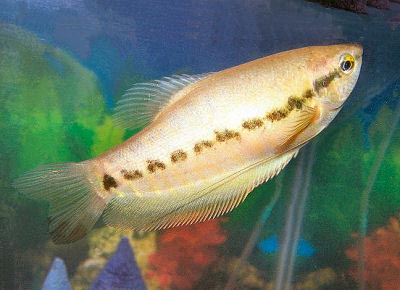
The Snakeskin Gourami is known as the most peaceful and the most prolific of all the gourami species!
The Snakeskin Gourami Trichopodus pectoralis (previously Trichogaster pectoralis) is a large fish. In the aquarium they generally reaching between 6 – 8″ (15 – 20 cm) in length. But they have been reported to reach lengths of 10 inches (25.4 cm) in their native habitat with bodies as thick as a man’s hand. They are regarded by the locals as good to eat. It’s a very popular as a food fish and is cultivated for that purpose, and to a lesser degree is sold as an aquarium fish.
Though not necessarily the most beautiful gourami, they do have a rather striking appearance for which they are aptly named. The scientific term ‘pectoralis‘ is derived from the long pectoral fins. Its other descriptive common names include Siamese gourami and Snake-skinned Gourami.
Overall they are colored in olive grays to light yellowish browns. Much like a snake’s skin, they have a broken dark line running along mid-body and numerous dark diagonal stripes, especially on the back half, though they are not always distinct. Juveniles are especially notable for a strong zig-zag line from the eye to the base of the tail. Males are noted for a fringe of orange-red along the edge of the pelvic fin and a dorsal fin that becomes a longer flowing pennant.
This fish is a member of the suborder Anabantoidei also known as Anabantoids or Labyringth fish. They differ from all other fish because they can breathe atmospheric oxygen. They can still get oxygen by passing water through their gills, but they have an additional respiratory organ called the “labyrinth organ”. In nature if the water begins to dry up or becomes polluted, this organ gives them the distinct ability to breath oxygen by gulping air at the surface. Another labyrinth fish characteristic this fish displays is that of being a bubble nest builder.
Some labyrinth fish also have voices and the Snakeskin Gourami is no exception. The fish has a kind of vocalization that sounds like croaking, growling, or cracking tones. This is generally most pronounced during breeding or with territorial type behavior, but whether it has any special function is unknown.
This fish is extremely hardy and easy to breed, making it a great fish for beginners with a large aquarium. It is a long lived species and seems to be quite aware of its owners. It also has an endearing habit of using its pelvic fins to feel the environment and even feel its tank mates. But if you want to keep or breed this gourami make sure you have a good sized aquarium. Not only does this fish get quite large, but its spawns are also unusually large. There can be as many as 5,000 fry from a single spawning period. While juveniles can be easily housed in a 15 – 20 gallon aquarium, adults do better with at least 35 gallons. The tank needs to be well planted but roomy, with open areas for swimming.
These are hardy fish but even better than that they are an exceptionally peaceful gourami. Their pleasant demeanor makes them an excellent candidate for a community aquarium. They can be kept with all sorts of other mild mannered fish as long as their companions won’t be intimidated by their eventual large size. In fact these fish are so peaceful they won’t even eat their fry, which is unusual for for gouramis and many other types of fish. They also won’t eat the fry of any other species. But because they are quite timid, their tankmates also need to be non-aggressive fish.
For Information on keeping freshwater fish, see:
Freshwater Aquarium Guide: Aquarium Setup and Care
- Kingdom: Animalia
- Phylum: Chordata
- Class: Actinopterygii
- Order: Perciformes
- Family: Osphronemidae
- Genus: Trichopodus
- Species: pectoralis
- Aquarist Experience Level: Beginner
- Size of fish – inches: 9.8 inches (24.99 cm)
- Minimum Tank Size: 35 gal (132 L)
- Temperament: Peaceful
- Aquarium Hardiness: Very Hardy
- Temperature: 72.0 to 86.0° F (22.2 to 30.0° C)
- My Aquarium – Enter your aquarium to see if this fish is compatible!
- Beginner Fish – Freshwater fish for beginners
- Community Fish – Peaceful Freshwater fish
- Hardy Fish – Hardy Freshwater fish
- Similar size fish – Fish that are 1 inch bigger or smaller
- Coldwater Fish – Looking for cold water fish? (65 °)
Habitat: Distribution / Background
The Snakeskin Gourami Trichopodus pectoralis (previously Trichogaster pectoralis was described by Regan in 1910. It is found in Asia, originating from the tropical Far East in Thailand and Cambodia to southern Viet Nam, Malaysia, Mekong basin in Laos, Malakka, and the Chao Phraya basin. it has also been introduced outside of its native range with populations found in the Philippines, Malaysia, Indonesia, southern China (Hong Kong), Singapore, Papua New Guinea, Sri Lanka, and New Caledonia. Other common names it is known by include Siamese gourami, Snake-skinned Gourami, and Snake Skin Gourami.
There has been a recent change to its generic name. A paper by Myers back in 1923 resulted in a taxonomic misinterpretation which was only recently brought to light. At the time of his paper, the generic name Trichogaster was adopted for the larger eastern species of gourami from Southeast Asia. Recently the interpretation by Myers came under review and this previous taxonomical structure was revisited and then restructured. The result is that the species which had been placed under Trichogaster have now been reverted back to Trichopodus, as per Topfer and Schindler in 2009, and Tan and Kottelat in 2009.
This species is listed on the IUCN Red List as Least Concern (LC). Although native populations have been declining, primarily due to habitat loss and degradation, it is widely distributed throughout its natural range and has been widely introduced into many other areas. It is used as a food fish in the countries of its origin and it has been introduced in other areas including Sri lanka as a food fish. At least one country now reports it as having an adverse ecological impact.
In nature these fish are found in rice paddies, shallow ponds, and swamps. They inhabit shallow, slowly flowing or standing waters, that have dense vegetation. During the wet seasons they will enter the flooded forests of the lower Mekong, and then gradually move back as floodwaters recede. They are omnivorous in nature but feed primarily on aquatic plants.
An interesting behavior found in both the Trichopodus and Trichogaster species, similar to that of the Archer FishToxotes jaculatrix, is that they have been observed catching their prey by squirting water. They do this by aligning themselves diagonally in the water to watch for prey above. Then with sudden contractions of their mouth cavity, they will squirt drops of water at the prey, knocking it off its perch into the water, where it is quickly snapped up by the fish. It has been observed in these fish mostly during breeding.
- Scientific Name: Trichopodus pectoralis
- Social Grouping: Groups – In nature these fish live communally with other peaceful species.
- IUCN Red List: LC – Least Concern
Description
The Snakeskin Gourami has an elongated oval shape and is somewhat compressed laterally. This fish has long pectoral fins, from which its scientific name ‘pectoralis‘ is derived. The male’s dorsal fin also becomes a longer flowing pennant while the female’s dorsal fin is rounded. The ventral fins are threadlike and extremely sensitive.
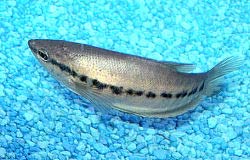 Snakeskin Gourami – juvenile Photo © Animal-World: Courtesy Michelle Storsberg
This fish has a labyrinth organ, a part of the fish which allows it to absorb atmospheric oxygen directly into the bloodstream. It will generally reach between 6 – 8 inches (15 – 20 cm) in the aquarium, but specimens in the wild have been reported to reach up to almost 10 inches (25 cm) in length. They will breed at 5 inches (12.5 cm) in length. The average lifespan is about 4 to 6 years with good care.
The body color of this gourami is an olive gray to light yellowish brown. There is a broken dark line running horizontally mid body and numerous dark diagonal stripes, though they are not always distinct. Males also develop a fringe of orange-red along the edge of the pelvic fin. Juveniles are perhaps the most striking, having strong zig-zag lines from the eye to the base of the tail. This patterning fades away as the fish matures.
- Size of fish – inches: 9.8 inches (24.99 cm) – These fish generally get up to 6 – 8″ (15 – 20 cm), though they can reach up to almost 10 inches (25 cm) in the wild.
- Lifespan: 4 years – The average lifespan is 4 – 6 years with proper care.
Fish Keeping Difficulty
This gourami is extremely hardy and easy to breed. It can make a great fish for beginners who can provide them with a proper aquarium. This is a very peaceful fish so can be kept with a variety of community tankmates. However because it is a really good sized fish with a timid nature, it needs a large tank with plenty of plants.
- Aquarium Hardiness: Very Hardy
- Aquarist Experience Level: Beginner
Foods and Feeding
The Snakeskin Gouramis are omnivorous, though in the wild they primarily feed on aquatic plants. In the aquarium these fish will generally eat all kinds of live, fresh, and flake foods. To keep a good balance give them a quality flake or pellet food as the base to the diet. Generally feed once or twice a day.
In the wild a good portion of their diet is green foods so they need regular offerings of vegetable pellets (like spiralina algae wafers) and fresh vegetables such as blanched lettuce. Supplementation can also include white worms, blood worms, brine shrimp, or any other suitable substitute. This fish will not eat fry of any sort, nor even snails.
- Diet Type: Omnivore
- Flake Food: Yes
- Tablet / Pellet: Yes
- Live foods (fishes, shrimps, worms): Some of Diet
- Vegetable Food: Most of Diet
- Meaty Food: Some of Diet
- Feeding Frequency: Daily – Generally feed once or twice a day.
Aquarium Care
These are extremely hardy fish but because they eat a lot, water quality must be maintained. Although the labyrinth organ allows the fish to survive in oxygen depleted water, it is a common misconception that this makes water changes unnecessary. This is hardly the case as these fish will suffer the same tissue damage from built up toxins as any other fish. Regular water changes are a must with 25% weekly being recommended.
- Water Changes: Weekly – Weekly water changes of 25% are recommended.
Aquarium Setup
The Snakeskin Gouramis enjoy an aquarium that is roomy but with more subdued lighting. They will swim in all areas of the tank, but particularly in the middle and top portions. While juveniles can be easily housed in a 15 – 20 gallon aquarium, adults do better with at least 35 gallons. It’s desirable to keep the tank in a room with a temperature as close as possible to the tank water to prevent damaging the labyrinth organ. Provide a good filtration system that produces a gentle flow while also efficiently removing waste. This fish will be bothered by a strong current in the tank, especially if the tank is small. Air stones can help provide well oxygenated water.
These gouramis will show their colors best on a dark substrate. The tank should be decorated in a manner that offers plenty of hiding places for this shy fish to live happily. This species appreciates plenty of plants and the cover of floating plants, however they will regularly breath air at the surface so its important to have some open areas as well.
- Minimum Tank Size: 35 gal (132 L) – Juveniles can be kept in a 15 – 20 gallon aquarium, but adults need more space.
- Suitable for Nano Tank: Sometimes
- Substrate Type: Any
- Lighting Needs: Low – subdued lighting
- Temperature: 72.0 to 86.0° F (22.2 to 30.0° C) – Keep the surrounding room temperature consistent with the water temperature to avoid causing trauma to the labyrinth organ.
- Breeding Temperature: 82.0° F – They will breed with temperatures at about 82° F (28° C).
- Range ph: 6.0-8.3
- Hardness Range: 2 – 30 dGH
- Brackish: No
- Water Movement: Weak – This fish will be bothered by a strong current in the tank, especially if the tank is small.
- Water Region: All – These fish will swim in all areas, but particularly in the middle and top portions of the aquarium.
Social Behaviors
The Snakeskin Gouramis are the most peaceful of all gouramis. Even though they get quite large they are an excellent community fish. They are so unassuming that they won’t eat their offspring when fry, nor will they eat the fry of any other fish. But because they are quite timid, they need to be housed with other non-aggressive fish.
All sorts of commonly available aquarium fish make excellent tankmates. They can be kept with cyprinids like barbs, larger danios, and rasboras. Many of the Tetras, catfish like Corydoras and loricariids, many loach species, friendlier cichlids like the angelfish, and smaller Rainbowfish all make great tankmates.
- Temperament: Peaceful
- Compatible with:
- Same species – conspecifics: Yes – Though males will display territorial type behavior when breeding, they are relatively non-aggressive.
- Peaceful fish (): Safe
- Semi-Aggressive (): Monitor
- Aggressive (): Threat
- Large Semi-Aggressive (): Threat
- Large Aggressive, Predatory (): Threat
- Monitor
- Shrimps, Crabs, Snails: Safe – not aggressive
- Plants: Monitor
Sex: Sexual differences
The male is slimmer than the female and has longer more pointed dorsal and anal fins, and the female is slightly less colorful. Males also develop a fringe of orange-red along the edge of the pelvic fin.
Breeding / Reproduction
The Snakeskin Gourami is easy to breed and like most fish in this family, they are bubble nest builders. They will breed when they reach 5 inches (12.5 cm) length. Males will participate in mouth combat with other males. It’s not quite like that of the cichlid species, but more like that seen in the Kissing GouramiHelostoma temminkii. They will face each other and swim slowly together. The lips are then pressed into contact and quickly released.
The nest of this species is generally rather small and they build it under plants or pieces of vegetation, yet these are the most prolific of all the gourami species. As many as 5,000 fry will result from a single spawning period. An unusual trait of this species is that once they have spawned, they have no further interest in the eggs or the fry. They won’t collect any of the eggs that didn’t make it into the nest as other gouramis do, nor will they eat the eggs or the fry.
Prior to spawning they should be well conditioned with small offerings of live and frozen foods several times a day. When well fed, females should begin filling out with eggs, appearing very plump. A pair will be most likely to spawn if the tank is roomy and well planted with a good sized surface area and a temperature to their liking. It is best to provide a breeding tank, 10 to 20 gallons or more, and keep the water level low, ideally about 4 – 5″ (10 – 13 cm). Water parameters should have a pH of around 7 and a temperature at about 82° F (28° C). A small gently air-powered sponge filter or some peat filtration can be added, but the tank current should be minimal. They need some floating plants like Ricca or stem plants grown to the surface which will help keep the bubble nest in place.
They are more likely to breed when kept as a pair, and when not bothered by other tankmates. A healthy pair of adults can be introduced into the breeding tank. Once the nest had been built the male will begin a courtship display to entice the female to spawn. After a few trial pairings, the will spawn directly under the nest with the male wrapping his body around the female, and she then expels a few eggs. The male will immediately fertilize them and the pair will then spawn again, producing up to 5000 eggs. Their eggs as well as the fry, are lighter than water and float to the top.
After spawning the neither the male nor the female have any interest in the eggs. Any eggs that fail to go into the nest are not collected, and are completely ignored. The eggs will hatch in about 36 hours and the fry become free swimming in about 3 more days. Both parents have no interest in the fry and will completely ignore them. The free swimming fry can be fed infusoria or a liquid fry food until they are large enough to eat baby brine shrimp. At this time the tank needs to have little or no water movement, filtration won’t be necessary as they can receive air at the surface. The water also needs to be kept quite warm for the fry, at about 84° F (29° C). See the description of anabantoid breeding techniques in: Breeding Freshwater Fish: Anabantoids. Also see Fish Food for Fry for information about types of foods for raising the young.
- Ease of Breeding: Easy
Fish Diseases
Snakeskin Gouramis are very hardy so disease is not usually a problem in a well maintained aquarium. Some diseases they are prone to are bacterial infections, constipation and Hole in the Head if good water quality, nutrition, and maintenance is not provided. With any additions to a tank such as new fish, plants, substrates, and decorations there is a risk of introducing disease. It’s advisable to properly clean or quarantine anything that you want add to an established tank prior to introduction, so as not to upset the balance.
These fish are very resilient but knowing the signs of illness, and catching and treating them early makes a huge difference. An outbreak of disease can often be limited to just one or a few fishes if you deal with it at an early stage. The best way to proactively prevent disease is to give your fish the proper environment and a well balanced diet. The closer to their natural habitat the less stress the fish will have, making them healthier and happy. A stressed fish will is more likely to acquire disease. For information about freshwater fish diseases and illnesses, see Aquarium Fish Diseases and Treatments.
Availability
The Snakeskin Gourami is available from time to time both in stores and online, and is reasonably priced.
References
- Animal-World References: Freshwater Fish and Plants
- Trichopodus pectoralis (Regan, 1910) Snakeskin gourami, Fishbase.org
- Trichopodus pectoralis, The IUCN Red List of Threatened Species
- Dr. Rudiger Riehl and Hans A. Baensch, Aquarium Atlas Vol. 1, Publisher Hans A. Baensch, 1991
- Joseph S. Nelson, Fishes of the World, Wiley, 2006.
- Greg Jennings (Editor), 500 Freshwater Aquarium Fish, Firefly Books Ltd, 2006.
- Glen S. Axelrod, Brian M. Scott, Neal Pronek, Encyclopedia Of Exotic Tropical Fishes For Freshwater Aquariums, TFH Publications, 2005
- David Alderton, Encyclopedia of Aquarium and Pond Fish , DK Publishing, Inc., 2005.
- Hans-Joachim Richter, Gouramis and Other Anabantoids, T.F.H Publications, Inc., 1988
- Dr. Herbert R. Axelrod, Aquarium Fishes of the World, TFH Publications, 1998