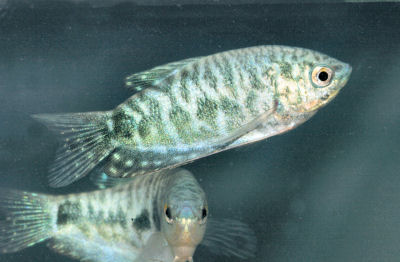
The Opaline Gourami is a long time favorite with aquarists, and a very attractive fish that comes in a variety of color patterns!
The Opaline Gourami is a very attractive color-morph of the Three Spot GouramiTrichopodus trichopterus (previously Trichogaster trichopterus). This is a long time favorite. Its colored in a light bluish tone that’s topped with a darker marble-like patterning, and thus it is also known as the Marbled Gourami. The pattern is dynamic and variable, making this pretty fish an appealing addition to a community aquarium.
This gourami is one of many varieties of the Three-spot Gourami. Breeders selectively pair individuals for their desired coloration and strengthened it over several generations. Other well known varieties included a gold color form called the Gold Gourami and a silver form called the Platinum Gourami, both of which appeared in 1970. The majority of these gourami mutations are commercially bred in the Far East and Eastern Europe.
The predecessor of the Opaline Gourami is the Cosby Gourami, developed by the American breeder named Cosby. The Cosby Gourami is an early color form of the Blue Gourami developed for a silver blue base topped with darker blue markings. From this came the Opaline Gourami which is now commercially bred itself in many different color variations. Because inbreeding is common in its genetic history, it is in the aquarist’s best interest to take extra care when choosing specimens. Look for a well formed fish free of skeletal defects or other deformities, and without obvious injury. Sulking or resting on the bottom of its environment is never a good sign.
Gouramis are members of the suborder Anabantoidei, also called Anabantoids or Labyrinth Fish. They are distinguished from other fishes because they posses a “labyrinth organ”. This is a respiratory organ that allows them to get air at the surface of the water. Like other fish they still have the ability to pass water through their gills to obtain oxygen, but they are also able to breathe atmospheric oxygen. Labyrinth fish are also characterized by their habit of building bubble nests. This male will build a floating nest full of bubbles at the surface of the water and once the female lays the eggs, he will place them in his nest and guard them until they hatch.
The Opaline Gouramis are very similar to their predecessors in all aspects other than coloring. They are the same in size and have the same habitat and care requirements. These are some some of the hardiest aquarium fish and make an excellent choice for the beginning aquarist. They are long lived and easy to breed. They use their pelvic fins to explore their environment and even feel their tank mates. Each individual has its own remarkable personality and they also seem to be quite aware of their owners.
Generally they are considered a good community fish when small, but that can change as they age. Adults are not as peaceful as the other gouramis and have been known to attack smaller fish. They can also get territorial as they mature and the males will squabble among themselves. The best tankmates are other fish that are of similar size and temperament.
These fish can reach a length of up to 6 inches (15 cm), though most are a bit smaller than that in the aquarium. Juveniles can be kept in a 15 – 20 gallon aquarium but they will soon outgrow it. As adults at least a 35 gallon tank or larger will be needed. Because of their varying temperaments, the tank should be decorated in a way which allows both the dominant and quieter personality type fish to live happily. Densely planted areas will help create some hiding places and they will also appreciate the cover of floating plants for some shadowy areas.
For Information on keeping freshwater fish, see:
Freshwater Aquarium Guide: Aquarium Setup and Care
- Kingdom: Animalia
- Phylum: Chordata
- Class: Actinopterygii
- Order: Perciformes
- Family: Osphronemidae
- Genus: Trichopodus
- Species: trichopterus
- Aquarist Experience Level: Beginner
- Size of fish – inches: 5.9 inches (15.01 cm)
- Minimum Tank Size: 35 gal (132 L)
- Temperament: Peaceful
- Aquarium Hardiness: Very Hardy
- Temperature: 73.0 to 82.0° F (22.8 to 27.8° C)
- My Aquarium – Enter your aquarium to see if this fish is compatible!
- Beginner Fish – Freshwater fish for beginners
- Community Fish – Peaceful Freshwater fish
- Hardy Fish – Hardy Freshwater fish
- Similar size fish – Fish that are 1 inch bigger or smaller
- Coldwater Fish – Looking for cold water fish? (65 °)
Habitat: Distribution / Background
The Three Spot Gourami Trichopodus trichopterus (previously Trichogaster trichopterus) was described by Pallas in 1770 and is found widespread throughout continental southeast Asia and Indonesia.
The Opaline Gourami is a captive bred color-morph of the Three Spot Gourami. Its history starts with an early variety known as the Cosby Gourami that was developed from the Blue Gourami by an american breeder named Cosby. Further developments of the Cosby Gourami became known as the Opaline Gourami or Marbled Gourami. The Opaline Gourami is now commercially bred in various color forms of its own.
In nature the Three Spot Gouramis occur in lowland wetlands. They are found in marshes, swamps to peatlands, as well as flowing streams and canals. They inhabit shallow waters that are sluggish or standing still, but with a lot of aquatic vegetation. They are omnivorous in nature and feed on crustaceans, insect larvae, and zooplankton.
- Scientific Name: Trichopodus trichopterus
- Social Grouping: Groups – In nature this species lives communally with other peaceful species.
- IUCN Red List: NE – Not Evaluated or not listed – There are no wild populations of this color morph.
Description
The Opaline Gourami is an elongated oval shaped fish and somewhat compressed laterally, with fins that are rounded and relatively large. It has long flowing ventral fins that are threadlike and extremely perceptive as they carry touch-sensitive cells. It also has a labyrinth organ, a respiratory organ which allows it to absorb atmospheric oxygen directly into its bloodstream. It can reach about 6 inches (15 cm) in length, but will generally be a bit smaller in the aquarium. They will be able to breed at about 3 inches (7.5 cm). They have an average lifespan of 4 to 6 years, but can live longer with good care.
The body color is a pale bluish tone with a darker marble-like patterning that varies with each color form. There are usually dark blotches at the pectoral fins and at the base of the tail and white spots that extend on to the fins, giving them a very attractive pattern. Many different color variations have been developed from this fish as well.
- Size of fish – inches: 5.9 inches (15.01 cm) – Five inches (12.6 cm) is a good length for the Opaline Gourami to reach in the aquarium. They will breed at 3 inches (7.5 cm).
- Lifespan: 4 years – The average lifespan is 4 – 6 years, but with proper care they can live longer.
Fish Keeping Difficulty
This is a hardy fish and has long been recommended as a good choice for the beginner. They are undemanding and can tolerate a range of tank conditions within reason, and will accept a wide variety of foods. They are normally marketed as community fish, but take caution that as these fish age they can become a bit nippy.
- Aquarium Hardiness: Very Hardy
- Aquarist Experience Level: Beginner
Foods and Feeding
The Opaline Gouramis are omnivorous, in the wild they feed on on crustaceans, insect larvae, and zooplankton. In the aquarium these fish will generally eat all kinds of live, fresh, and flake foods. To keep a good balance give them a quality flake or pellet food as the base to the diet. Supplementation should include white worms, blood worms, brine shrimp, or any other suitable substitute. Fresh vegetables can be offered as well, blanched lettuce being a good option for many aquarists. Generally feed once or twice a day.
An interesting characteristic of the Three-spot gourami varieties (as well as the Pearl Gourami), is that they are well known for eating hydra. The hydra is a tiny pest that has tentacles with a venom. They will capture very small fish and paralyze them with the venom and then hold them fast with the tentacles until eaten. If you have a hydra problem in your aquarium, here is your solution.
- Diet Type: Omnivore
- Flake Food: Yes
- Tablet / Pellet: Yes
- Live foods (fishes, shrimps, worms): Some of Diet
- Vegetable Food: Some of Diet
- Meaty Food: Some of Diet
- Feeding Frequency: Daily – Generally feed once or twice a day.
Aquarium Care
These gouramis are extremely hardy fish. Although the labyrinth organ allows the fish to survive in oxygen depleted water, it is a common misconception that this makes water changes unnecessary. This is hardly the case as these fish will suffer the same tissue damage from built up toxins as any other fish. Regular water changes are a must with 25% weekly being recommended.
- Water Changes: Weekly – Weekly water changes of 25% are recommended.
Aquarium Setup
The Opaline Gourami will swim in all parts of the tank. When young they can easily housed in a 15 – 20 gallon aquarium, but adults will need at least 35 gallons or more. It is desirable to keep the tank in a room with a temperature as close as possible to the tank water to prevent damaging the labyrinth organ.The tank should have an efficient filtration system but should not to create too much of a current. This fish will be bothered by a strong current in the tank, especially if the tank is small. Air stones can help provide well oxygenated water.
These gouramis will show their colors best on a dark substrate. The tank should be decorated in a way which allows both the dominant and quieter personality type fish to live happily. This means the construction of a few hiding places and some dense plant cover. This species appreciates the cover of floating plants, however they will regularly breath air at the surface so its important to have some areas unencumbered with plants.
- Minimum Tank Size: 35 gal (132 L) – Juveniles can be kept in a a 15 – 20 gallon aquarium, but adults need more space.
- Suitable for Nano Tank: Sometimes
- Substrate Type: Any
- Lighting Needs: Moderate – normal lighting
- Temperature: 73.0 to 82.0° F (22.8 to 27.8° C) – Keep the surrounding room temperature consistent with the water temperature will help avoid trauma to the labyrinth organ.
- Breeding Temperature: 80.0° F – They will breed with temperatures raised to about 80° F (26° C).
- Range ph: 6.0-8.8
- Hardness Range: 5 – 35 dGH
- Brackish: No
- Water Movement: Weak – This fish doesn’t like a strong current in the tank, especially if the tank is small.
- Water Region: All – These fish will inhabit all levels of the aquarium.
Social Behaviors
The Opaline Gourami is generally considered a good community fish when small, but they are not as peaceful as the other gouramis. They have been known to attack smaller fish. When they get older only keep them with fish their own size. Individuals will show varying degrees of aggression. Some will be very belligerent and will handle their tank mates quite roughly. Others will be peaceful to the point of shyness. The aquarist should be prepared to adapt their tank to suit all personality types.
A mix of neutral personalities is an ideal goal for the range of tank mates. You should not include fish which will provoke this species into aggression as they are often passionate fighters. Fin nippers and gouramis should absolutely never be mixed. The trailing pelvic fins and generally slower movement of this gourami make it the perfect victim for nippers. The Opaline Gourami is also a skilled hunter and extremely small fish or fish fry rarely last long.
Good tankmates for this fish are robust cyprinid species like barbs, but avoid those that are notorious fin nippers like Tiger Barbs and Clown Barbs. Other good selections include larger characins, loricariid catfish from South America, and loaches. They can be kept with other medium to large gouramis, but bullying between gouramis is a likely scenario. Bullying between gouramis is a likely scenario as these fish, typical of the family, are fixated on constantly working out the details of the hierarchy.
- Temperament: Peaceful – Although the fish is generally peaceful, very small tankmates may be bullied.
- Compatible with:
- Same species – conspecifics: Yes – Can be kept singly, in pairs, or groups. If kept in a group make sure there are plenty of hiding places to keep one or more of the individuals from being bullied. Males are territorial and will tussle amongst themselves, becoming very aggressive when breeding.
- Peaceful fish (): Safe – Will need to monitor compatibility as the fish matures.
- Semi-Aggressive (): Monitor
- Aggressive (): Threat
- Large Semi-Aggressive (): Threat
- Large Aggressive, Predatory (): Threat
- Monitor – Gouramis can be quick at feeding time. Make sure any fish that are not so quick get fed if you are keeping them with gouramis.
- Shrimps, Crabs, Snails: May be aggressive
- Plants: Safe
Sex: Sexual differences
The male Opaline Gourami has a longer and more pointed dorsal fin while the female’s is shorter and rounded.
Breeding / Reproduction
Like most Labyrinth fish, the Opaline Gouramis are bubble nest builders. Breeding is fairly easy and providing a breeding tank that is to their liking is perhaps the biggest challenge. A pair will be most likely to spawn if there is a fair amount of plants, a good sized surface area, and the temperature is to their liking. Prior to spawning they should be well conditioned with small offerings of live and frozen foods several times a day. When well fed, females should begin filling out with eggs, appearing very plump.
An individual breeding tank of 10 to 20 gallons or more should be set up. A shallow water level is not as critical for this fish as it is for other Labyrinth fish species, but it can be kept at about 5 – 6″ (13 – 15 cm). Normal water parameters are fine but raise the temperature to about 80° F (26° C). You can add a small gently air-powered sponge filter or some peat filtration, but the tank current should be minimal. Many aquarists find that floating plants, or stem plants grown to the surface, or any other floating debris will help keep the bubble nest in place.
A healthy pair of adults should be introduced into the breeding tank. The male will spend a lot of time building a large bubble nest, usually in a corner. Once the nest had been built the male will begin a courtship display to entice the female to spawn. He will swim back and forth, flaring his fins and raising his tail until the female allows him to wrap his body around hers and the two will spawn. Their eggs as well as the fry, are lighter than water and float to the top and be deposited in the nest. If the female was well filled out the spawn can be huge, between 700 to 800 eggs.
The female must be removed after the eggs are produced or she risks being killed by the male. The male will tend the nest and guard the eggs until they hatch. After hatching the fry will soon emerge from the nest and become free swimming. This is when the male should be removed or he might eat the fry which emerge from the nest. Free swimming fry can be fed infusoria or a liquid fry food until they are large enough to eat baby brine shrimp. See the description of breeding techniques in: Breeding Freshwater Fish: Anabantoids. Also see Fish Food for Fry for information about types of foods for raising the young.
- Ease of Breeding: Easy
Fish Diseases
Opaline Gouramis are very hardy so disease is not usually a problem in a well maintained aquarium. Some diseases they are prone to are bacterial infections, constipation and Hole in the Head if good water quality, nutrition, and maintenance is not provided. With any additions to a tank such as new fish, plants, substrates, and decorations there is a risk of introducing disease. It’s advisable to properly clean or quarantine anything that you want add to an established tank prior to introduction, so as not to upset the balance.
These fish are very resilient but knowing the signs of illness, and catching and treating them early makes a huge difference. An outbreak of disease can often be limited to just one or a few fishes if you deal with it at an early stage. The best way to proactively prevent disease is to give your fish the proper environment and a well balanced diet. The closer to their natural habitat the less stress the fish will have, making them healthier and happy. A stressed fish will is more likely to acquire disease. For information about freshwater fish diseases and illnesses, see Aquarium Fish Diseases and Treatments.
Availability
The Opaline Gourami is readily available both in stores and online and is moderately priced.
References
- Animal-World References: Freshwater Fish and Plants
- Trichopodus trichopterus (Pallas, 1770) Three spot gourami, Fishbase.org
- Trichogaster lalius Dwarf Gourami, Seriously Fish, 2013
- Dr. Rudiger Riehl and Hans A. Baensch, Aquarium Atlas Vol. 1, Publisher Hans A. Baensch, 1991
- Joseph S. Nelson, Fishes of the World, Wiley, 2006.
- Greg Jennings (Editor), 500 Freshwater Aquarium Fish, Firefly Books Ltd, 2006.
- Glen S. Axelrod, Brian M. Scott, Neal Pronek, Encyclopedia Of Exotic Tropical Fishes For Freshwater Aquariums, TFH Publications, 2005
- David Alderton, Encyclopedia of Aquarium and Pond Fish , DK Publishing, Inc., 2005.
- Hans-Joachim Richter, Gouramis and Other Anabantoids, T.F.H Publications, Inc., 1988
- Dr. Herbert R. Axelrod, Aquarium Fishes of the World, TFH Publications, 1998