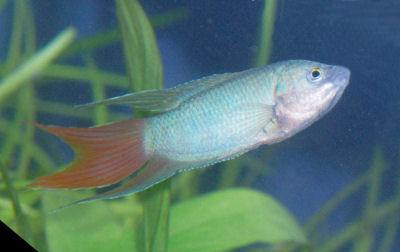
The Paradise Fish was one of the first tropical fish in the trade, and the start of the aquarium hobby!
The Paradise Fish Macropodus opercularis is often referred to as the “founding fish of the hobby”. It was one of the first tropical fish exported to Europe, second only to the well known GoldfishCarassius auratus. It was first brought to France in 1869 and later to Berlin by Sasse in 1876. This small but very attractive beauty was instrumental in popularizing freshwater fish keeping.
With the introduction of so many other species its popularity has diminished somewhat, yet this fish is still among the most glamorous specimens found in the freshwater aquarium hobby. In size the male reaches only a mere 4 inches (10 cm) with females slightly smaller at just over 3 inches (8 cm), but it is endowed with a rich and brilliant color pattern. The body has a blue color usually accented with red stripes, blacks and whites, and it has a red tail. Males become quite distinguished as they mature, developing very long flowing fins that will extend into serrated filaments.
There are also a number of color forms including black and albino. Albino varieties can be very beautiful, having the blue color on the body replaced by white, then accented with brilliant red blotches and vertical stripping across the body and onto the fins. Other common names the species is known by include Blue Paradise Fish, Paradise Gourami, Red and Blue Paradise Fish, Paradisefish, and Blue Paradise Gourami.
Paradise Fish are surprisingly intelligent and curious. They make very personable and attractive aquarium inhabitants and are a joy to keep if appropriate research and planning goes into their aquarium set-up, tank mates, and care. These fish are one of the more aggressive member of their family. When young they can easily be kept together, but once mature, adult males are very quarrelsome and will battle as fiercely with others of their own kind as their cousin, the Siamese Fighting Fish Betta splendens. Males should be kept singly or in pairs with lots of hiding places for the female. Females can be kept in groups. These are good community fish as long as tank mates are not combative and are too big to eat. They do best in a community with fish that are significantly larger and non-aggressive.
These fish are quite hardy with a great appetite, making them an excellent fish for the beginner. They are very adaptable and not too picky about their water parameters. They are naturally found habitats ranging from slow moving or stagnant ditches to the backwaters of large rivers. Consequently they can tolerate a wide range of conditions and temperatures, including an unheated aquarium or an outdoor pond. A good sized male can be kept in a 20 gallon tank, but to keep a pair or a community of fish, a 20 gallon long or 30 gallon aquarium will be needed. They will enjoy sturdy plants, and some driftwood and rocks can also be included, all of which will provide places for hiding and retreat. The tank needs to be covered as they are jumpers.
When picking out a Paradise fish, be sure to choose your stock carefully. A desire to breed these fish in the brightest coloration and to provide them in large quantities, has unfortunately led to a mass production of fish that are neither colorful nor healthy. The Paradise Fish you pick should be alert and enjoying moving about, a lethargic fish is not healthy and is unlikely to “recover”.
For Information on keeping freshwater fish, see:
Freshwater Aquarium Guide: Aquarium Setup and Care
- Kingdom: Animalia
- Phylum: Chordata
- Class: Actinopterygii
- Order: Perciformes
- Family: Osphronemidae
- Genus: Macropodus
- Species: opercularis
- Aquarist Experience Level: Beginner
- Size of fish – inches: 3.9 inches (10.01 cm)
- Minimum Tank Size: 20 gal (76 L)
- Temperament: Semi-aggressive
- Aquarium Hardiness: Very Hardy
- Temperature: 61.0 to 79.0° F (16.1 to 26.1° C)
- My Aquarium – Enter your aquarium to see if this fish is compatible!
- Beginner Fish – Freshwater fish for beginners
- Community Fish – Peaceful Freshwater fish
- Hardy Fish – Hardy Freshwater fish
- Similar size fish – Fish that are 1 inch bigger or smaller
- Coldwater Fish – Looking for cold water fish? (65 °)
Habitat: Distribution / Background
The Paradise Fish Macropodus opercularis was described by Linnaeus in 1758. This species is found across a considerably wide range of southeast Asia. In China it is found from the east in the Yangtze river basin to the Pearl River basin, in Hong Kong, and on Hainan Island. It also occurs in Taiwan, northern and central Viet Nam, northeastern Laos, Cambodia, Malaysia, Japan, the Ryukyu Islands and Korea. it has also been introduced outside of its native range with populations found in in Madagascar and the United States. Some other common names it is known by include Blue Paradise Fish, Paradise Gourami, Red and Blue Paradise Fish, Paradisefish, and Blue Paradise Gourami.
This species is listed on the IUCN Red List as Least Concern (LC). Although there are areas recognized as having habitat destruction as well as water pollution resulting from the use of agricultural pesticides, overall it has a large distribution with no major widespread threats.
M. opercularis is one of nine currently recognized species in the Macropodus genus, with six of these species recognized in just the last few years. The Paradise Fish is the oldest of the genus and has been in the aquarium hobby for well over a hundred years. This species was the first ornamental fish, after the Goldfish Carassius auratus, to be exported to Europe. It was brought to France in 1869 and later to Berlin by Sasse in 1876. The nine species in the Macropodus genus, in the order they were recognized, include:
- Paradise fish or Paradisefish Macropodus opercularis – (Linnaeus, 1758) Paradisefish)
- Round Tail Paradisefish Macropodus ocellatus – (Cantor, 1842)
- Black Paradise Fish Macropodus spechti – (Schreitmüller, 1936)
- Red-Backed Paradisefish Macropodus erythropterus – (Freyhof & Herder, 2002)
- Macropodus hongkongensis – (Freyhof & Herder, 2002)
- Macropodus baviensis – (Nguyen & Nguyen, 2005)
- Macropodus lineatus – (Nguyen, Ngo & Nguyen, 2005)
- Macropodus oligolepis – (Nguyen, Ngo & Nguyen, 2005)
- Macropodus phongnhaensis – (Ngo, Nguyen & Nguyen, 2005)
This species occurs in all kinds of lowland habitats. They are found in streams and the backwaters of major rivers, rice paddies and irrigation ditches, marshes and stagnant ponds. They exhibit a clear preference for slow-moving or still waters. They are Labyrinth fish, members of the suborder Anabantoidei often called Anabantoids, that can breathe atmospheric oxygen. These type of fish have an additional respiratory organ called the “labyrinth organ”, which allows them to survive in stagnant water bodies that have very low oxygen content or are even polluted. They are able to get oxygen by passing water through their gills, but also have the ability to gulp air at the surface. This organ tends to be more developed in those specimens occurring particularly in oxygen deprived waters.
They are opportunistic feeders in nature, and though omnivorous they show a tendency for an animal diet over vegetable matter. They feed on small fish and other small aquatic animals including planktonic invertebrates and other zoobenthos. An interesting behavior observed with this species is that sometimes the fish sees potential prey above the water surface, and attempts to catch it by jumping out of the water.
- Scientific Name: Macropodus opercularis
- Social Grouping: Solitary – In nature this species is primarily solitary, forming pairs when spawning.
- IUCN Red List: LC – Least Concern
Description
The Paradise Fish has a stout elongated body and all the fins are pointed. The tail fin is forked and becomes quite long on the males, up to an inch or two, extending into serrated filaments. Like all other labyrinth fish they can breath air, generally gulping it at the water’s surface. They have a special ‘labyrinth organ’ which acts like a lung that enables them to survive in oxygen-depleted or polluted waters. Males will reach about 4 inches (11 cm) in length with the tail fin trailing on for an extra inch or two. The females are a bit smaller reaching just over 3 inches (8 cm). They have an average life span of about 6 years, but can live up to 8 years with good care.
These are quite colorful fish adorned in a medley of reds and blues accented in blacks and whites, and the tail fin is red. The body is generally blue overall with red vertical striping extending onto the fins. There are several color forms including black and albino. Albino varieties can have a very attractive pattern, white overall accented with brilliant red blotches and vertical stripping across the body that extends onto the fins.
- Size of fish – inches: 3.9 inches (10.01 cm) – This fish will reach about 4 inches (10 cm), with the female a bit smaller at just over 3 inches (8 cm).
- Lifespan: 6 years – The average lifespan is 6 years, but with proper care they could live up to about 8 years.
Fish Keeping Difficulty
This is a hardy fish and makes a good choice for the beginner. They are undemanding and can tolerate a range of tank conditions and temperatures, even tolerating an unheated aquarium. They are hardy eaters and will readily accept a wide variety of foods. They are normally marketed as community fish, but take caution as the males will fight each other. Males should be kept singly or in pairs, but will be fine in a mixed community with other fish that are slightly larger and non-aggressive.
- Aquarium Hardiness: Very Hardy
- Aquarist Experience Level: Beginner
Foods and Feeding
Although the Paradise Fish are omnivores, they favor rich meaty foods. In the wild they are predators, feeding on small fish and small aquatic animals like planktonic invertebrates and other zoobenthos. An interesting characteristic observed in these fish is that sometimes if they see potential prey above the water surface, like insects, they will attempt to catch them by jumping out of the water.
To keep a good balance in the aquarium give them a quality flake or pellet food as the base of the diet. They will gladly eat foods designed for Bettas, but they shouldn’t be fed that type of food exclusively. They enjoy exercising their predatory nature on live foods, but should also be provided some vegetable matter. Supplementation should include white worms, blood worms, brine shrimp, or any other suitable substitute. Generally feed once or twice a day.
- Diet Type: Omnivore
- Flake Food: Yes
- Tablet / Pellet: Yes
- Live foods (fishes, shrimps, worms): Some of Diet
- Vegetable Food: Some of Diet
- Meaty Food: Half of Diet
- Feeding Frequency: Several feedings per day – Generally feed once or twice a day.
Aquarium Care
These are extremely hardy fish and although the labyrinth organ allows the fish to survive in oxygen depleted water, it is a common misconception that this makes water changes unnecessary. This is hardly the case as these fish will suffer the same tissue damage from built up toxins as any other fish. Regular water changes are a must with 25% weekly being recommended.
- Water Changes: Weekly – Weekly water changes of 25% are recommended.
Aquarium Setup
The Paradise Fish will swim in all parts of the tank. They are fairly hardy and will adapt to most aquarium conditions. They will tolerate a wide range of temperatures, even being kept in an unheated aquarium. A single fish can be kept in a 20 gallon tank, but a pair or a community of fish will do best in a tank that’s at least 30″ long. Provide a 20 gallon long or 30 gallon aquarium with plants for the female to hide in. The tank should have an efficient filtration system but should have very gentle water movement. The tank also needs to be covered as they are jumpers.
Paradise Fish are often found living in tiny water bodies in nature. They will generally stake out about a few square feet of territory, which they will defend and inhabit, and In the aquarium this environment is emulated. The tank should be decorated in a way which allows both the dominant and quieter personality type fish to live happily. This means the construction of a few hiding places and some surface cover.
They will show their colors best on a dark substrate and need some sturdy aquarium plants to provide the female with places to hide. Some driftwood and rocks can also be included which will offer additional places for retreat. This species appreciates some cover with floating plants, but be sure to leave some open areas for them to gulp air at the water surface.
- Minimum Tank Size: 20 gal (76 L) – A single fish could be kept in a little as 5 gallons, but this small size is more difficult to maintain. For long term care a standard 20 gallon tank works best for a single male, and the minimum size suggested for a pair or a mixed community is a 20 gallon long or 30 gallon aquarium.
- Suitable for Nano Tank: Yes – A 20 gallon Nano tank can house a single male, but a larger Nano should be provided for a pair or community.
- Substrate Type: Any
- Lighting Needs: Moderate – normal lighting
- Temperature: 61.0 to 79.0° F (16.1 to 26.1° C) – They have a wide tolerance, even temperatures slightly beyond these typical parameters, so can be kept in outdoor ponds or unheated aquariums.
- Breeding Temperature: 70.0° F – They will breed with temperatures between 70 -75° F (21-24° C).
- Range ph: 5.8-8.0
- Hardness Range: 5 – 30 dGH
- Brackish: No
- Water Movement: Weak – Will be uncomfortable with strong water currents.
- Water Region: All – These fish will inhabit all levels of the aquarium.
Social Behaviors
These fish make good community tank inhabitants, but only with the right companions. They are similar to Bettas in disposition and although the Paradise Fish is slightly less extreme, both these types of Labyrinth fish are belligerent and predatory and it is difficult to select good tank mates for them. They really prefer to live alone, but will accept some other species of fish as long as they are larger and non-aggressive.
Young Paradise fish can be kept in groups, but as they mature the males become combative with other males and any small fish can become a snack. Males generally don’t get along together unless the tank is very, very large with lots of decor for hiding and retreat. Male should be kept apart or they will engage in aggressive combat, locking jaws and damaging one another. These fish do best singly, in male/female pairs in their own tank, or a group of females can be kept together with success,
In a community setting this fish needs to be the dominant species and should not be kept with other robust fish that may compete for control. It will fight with other dominant fish, or if the others are larger and aggressive it will hide, and often succumb to stress. Some people believe this fish will peacefully share a bowl with a Betta, but there is no truth to this and can lead to disaster.
A mix of neutral personalities of fish that are not similar in looks is the ideal goal for its range of tank mates. Be careful in selections, and be prepared to adjust companions if needed. Good tank mates can be non-aggressive medium to large gouramis, robust cyprinid species, larger characins, eartheater type Geophagus cichlids, loricariid catfish from South America, large Synodontis catfish, and loaches. Avoid slow swimming fish or fish with long flowing fins. Being skilled hunters, extremely small fish or fish fry rarely last long.
- Venomous: No
- Temperament: Semi-aggressive – They are peaceful with the right tankmates, avoid similar looking fish and very small fish.
- Compatible with:
- Same species – conspecifics: Sometimes – Males should not be kept together as they will fight, they can be kept in pairs and females can normally be kept in groups.
- Peaceful fish (): Monitor – It is difficult to select appropriate tankmates. Larger, non-aggessive fish are fine, but similar looking fish and smaller fish may be bullied.
- Semi-Aggressive (): Threat
- Aggressive (): Threat
- Large Semi-Aggressive (): Threat
- Large Aggressive, Predatory (): Threat
- Threat
- Shrimps, Crabs, Snails: Threat – is aggressive
- Plants: Safe
Sex: Sexual differences
Males larger than females, and are brighter with stronger color patterns. Their fins are also longer and larger.
Breeding / Reproduction
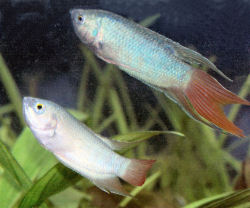
Pair of Paradise Fish Photo © Animal-World: Courtesy David Brough
Like most fish in the labyrinth fish family, the Paradise Fish are bubble nest builders and breeding this species is not difficult. They will breed Betta style, employing a bubble nest which they will defend to the death.
Males will build bubble nests frequently, usually beneath a leaf. Prior to spawning they should be well conditioned in a separate environment, with small offerings of live and frozen foods several times a day. When well fed females should begin filling out with eggs, appearing very plump. Females not yet ready for egg-laying should be kept away as males have a nasty temperament and may mutilate or even kill an unprepared female.
An individual breeding tank. about 20 gallons in size, should be set up with the water level low, at about 6 – 8″ (15 – 20 cm). Normal water parameters are fine but raise the temperature to between 80 – 84° F (26 – 29° C). You can add a small gently air-powered sponge filter or some peat filtration, but the tank current should be minimal.
They need several good sized clumps of fine leaved plants, like Hornwort or Milfoil. During the courtship and after building the nest, a male will consider females to be rivals and bully them. The plants are essential for the female to have places for retreat. Many aquarists find that floating plants like Ricca, stem plants grown to the surface, or any other floating debris will help keep the bubble nest in place.
Males will build the nest and then corner the female below. The male will wrap his body around the female and the two will spawn, with eggs and sperm released simultaneously. Then the male will go limp, the pair will separate, and the exhausted female will drift to the bottom of the tank. This behavior may be repeated several times, and if the female was well filled out, the spawn can produce around 500 eggs. The eggs are buoyant and most will float up to the nest. The male will pick up any that sink in his mouth and place them in his nest. He will guard the eggs until they hatch. Males are most ferocious after spawning and will chase off the female. The female must be removed after the eggs are produced or she risks being killed by the male.
Hatching time varies some with temperature. Generally the fry will emerge between 30 to 50 hours, but could be between 48 to 96 hours. After hatching the fry will soon emerge and become free swimming, indicated by the nest breaking apart. This is when the male should be removed or he might eat the fry which emerge from the nest. Free swimming fry can be fed infusoria or a liquid fry food until they are large enough to eat baby brine shrimp. See the description of breeding techniques in: Breeding Freshwater Fish: Anabantoids. Also see Fish Food for Fry for information about types of foods for raising the young.
- Ease of Breeding: Easy
Fish Diseases
Paradise Gouramis are very hardy so disease is not usually a problem in a well maintained aquarium. Some diseases they are prone to are bacterial infections, constipation and Hole in the Head if good water quality, nutrition, and maintenance is not provided. With any additions to a tank such as new fish, plants, substrates, and decorations there is a risk of introducing disease. It’s advisable to properly clean or quarantine anything that you want add to an established tank prior to introduction, so as not to upset the balance.
These fish are very resilient but knowing the signs of illness, and catching and treating them early makes a huge difference. An outbreak of disease can often be limited to just one or a few fishes if you deal with it at an early stage. The best way to proactively prevent disease is to give your fish the proper environment and a well balanced diet. The closer to their natural habitat the less stress the fish will have, making them healthier and happy. A stressed fish will is more likely to acquire disease. For information about freshwater fish diseases and illnesses, see Aquarium Fish Diseases and Treatments.
Availability
The Paradise Fish is readily available in many pet stores, although quality fish can be difficult to obtain. They are also offered by some online retailers. Males are easier to find than females. Cost can range depending on the color and size, anywhere from moderate in price to moderately expensive.
References
- Animal-World References: Freshwater Fish and Plants
- Macropodus opercularis (Linnaeus, 1758) Paradisefish, Fishbase.org
- Macropodus opercularis, The IUCN Red List of Threatened Species
- Ingo Schindler, News on the taxonomy and distribution of Macropodus species, Der Makropode, 31. 9-12: Jahrgang 1, 2009.
- Dr. Rudiger Riehl and Hans A. Baensch, Aquarium Atlas Vol. 1, Publisher Hans A. Baensch, 1991
- Joseph S. Nelson, Fishes of the World, Wiley, 2006.
- Greg Jennings (Editor), 500 Freshwater Aquarium Fish, Firefly Books Ltd, 2006.
- Glen S. Axelrod, Brian M. Scott, Neal Pronek, Encyclopedia Of Exotic Tropical Fishes For Freshwater Aquariums, TFH Publications, 2005
- David Alderton, Encyclopedia of Aquarium and Pond Fish , DK Publishing, Inc., 2005.
- Hans-Joachim Richter, Gouramis and Other Anabantoids, T.F.H Publications, Inc., 1988
- Dr. Herbert R. Axelrod, Aquarium Fishes of the World, TFH Publications, 1998