
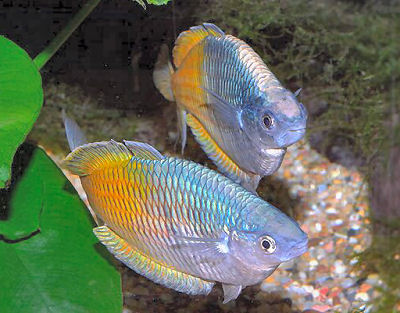
The Rainbowfish species come in many vivid ‘rainbow’ colors, and are as beautiful as their name suggests!
Rainbowfish are also called Blue Eyes or Rainbow Fish. These are gorgeous fish to observe in nature. They also make fascinating aquarium fish. Kept in a school, they are peaceful, hardy, and undemanding. They will readily accept aquarium fare and rarely get sick. They spawn year round in their natural environment and will readily breed in captivity. Sometimes they will even spawn in a community aquarium and the fry are not difficult to raise.
The first species of Rainbowfish was described in 1843. These fish were originally called ‘sunfish’, though today that term is used for a number of other saltwater and freshwater species. Rainbow fish are found in primarily Australia and New Guinea, with a few close relatives in Indonesia and Madagascar. A few specimens of Rainbow fish have been kept in aquariums since the early 1900’s, but overall these fish are a relatively modern addition to the aquarium world. They have been coming into their own, most especially since their introduction in 1982 by authors Gerald Allen and Norbert Cross, with the publishing of Rainbowfishes of Australia and Papua New Guinea.
These fish can easily be passed over when seen in a dealer’s tank because in this setting Rainbow fish are seldom in their true adult coloration. Dealers often offer young specimens which are more drab, or adults that are not comfortably established so do not display their fantastic hues. If you provide a small school, ideally 8 – 10 rainbows, with a roomy environment along with some roots and river rock decor, you will soon enjoy a fabulous display!
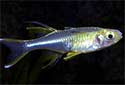
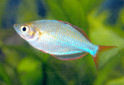
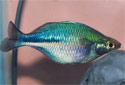
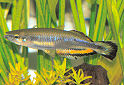
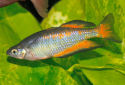
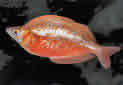
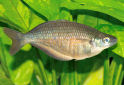
The Rainbowfish species list below includes popular Blue Eyes, as well lesser known rainbow fish varieties. Each fish guide has a description of the rainbow fish, its place of origin, habitats and behaviors, as well as rainbow fish care to successful maintain them in an aquarium. Pictures are also provided within each fish guide to help with identification, and to aid in choosing the best rainbow fish species for your freshwater tank.
For Information on keeping freshwater fish, see:
Freshwater Aquarium Guide: Aquarium Setup and Care
RainbowfishWFRa_C1440_vsm.jpg)
RainbowfishWFRa_C1884_vsm.jpg)
Rainbow Fish Description
The most impressive characteristic of the Rainbow fish is their elegant coloring. Though each species has its own variety of colors, they are all extremely attractive. During courting and spawning, the male of most species will attract the female with a courtship stripe. This bright stripe can be a variety of colors depending on the species. There are only a few species, primarily in the Melanotaenia genus, that do not display a stripe. Even some females will show a courtship stripe, though it is much more subdued than the male’s.
Rainbowfish have a laterally compressed body in an elongated diamond shape. This shape varies by species, ranging from very deep bodied to a more slender appearance. They also have elegant fins. Rainbowfish vary in size from about 1″ (3 cm) up to 6″ (15 cm). Most are quite hardy, with the larger species living 6 years or so in captivity.
There are 6 genera and about 61 known species of these beautiful fish in the family Melanotaeniidae, with more still being discovered. Very similar to this family are their close relatives the Blue Eyes, in the family Pseudomugilidae. Though currently in a separate family, there is ongoing debate as to whether they should actually be included as a subfamily of the Melanotaeniidae family. Another close relative are the Madagascar Rainbowfishes in the family Bedotiidae with 2 genera and 9 species. They are found on the eastern side of the tropical island Madagascar, Africa.
Rainbow Fish Care
Rainbowfish readily accept aquarium fare. As they are omnivores, these fish will generally eat all kinds of live, fresh, and flake foods. A quality flake or pellet food makes a good base to the diet. Supplementation should include white worms, blood worms, brine shrimp, or any other suitable substitute. Specially prepared commercial foods that are sold as ‘color food’ will contain dyes like carotene. This is advantageous to enhance their colors, especially in red rainbows.
As these are schooling fish they will do best kept in shoals of 8 – 10 fish. Provide an adequate sized aquarium with plenty of open swimming space. A general rule of thumb is that the length of the tank be ten times the length of the adult rainbow fish. Small species up to about 2 1/2″ (6 cm) can be kept in a 20 gallon tank. Species ranging from 2 1/2 – 4 1/2″ (6 – 12 cm) will need about 50 to 60 gallons. Those that are larger still, reaching up to 6 ” (15 cm), will need upwards of 150 gallons or more.
A standard Rainbowfish habitat is one with variably sized gravels for the substrate along with some larger smooth river rocks. As these fish can be easily startled, keep their aquarium in a quieter location. When they need to retreat, they will appreciate some hiding places in wood/ root decor. Most species are not particular about a planted environment, however they won’t bother plants if you add them. Though their shimmering colors show best in sunlight, they prefer a more subdued aquarium lighting for most of the day. At the most, sunlight should only be provided for an hour or two a day, preferably in the morning.
Choose tank mates that require similar tank conditions and are of a similar size with complimentary personalities. Though Rainbow fish are basically peaceful, the larger species can be kept with fish that are a bit more boisterous, such as dwarf cichlids and large barbs. Most nocturnal fish, like the ‘eel’ tailed catfish, are also acceptable as Rainbowfish sleep near the surface.
Breeding Rainbow Fish
Rainbowfish are egglayers and spawn year round in their native habitat. Fortunately these fish are easy to breed and their fry are not difficult to rear. Australia has strong restrictions on the exportation of live animals, so many of the Rainbowfish species that have become available from that area were the result of eggs being airmailed to Europe and the United States. where they were then hatched and the fry reared.
Most Rainbowfish have been found to breed most readily in the aquarium, especially after a water change. They will often even spawn in a community tank, but other fish and young rainbow fish will snack on the eggs. A tank devoted to breeding will prevent this as well as insuring purity of the species. For more information on how to breed Rainbow fish, see: Breeding Freshwater fish: Rainbowfish.
Dwarf neon rainbows (Image Credit: Anandarajkumar, Wikimedia Commons CC BY-SA 3.0 Unported)