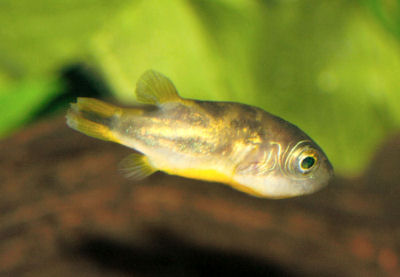
The Dwarf Puffer fish is a newer arrival to the hobby and the most widely purchased of all the puffer fish!
The Dwarf Puffer or Malabar Puffer Carinotetraodon travancoricus is about the size of a pea when you first get one of these cute little puffers. This tiny freshwater puffer is even called Pea Puffer, and is quite intriguing with its unique and endearing behaviors. There are quite a number of other common names it is also known by including India Malabar Pufferfish, Pygmy Pufferfish, Marble Puffer, Indian Dwarf Puffer, and Bumblebee Puffer.
This pygmy puffer fish is a very active and intelligent little fish. The Dwarf puffer fish swims in its own unique pattern making it a joy to watch. It has quite an inquisitive nature and is aware of what goes on outside the aquarium. Though a bit shy, it will watch you as you watch it and soon will come to recognize you.
The Dwarf Puffer is a freshwater fish that can be kept in a small aquarium, but like all puffers it has special needs and requirements. They should be kept in a species only tank as they are very aggressive fin nippers and can kill tank mates much larger than themselves. They need an environment full of plants and retreats, good water quality, and a good diet. If you meet their needs, you will find them a delightfully entertaining fish to keep.
The Dwarf Puffer fish is somewhat easier to take care of then many puffers. Their teeth are much softer then other puffers so the need to clip their teeth usually doesn’t become a problem. They are however just as aggressive as the larger species so great care needs to be taken when choosing tank mates. Most slow swimming long-finned fish will become targets. Even though these little guys do not grow much over an inch they can kill fish much larger then themselves.
As adorable as these little guys are they come with great responsibility. A Dwarf Puffer owner can potentially have a pet that will be endangered in the near future. Though not currently listed on the IUCN Red List, the Malabar Puffers or Dwarf Puffers are reported as probably being an endangered species.
For Information on keeping freshwater fish, see:
Freshwater Aquarium Guide: Aquarium Setup and Care
- Kingdom: Animalia
- Phylum: Chordata
- Class: Actinopterygii
- Order: Tetraodontiformes
- Family: Tetraodontidae
- Genus: Carinotetraodon
- Species: travancoricus
- Aquarist Experience Level: Intermediate
- Size of fish – inches: 1.0 inches (2.49 cm)
- Minimum Tank Size: 10 gal (38 L)
- Temperament: Aggressive
- Aquarium Hardiness: Moderately hardy
- Temperature: 72.0 to 82.0° F (22.2 to 27.8° C)
- My Aquarium – Enter your aquarium to see if this fish is compatible!
- Beginner Fish – Freshwater fish for beginners
- Community Fish – Peaceful Freshwater fish
- Hardy Fish – Hardy Freshwater fish
- Similar size fish – Fish that are 1 inch bigger or smaller
- Coldwater Fish – Looking for cold water fish? (65 °)
Habitat: Distribution / Background
The Malabar Puffer Carinotetraodon travancoricus, commonly called the Dwarf Puffer, was described by Hora and Nair in 1941. It is a more recent addition to the hobby. They are found in Asia; Sri Lanka to Indonesia and north to China.They inhabit freshwater to brackish coastal estuaries; streams, rivers, and flood plains where they are found singly or in small groups. Little is actually known about what the Malabar Puffer eats in nature. Zooplankton,benthic crustaceans and molluscs are commonly natural foods of others in the same genus and seems to be the same in aquariums.
This is one of those fish that has been given a huge number of common names. It is known not only as the Malabar Puffer or Dwarf Puffer, but its nomenclature also includes: Pea Puffer, Pygmy Puffer, Malabar Dwarf Puffer, Blue Eyed Puffer, Indian Dwarf Puffer, Marble Puffer, Bumblebee Puffer, Malabar Pufferfish, Indian Malabar Pufferfish, Abeni Puffer, BB Puffer, and Sea Frog.
Though first described in 1941, the Malabar Dwarf Puffer Carinotetraodon travancoricus did not become available to the United States until the later 1990’s. Though not currently listed on the IUCN Red List, the Malabar Puffers or Dwarf Puffers are reported as probably being an endangered species on www.Fishbase.org website.
In 1991 a color variation of this species was described, the Dwarf Imitator PufferCarinotetraodon imitator. This fish was probably imported simultaneously with the Malabar Puffer. Whether a distinct species, subspecies, or a variation is not yet determined, but the Dwarf Imitator Puffer is distinguished by having blue spots.
- Scientific Name: Carinotetraodon travancoricus
- Social Grouping: Groups – In the wild they are found singly or in small groups
- IUCN Red List: VU – Vulnerable
Description
The Malabar Puffer or Dwarf Puffer is the smallest of the puffer fish, only reaching about an inch (2.5 cm). It has a rounded body shape similar to that of a bean or pea, with a tail attached. Their overall body color is a golden brown on top becoming lighter yellow or whitish underneath, with dark greenish blue green to black markings. Like many of the pufferfish, the coloring can vary with age, disposition, and environment. Mature males develop a dark vertical line along the underside and tend to have a more yellowish belly than the females. These pufferfish also have mobile blue eyes, thus one of its common names being the ‘Blue Eyed Puffer’.
Pufferfish have the ability to ‘puff’ themselves up with water or air if threatened. When they inflate, their spines protrude outward and this apparently helps keep them from being eaten. Another defense of many puffer species is to produce toxic substances in their flesh that is poisonous if eaten. The Puffer fish can be quite long lived in the aquarium, many living for 10 or more years.
- Size of fish – inches: 1.0 inches (2.49 cm)
- Lifespan: 10 years
Fish Keeping Difficulty
As with all puffers there is a moderate difficulty associated with owning a Malabar Puffer. These fish due to the lack of scales and gill covers are more prone to disease and more sensitive to changing water conditions. They should never be introduced into a non-cycled tank. These puffers are aggressive and will not be able to go in a community tank. They need weekly water changes and high output filters.
- Aquarium Hardiness: Moderately hardy
- Aquarist Experience Level: Intermediate
Foods and Feeding
The Malabar Puffers or Dwarf Puffers are carnivores and love to feed on snails. Ramshorn snails are perfect for your puffer and are very nutritious. The ramshorn snails are very easy to breed as well and so will give an endless supply of food for your puffer.
Dwarf Puffers eat differently then others in their genus, they will bite the snail and sort of suck the meat out instead of crushing the shell. Do not introduce Malaysian Trumpet Snails, they have extremely hard shells and will damage or break their teeth. Dwarf puffer’s teeth are thinner then other puffers and the need for hard shelled foods isn’t as important.
Dwarf Puffer owners have had success with feeding blackworms, mosquito larva, tubifex worms, bloodworm, white worm, water fleas, and presoaked brine shrimp. Some Malabar puffers will eat live shrimp while others will make them tank mates. These puffers are slow eaters and like to look their food over before eating. Because of this do not throw multiple worms in the tank at once until the puffers realize it is food, most of the worms will burrow into the sand if you do.
These puffers need to be feed one or two times a day and only feed what they can consume in five minutes. Puffers will eat beyond what is good for them. Because their stomach is not surrounded by ribs, it is easy to see if they are over eating. Puffer should have a rounded belly not bulging. Over feeding will cause liver and kidney issues down the road.
- Diet Type: Carnivore –
- Flake Food: No
- Tablet / Pellet: No
- Live foods (fishes, shrimps, worms): Most of Diet – Blackworms, blood worms, snails, and some shrimp.
- Meaty Food: Most of Diet – Though snails are the main staple, Malabar Puffer owners have had success with feeding blackworms, mosquito larva, tubifex worms, bloodworm, white worm, water fleas, and presoaked brine shrimp. Some Malabar puffers will eat live shrimp while others will make them tank mates.
- Feeding Frequency: Several feedings per day – Only feed what they can consume in 5 minutes.
Aquarium Care
Since puffers do not have gill covers or scales, they are thought to be more susceptible to diseases, nitrite, nitrate and ammonia levels. Like all puffers, the Dwarf Puffer is not a good fish to cycle an aquarium with. Also because they usually don’t eat all of their food (messy eaters!), these fish will usually put more load on the aquarium filtration requiring more frequent water changes and better maintenance in general.
A generous weekly water change of 30% to 50% is the standard recommendation for a puffer aquarium. A larger then normal canister filter will be required and should turn the tank over 6-10 times per hour. This puffer is especially sensitive upon arrival to a new aquarium, though once it is acclimated it is quite hardy.
The Dwarf Puffer is a freshwater species and does not require salt. Due to its small size it doesn’t require a large aquarium, so a 10 gallon aquarium will work fine. However if you want to keep more than one or some other species with them, a well planted 20 – 30 gallon aquarium is better.
- Water Changes: Weekly – Water change should be 30-50% weekly.
Aquarium Setup
The setup of your aquarium is extremely important in keeping your curious puffer healthy and stress free. The Dwarf Puffer fish requires a tank capacity of at least 10 gallons. As with all puffers Malabar Puffer is extremely sensitive to nitrates and ammonia. These puffers are wild caught and swim up and down currents in nature. This makes it important to have some rotating power heads to create current. They are also slow eaters and have very messy eating habits. A larger canister filter that will turn the tank over 6 to 10 times per hour is recommended, and will also help with water movement.
These are very intelligent fish and need a well decorated tank to engage their curiosity. Not only do you want to reduce boredom for your fish, you also want to prevent aggressive encounters. Providing a well planted aquarium and possibly some other decor, arranged in a manner that will break the line of sight and provide nooks and crannies can help immensely.
The substrate should be sand as puffers like to root around. You will notice when the Puffers see their reflection they frantically go up and down the glass. To stop their anxiety use tall plants. Having twisted rooted plants throughout the tank and especially each corner will cut down the reflection. These plant will also provide needed cover and a swimming area to weave in and out of to keep them entertained. In the wild these puffers can be found floating in small groups under logs and plants. So having some floating drift wood and plants also makes for great cover.
- Minimum Tank Size: 10 gal (38 L) – The Dwarf Puffer does not require a large tank for itself, but to keep more than one a well planted 20 – 30 gallon tank or more is recommended.
- Suitable for Nano Tank: Yes – A Nano tank is fine as long as it meets the size requirements and has proper filtration.
- Substrate Type: Sand
- Lighting Needs: Moderate – normal lighting
- Temperature: 72.0 to 82.0° F (22.2 to 27.8° C)
- Breeding Temperature: 81.0° F
- Range ph: 7.5-8.3
- Hardness Range: 8 – 15 dGH
- Brackish: No – Although it is a freshwater fish, some are found in brackish coastal estuaries so can be kept in slightly brackish conditions.
- Water Movement: Moderate
- Water Region: Middle
Social Behaviors
Dwarf Puffers are not community tank fish and are normally left as single species fish or with others of their own kind. Like all the puffer fish, the Malabar Puffer or Dwarf Puffer can vary greatly in temperament from one individual to another. Even the most mild tempered Dwarf puffer can have a mean streak that can come out at any time.They are extremely aggressive and territorial and are known to kill fish much larger then themselves. People have had success keeping the Dwarf puffer with the small active algae eater, the Otocinclus, called ‘Oto” or “Otto’, Kuli Loaches, and some Shrimp without incident.
With a big enough tank Dwarf puffer can be kept together in groups. In a group there will always be one that asserts Its dominance and that is usually a male. Because the males are so aggressive and territorial, and become scrappier as they mature, it is best to keep a ratio of 1 male with 3 or 4 females. To help avoid fighting the tank should be large, well planted in a manner to break their line of site, and offer plenty of caves and hiding places. Also make sure the puffers are well feed. Other puffers that have reportedly been kept successfully with them are the Golden Puffer or Avocado Puffer FishAuriglobus modestus.
When first introduced to a new environment, you will notice your puffer swimming around with it tail curled in. There is nothing wrong with the puffer when it does this, it’s a defensive sign. Once the puffer is use to its environment it will uncurl its tail and only do it while sleeping or examining things.
- Venomous: Yes – Puffer fish harbor toxic substances in their flesh, and the Malabar Puffer may be venomous if it is consumed.
- Temperament: Aggressive
- Compatible with:
- Same species – conspecifics: Yes – Best if groups have a ratio of 1 male per 3-4 females.
- Peaceful fish (): Monitor – Otocinclus, Kuli Loaches and some shrimp have been successfully housed together.
- Semi-Aggressive (): Monitor
- Aggressive (): Threat
- Threat
- Shrimps, Crabs, Snails: Threat – is aggressive – Snails are the main staple of puffers. Some shrimp will seem to do fine as tankmates, but it depends on the individual puffer.
- Plants: Safe
Sex: Sexual differences
The Malabar Puffers are unique in the puffer fish world in that they show sexual dimorphism once they mature. The male has a few distinctive characteristics. They have a dark vertical line along the center of their bellies which becomes even darker during spawning, and they also have lines behind their eyes similar to ‘wrinkles’. Females won’t have wrinkles or the vertical line, and will be a bit more plump.
Breeding / Reproduction
The Dwarf Puffer is one of the few puffers that have been easily mass bred commercially and by hobbyists. Malabar Puffers are considered plant-spawners. Java moss is normally used in aquariums for this. Condition and warm them, increasing the temperature by five to ten degrees, to induce spawning. When spawning, they scatter their eggs in the open water where they typically become hidden in the vegetation.
The female puffer will lay her eggs and they are fertilized externally. The Dwarf Puffer does not guard the eggs as most puffers do. There needs to be plenty of plant cover to protect the eggs. In about 5 days the the fry can be seen to start hatching. Once fry hatch be sure to remove them. A ten gallon tank works fine for this. They will start to feed on infusoria and after about a week will be able to take baby brine shrimp and microworms.
- Ease of Breeding: Moderate
Fish Diseases
The Malabar Puffer does not have gill covers or scales which make it more prone to disease. Puffers are normally the first fish in a tank to show signs of ick and will twitch and rub around the tank. They respond well to most medication and normally heal quickly. NEVER use copper in an Malabar Puffer tank.
Another common issue, though not a disease; Puffer’s teeth grow very fast and if not wore down or clipped will lead to overgrowth and starvation. In an aquarium; even when feeding snails and other shelled foods, there is still normally a chance you will have to trim their teeth. This sound much worse then it is. To accomplish this carefully place puffer in a container of water without exposing them to the air. Add 3 drops of clove oil per liter of water; this will temporarily sedate the puffer so you can hold the puffer in your hand more easily. You will need cuticle clippers; use these to clip bottom and top teeth. Once done put puffer in a container or net that will have the current flowing over them. Once awake release back into tank.
However this is extremely unlikely to need to be done with Malabar Puffers as their teeth do not grow at a rapid rate as most puffers and are much softer so the snail shells will wear their teeth down easily.
Because the Malabar Puffer may wild caught it could carry internal parasites, so if it hasn’t been done a de-worming would be smart. For more information about freshwater fish diseases and illnesses, see Aquarium Fish Diseases and Treatments.
Availability
The Dwarf Puffer, also called Malabar Puffer or Pea Puffer, is commonly available from pet stores and online.
References
- Animal-World References: Freshwater Fish and Plants
- Carinotetraodon travancoricus (Hora & Nair, 1941) Malabar pufferfish, Fishbase.org
- Carinotetraodon travancoricus, The IUCN Red List of Threatened Species