
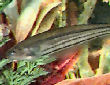
The graceful Knifefishes have an attractive elongated body, and yes… it is shaped like a knife!
The Knifefish move in a beautiful smooth, rippling motion that is a pleasure to watch. Their bodies are long, tapered, and laterally compressed. This shape along with a continually moving fin on their underside, likens them to a household knife. The undulating motion of this bottom fin is what they use to swim about.
These are unusual and fascinating aquarium specimens. Some are small and others can get rather large. But all in all, they make an attractive addition to a community tank or a splendid show fish in a specialty tank. The graceful movements of the knifefish are shown to best advantage in a longer aquarium.
Knifefish are found in two groups. The largest group are the Gymnotiformes. These are the electric knifefishes, and are also known as the Neotropical or South American knifefishes. These include the Glass Knifefishes, Sand Knifefishes, Naked-back Knifefishes, and the Ghost knifefishes. They are strictly freshwater fish and are found in Central and South America. There are about 150 described species in 32 genera, and another 50 or so species that are known but yet to be described. The actual number of species in the wild still to be discovered, is unknown.
The other group of knifefishes are members of the Notopteridae family belonging to the Osteoglossiformes Order. They are known as the Featherbacks, or Featherfin Knifefishes, and Knifefishes. They are found in Southeast Asia and Africa. This is a small group of knife fish, with only ten species in four genera. These fish are generally smaller fish that inhabit freshwater or brackish environments. Although they swim in a manner similar to the Gymnotiformes, they are not closely related.
Now just to confuse the issue, there are also a few species that have the term ‘knifefish’ used in their common name due to their body shape. These are not true knife fish, but are actually in the order Perciforms, which are the ‘perches’ or ‘perch-like’ fishes. These are the Grey knifefish Bathystethus cultratus, the Blue knifefish Labracoglossa nitida, Collared knifefish or Finscale razorfish Cymolutes torquatus, and the Jack-knifefish Equetus lanceolatus. These fish will not be found here, rather they will be included in the Perches and Perch-like fish category.
The Knifefish species list below includes popular types, as well lesser known knifefish varieties. Each fish guide has a description of the species, its place of origin, habitats and behaviors, as well as fish care to successfully maintain them in an aquarium. Fish pictures are also provided within each fish guide to help with identification, and to aid in choosing the best type of knifefish for your freshwater or brackish water fish tank.
- For information on keeping freshwater fish, see: Freshwater Aquarium Guide: Aquarium Setup and Care
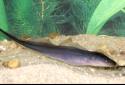
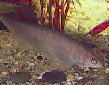
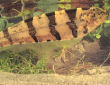
GhostKnifefishWFKn_Ap4AKn_vsm.jpg)
WFKn_Ap4AKn_vsm.jpg)
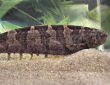
WFKn_Ap19AF_vsm.jpg)
WFKn_Ap4AKn_vsm.jpg)
Knifefish Description
The Knifefish fall in two groups, the Gymnotiformes Order of electric knifefishes and the family Notopteridae of the Osteoglossiformes Order.
Osteoglossiforms:
- This order includes the family Notopteridae, called the Featherbacks or Featherfin Knifefishes and are found in Southeast Asia and Africa.
- They are characterized by having a continuous fin along the underside formed by a joining of the caudal and anal fin, and by either not having a dorsal fin or having a very small one. These fish can be quite large, ranging in size from about 8 inches (20 cm) up to about 5 feet (152 cm) though most are in about the 3 to 4 foot (91 – 122 cm) size.
- Some of the other families in this order include Unusual Fishes such as the Arowanas and Butterflyfish, as well as the Mormyridae family of Elephantfishes.
Gymnotiformes:
- This order includes six families; the family Sternopygidae called the Glass Knifefishes, the family Rhamphichthyidae called the Sand Knifefishes, the family Hypopomidae, the family Gymnotidae called the Naked-back Knifefishes, and the family Apteronotidae called the Ghost knifefishes
- These fish are found in Central and South America. Some of their characteristics are an eel-like body that’s either flattened or rounded, no dorsal fin, an extremely long anal fin starting near the pectoral fin area which can move in an undulating forward or backward motion, no caudal fin or a greatly reduced one, and they have electric organs present.
- The electric organs allow them to generate a very weak electric field around their body which helps them identify objects other than water. This field helps them with their spatial orientation and to navigate, along with helping them detect food. Males use an electric ‘stereotyped’ communication to court females.
- Some of these fish inhabit quiet lakes or lagoons while others live in main river channels. Others, as some of those in the family Sternopygidae, the genus Gymnotus, live along river banks or on flood plains among roots or plant matter. Some species even like to burrow into substrate. Largely nocturnal they become active at night and are predators that eat insects, crustaceans, and other fish. They are sensitive to some fish medications such as copper and those containing formalin.
Knifefish Care
In general, Knifefish are shy secretive fish that will avoid the light, so provide them with hiding places such as hollow logs, rocks, and caves. Most are nocturnal, eating and being more active at night. Though usually peaceful with similar-sized tank mates they can be aggressive eaters, smaller fish will not do well with them. Some are also territorial and will quarrel with others of their own species. They are great jumpers so be sure you have a tight-fitting top on the aquarium.
For success in keeping Knifefish pay special attention to their feeding needs. Being nocturnal they can be fed after you turn out the lights, just be sure to remove any uneaten foods in the morning to maintain good water quality and prevent an additional load on your filtration. Knifefish live on average 3 to 7 years, with some species living over 10 years.
Featured Image Credit: Tatiana Belova, Shutterstock