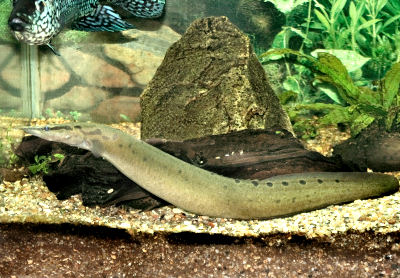
The Peacock Spiny Eel with its six attractive ‘eyespots’ is a very handsome freshwater eel!
The Peacock Eel Macrognathus siamensis is a very handsome spiny eel. There can be some variation in its color and patterning, depending on where it originates from. But basically they are light brown in color with a thin pale yellow stripe running from the eye to the base of the tail.
You can readily see where the name ‘Peacock’ Eel comes from. They will generally have between three to six decorative ‘eye spots’ adorning the upper rear portion of the body along the base of the dorsal fin. Other common names they are known by are Spot-Finned Spiny Eel, Peacock Spiny Eel, Striped Peacock Eel, and Siamese Spiny Eel.
Although not considered to be true eels, the body shapes of all members of the spiny eel family, Mastacembelidae, are definitely eel-like. The Peacock Eel has an elongated, but rather thick body and a pointed snout. This is an aquarium eel that doesn’t get too big, reaching just under a foot (30 cm) in length. Juveniles can be kept in about a 20 gallon tank, but larger specimens will need a bigger area. Adults will need a tank that is 36 inches in length and about 35 gallons. Make sure you have a tight fitting cover as these guys are escape artists
Peacock Spiny Eel is very hardy and commonly available. It makes a great starter fish for first time spiny eel keepers. It is generally a willing feeder and readily adapts to aquarium life. It is also relatively small, with its maximum adult size being just under a foot long. As it is nocturnal you may not always see it though. It will usually hide during the daytime by burying itself in the substrate.
Peacock Eels are peaceful fish that can be kept in a community tank with larger fish. As you can see from the photo above where this adult specimen is housed with a Jack Dempsey cichlid, they are great with a variety of tank mates. Unlike many of the spiny eels, this species will also get along well with others of its own kind as long as they are of a similar size.
For Information on keeping freshwater fish, see:
Freshwater Aquarium Guide: Aquarium Setup and Care
- Kingdom: Animalia
- Phylum: Chordata
- Class: Actinopterygii
- Order: Synbranchiformes
- Family: Mastacembelidae
- Genus: Macrognathus
- Species: siamensis
- Aquarist Experience Level: Intermediate
- Size of fish – inches: 11.8 inches (29.97 cm)
- Minimum Tank Size: 35 gal (132 L)
- Temperament: Peaceful
- Aquarium Hardiness: Moderately hardy
- Temperature: 73.0 to 82.0° F (22.8 to 27.8° C)
- My Aquarium – Enter your aquarium to see if this fish is compatible!
- Beginner Fish – Freshwater fish for beginners
- Community Fish – Peaceful Freshwater fish
- Hardy Fish – Hardy Freshwater fish
- Similar size fish – Fish that are 1 inch bigger or smaller
- Coldwater Fish – Looking for cold water fish? (65 °)
Habitat: Distribution / Background
The Peacock Eel Macrognathus siamensis was described by Günther in 1861. They are found in Asia: Mekong, Chao Phraya, Maeklong, Peninsular and Southeast Thailand. This species is listed on the IUCN Red List as least concern (LC) because it is common throughout its range, and although there is pollution and overfishing they are not considered significant threats at present. Other common names they are known by are Spot-Finned Spiny Eel, Peacock Spiny Eel, Striped Peacock Eel, Siamese Spiny Eel, and Spotfinned Spiny Eel.
They inhabit slow-moving, thickly vegetated areas of rivers and the still waters of flooded fields. They are nocturnal and will bury themselves (except for the head) in the silt or fine sand substrate during the day. They will emerge at night to feed on insect larvae, crustaceans, and worms.
- Scientific Name: Macrognathus siamensis
- Social Grouping: Groups
- IUCN Red List: LC – Least Concern – .
Description
The body of the Peacock Eel is elongated with a pointed snout. Both the dorsal and anal fins are extended back to the caudal fin, which is quite small. These fish will grow up to almost 12 inches (30 cm) in length and generally have a life span of about 8 – 18 years.
This eel is primarily light brown in color and it has a thin pale yellow stripe running from the eye to the base of the tail. Its common name ‘Peacock’ Eel is derived from the approximately 3 to 6 ocelli or ‘eyespots’ found along the base of the dorsal fin. There can be some color and pattern variations depending upon it place of origination.
- Size of fish – inches: 11.8 inches (29.97 cm)
- Lifespan: 18 years – Spiny eels have a lifespan of 8 – 18 years.
Fish Keeping Difficulty
Eels are generally suggested for an aquarist with some experience rather than the beginner fish keeper. This eel can be a bit sensitive to change and usually takes awhile to get over its shyness. The first few weeks can be extremely difficult getting them to eat. They do require extremely pristine water. They have very small scales protecting their body so are prone to fungus and parasites and very sensitive to medications. These fish respond poorly to copper based medications, so these should be avoided. If cared for properly, these eels get fairly large and can live for a long time.
- Aquarium Hardiness: Moderately hardy
- Aquarist Experience Level: Intermediate
Foods and Feeding
The Half-banded Spiny Eels are carnivores. They feed at night on insect larvae, crustaceans, and worms.Like all spiny eels they prefer a diet of live and fresh frozen foods such as brine shrimp, black worms, earthworms or bloodworms. Some spiny eels can be trained to eat freeze dried brine shrimp or bloodworms but this is not something that can be counted on. They will also eat small fishes so make sure their tank mates are too large to be able to fit into their mouths.
This fish is nocturnal and likes to be fed after the lights are turned off for the night. Eels only need to be fed a couple of times a week and some may refuse food offered more than that, then often eating only once every two or three weeks.
- Diet Type: Carnivore
- Flake Food: No
- Tablet / Pellet: Occasionally – Not all specimens will accept processed foods.
- Live foods (fishes, shrimps, worms): Some of Diet
- Meaty Food: All of Diet
- Feeding Frequency: Weekly – Eels only need to be fed a couple of times a week, and sometimes will eat even less.
Aquarium Care
The most important thing for these eels is that they always have clean and well-oxygenated water. Frequent water changes of about 30% a week are needed for this eel. With your weekly water change make sure to vacuum the gravel to remove all excess food and waster. but It’s best not to remove any bio film on rocks and decor. A magnet algae cleaner normally does a great job in keeping the viewing pane clear.
It is also helps to add efficient bottom cleaning tank mates to keep the bottom free from decaying foods in between cleanings. Be careful however, to add bottom cleaners after your eel is adjusted to its tank and is eating.
- Water Changes: Weekly – Water changes of about 30% weekly.
Aquarium Setup
Peacock Eels will spend most of their time on the bottom of the aquarium. Small specimens can be kept in a tank that is about 24 inches long and about 20 gallons. Larger specimens will need a bigger area, tanks that are 36 inches in length and about 35 gallons and up will suit an adult.
They do best in a soft to medium-hard water with good movement that provides plenty of oxygenation. These fish require pristine water. The tank water should turnover at least 10-15 times per hour. An undergravel filter is a great choice for these fish as it creates high oxygen through out the tank as well as reducing the waste. A canister filter or powerheads and airstones can be introduced to achieve proper flow and oxygenation. Provide a tight fitting lid as spiny eels are escape artists.
They like a dimly lit aquarium or one with floating plants to help subdue the light. If their tank has a sand or fine gravel substrate, they may burrow into it. Make sure they have plenty of hiding places so they will feel secure in their new home. Provide other decor such as rocks, caves, and roots to give it some dark areas to retreat. PCV tubing also makes great caves for long spiny eels. Be sure to place heavy decor firmly on the bottom. These fish are not actively destructive, but because of their size and burrowing nature, they can dislodge anything that gets in their way, including plants. Multiple hiding places need to be made for the eel to feel safe in the tank.
- Minimum Tank Size: 35 gal (132 L)
- Suitable for Nano Tank: No
- Substrate Type: Sand – Substrate should be soft and smooth so the Peacock Eel can burrow without injury.
- Lighting Needs: Low – subdued lighting – In moderately lit tanks a lot of shaded hiding places are needed. Providing floating plants will also help subdue the light.
- Temperature: 73.0 to 82.0° F (22.8 to 27.8° C)
- Range ph: 6.0-8.0
- Hardness Range: 6 – 25 dGH
- Brackish: No
- Water Movement: Moderate
- Water Region: Bottom – Peacock Eels will spend most of their time on the bottom of the aquarium.
Social Behaviors
They are a nocturnal species but are generally peaceful and shy. They mostly ignore other tankmates. They can be kept in a community tank with a wide variety of larger fish. Unlike many of the spiny eels, this species will also get along well with others of its own kind as long as they are of a similar size.
These eels are very shy when first introduced to a new tank and are known to be too shy to eat at times. It is wise not to have tank mates like catfish or loaches, at least not until your spiny eel is settled in. These fish will simply take any food offered too quickly and the eel will not get comfortable enough to feed freely.
- Venomous: No
- Temperament: Peaceful – This fish is shy but fairly agreeable.
- Compatible with:
- Same species – conspecifics: Yes – They can be kept with their own kind as long as they are of similiar size.
- Peaceful fish (): Monitor – Safe as long as they are large enough not to fit in the eels mouth.
- Semi-Aggressive (): Safe
- Aggressive (): Threat – May injure the eel.
- Large Semi-Aggressive (): Threat
- Large Aggressive, Predatory (): Threat
- Monitor
- Shrimps, Crabs, Snails: May be aggressive
- Plants: Monitor – These eels like to burrow and will regularly uproot the plants.
Sex: Sexual differences
Sexual differences are unknown and it is almost impossible to identify the sexes, though a mature female may be more full bodied.
Breeding / Reproduction
The Peacock Eel has not been bred in captivity. Only a few spiny eels have been bred in the aquarium, possibly because they are generally kept singly rather than in a group where a male and female can find each other. Though it is not documented what makes them spawn, trying to emulate the bounty of the flood season can help stimulate breeding behavior. Feed more and higher quality food than you normally would and providing an influx of clean water. Their courtship lasts for several hours, where they chase each other and swim in circles.
The eggs are deposited among floating plants. They are sticky so will adhere to the plants and then hatch in 3 to 4 days. The fry becoming free swimming a few more days after that and should be fed nauplii. The fry are something of a challenge to raise as they are susceptible to fungal infections. Regular water changes and the use of an antifungal water treatment can help.
- Ease of Breeding: Unknown – This fish has not been bred in the home aqarium, however it is presumed that their breeding process is similar to other Spiny Eels.
Fish Diseases
Eels are prone to diseases caused by parasites and fungus, so take caution when introducing these fish to an established tank. Eels are also very sensitive to medications used to treat many diseases; a separate hospital tank is needed. Very low water temperatures and condition changes can also cause stress to this fish which makes them even more prone to disease. Take great care when netting eels as they have very delicate skin and scrapes can make them prone to bacterial and fungal infections.
The most common disease that an eel is susceptible to is Ich. Ich is short for Ichthyophthirius, also known as “white spot disease”. It is a parasite that can attack nearly all aquarium fishes, but you’ll find that Eels are often the first to be attacked. Take great care in treating ick as eels are very sensitive to the medications used to treat it. Often the dose is half of what is normally used. If nervous or unsure about medications, use Reef safe medications.
An outbreak of disease can often be limited to just one or a few fishes if you deal with it at an early stage. When keeping these sensitive types of fish, it is common to catch deteriorating water conditions and disease before other fish are affected. The best way to proactively prevent disease is to give your Peacock Eel the proper environment and give them a well balanced diet. The closer to their natural habitat the less stress the fish will have, making them healthier and happy. A stressed fish will is more likely to acquire disease.
Anything you add to your tank can bring disease to your tank. Not only other fish but plants, substrate, and decorations can harbor bacteria. Take great care and make sure to properly clean or quarantine anything that you add to an established tank so not to upset the balance. It is recommended to read up on the common tank diseases. Knowing the signs and catching and treating them early makes a huge difference. For information about freshwater fish diseases and illnesses, see Aquarium Fish Diseases and Treatments.
Availability
The Peacock Eel is commonly available at pet stores and online, and is reasonably priced.
References
- Animal-World References: Freshwater Fish and Plants
- Dr. Rüdiger Riehl and Hans A. Baensch, Aquarium Atlas Vol. 1, Publisher Hans A. Baensch, 1991
- Joseph S. Nelson, Fishes of the World, Wiley, 2006.
- Neale Monks, Brackish Water Fishes: An Aquarist’s Guide to Identification, Care & Husbandry, TFH Publications, 2006
- Dr. Herbert R. Axelrod, Dr. Warren E Burgess, Dr. Cliff W. Emmens, Neal Pronek, Jerry G. Walls, Ray Hunziker,
Dr. Axelrod’s Mini-Atlas of Aquarium Fishes, Mini- Edition, T.F.H. Publications, Inc., 1987 - Dr. Herbert R. Axelrod, Aquarium Fishes of the World, TFH Publications, 1998
- Macrognathus siamensis (Günther, 1861) Peacock eel, Fishbase.org
- Macrognathus siamensis, The IUCN Red List of Threatened Species