
This little creature is a very social animal with people. With the destruction of much of its natural habitat, the Common Ringtail Possum along with the Common Brushtail Possum has adapted to living close to people and is a very common site to people in Australia. They inhabit the roofs of peoples homes and will live in the walls of houses too. They are often seen in the evenings in gardens and running along power lines.
The Common Ringtail Possum can make quite a good pet if treated well and given lots of attention. They are a delightful little creature and are distinguished by their white tipped prehensile tail, which they curl up into a tight ball when they are sleeping.
A nocturnal animal with very good night vision, the Common Ringtail Possum gets active at night and sleeps during the day. Most of their activity is from dusk until midnight. This is great for people who have the evening hours to interact with their pet.
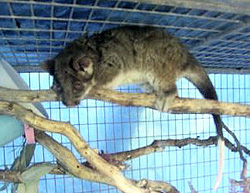
As you can see, the Common Ringtail Possum is very agile and likes to hang out in trees or other high places. They are arboreal (tree-dwelling) marsupials, and use their long white tipped prehensile tail for griping branches when climbing. They can also use their tail for carrying nesting materials. They have a soft, high pitched twittering call.
Most Possums are very solitary, but this little fellow is a bit more social and can be kept in pairs. But they do have a habit of marking there territory and this can be a bit overwhelming if kept in doors. If you try to clean up after them, they tend to scent mark again even more. For this reason you may wish to keep them in an outdoor type aviary.
The Common Ringtail Possum belongs to the order marsupialia. There are a variety of marsupials including such creatures as kangaroos, Sugar Gliders, Wombats, Short Tailed Opossums, and Tasmanian Devils.
- For information about Small Animals and their care visit: Guide to a Happy, Healthy Small Animal
Scientific Classification
| Kingdom: | Animalia |
| Phylum: | Chordata |
| Class: | Mammalia |
| Order: | Diprotodontia |
| Family: | Pseudocheiridae |
| Genus: | Pseudocheirus |
| Species: | peregrinus |
Scientific name
Sub-species
Pseudocheirus p. peregrinus
Pseudocheirus p. cooki
Pseudocheirus p. convolutor
Pseudocheirus p. pulcher

Background
The Common Ringtail Possum is from Australia, Tasmania, and New Guinea where there are over 20 different types of possums. The Ringtail Possum is the most widely distributed of the 13 ringtail species, fairly common, and are not considered threatened.
They live in a variety of habitats, as long as there is scrubby cover in the area, including rainforests, forests and woodlands, and even coastal dunes. They also live quite happily in close proximity to people and can be seen in gardens, roofs of homes, and even in the walls of houses.
Note: Possums are NOT the same thing as opossums. “Opossums” range from North America to southern Argentina and contain 15 genera with over 60 species. “Possums” are found in Australia with over 20 species. They are both marsupials, but are actually only distantly related within the same subclass.
| What’s in the name? | ||
|---|---|---|
| Pseudocheirus peregrinus | means | “false-hand from foreign parts” |
Description
A mature Common Ringtail Possum is about the size of a house cat, its body will reach a length of about 12″ – 14″ (30 – 35 cm) with a tail about the same length, and it will weight between 1 1/2 – 2 1/2 lbs (700 – 1100 g).
The smallest of the ringtails, the Common Ringtail Possum’s wooly fur is a grey-brown to red-brown and paler underneath. They have short rounded ears often with a patch of white behind them, brown bulging eyes, long sensitive whiskers, and a fairly good sense of smell.
They have 5 clawed toes on their hands, the first two being opposed. The hind feet also have five toes, but the only the first is opposable and it has no claw. The long tapering prehensile tail is friction padded, great for grabbing branches and nesting materials, and about a third of it is white. To move about they mostly use their strong hind feet and their tail.
A ringtail possum will live up to 10 or 12 years in captivity, if well taken care of with the inclusion of native plants in their diet.
Environment
The Common Ringtail Possums will mark their territory which can be rather pungent in a closely confined area. They are best kept in a outdoors aviary, but out of a draft. A good size for the aviary would be about 12′ (3.7 m) long 8′ (2.4 m) high and 4′ (1.2 m) wide. As they are tree dwelling animals, height with plenty of room to climb and move around is most important. They will need branches and thick pieces of bark for climbing on and for gnawing. Change the branches around and provide new ones regularly.
In the wild the Ringtail Possum will sleep during the day in hollow trees or in round nests called ‘dreys’ made out of leaves, stringy bark, and twigs. Provide them with a number of nesting logs or boxes in the aviary. Though sometimes they will share a nest, it is best to give them with more nests than the number of possums to prevent fighting.
Care and feeding
The Common Ringtail Possum is an herbivore, or plant eater, they eat at night, and they don’t eat insects. Provide a feeding platform high above the ground to put their food on. You can also hanging plants around their climbing branches for them to munch on.
In the wild their diet varies somewhat according to the range of each animal, but they mostly eat blossoms, fruits and leaves in the treetops at night, primarily eucalyptus and acacia. From living in close proximity to people, they have extended their foods to include introduced plants, flower, and fruits as well. This adaptation has not endeared them to gardeners! They will also eat their own fecal pellets and this allows them to digest their food twice, extracting the maximum amount of nutrients from the food.
You can provide them with a diet of greens, fruits, nuts, oats, flowers, flower petals, and native vegetation. Be sure any plants you offer are not toxic, such as oleander. Making a good portion of their diet native vegetation will help to ensure a healthy long-lived pet. Some native vegetation includes eucalyptus, acacia, gum, tea trees, she-oak, bottle brushes, grevillia, and wattles. For a treat you can offer some fruit-flavored yogurt. If you are having a problem getting them to eat, you can try putting a little honey on their food to encourage them. The other big thing is water – even though many of the fruits and vegetables contain much water, it is still mandatory to make sure Ringtail Possums have access to water at all times. Put water in a heavy dish attached to the side of the cage. Water also should be kept up high in the cage.

Social Behaviors
Most possums are very solitary, but this little fellow will live in a small family group for a period of time. Usually a temporary group will consist of one male and one or two females, and the family they are raising. The young don’t leave the group until they become adults at about eighteen months of age, and then they will leave to form their own families.
Though generally not overly aggressive, they are territorial and usually solitary except for these family groups. Occasionally some animals will become extremely aggressive and attack any intruder within their territory. Use caution when entering the aviary to avoid any injuries.
Activities – Exercise and Play
During the day, the Common Ringtail Possum sleeps in its nest. They become active in the evening, and will want to eat, climb, and play during the night.
Breeding/Reproduction
In the wild the Ringtail Possum may build as many as five or even more nests or ‘dreys’ within its home range. They are shaped like a round ball and are built in tree hollows or in dense vegetation. Both The male and female will build them together and they will readily move from one to another, taking their young with them.
Common Ringtails Possums are sexually mature at about 13 to 18 months of age. They breed from April to November having usually one or two litters per year. The gestation period is about four months and the litter size is usually two although one to four babies have been recorded. After birth the new born babies crawl into the mothers pouch and attach to a nipple for about 42 to 49 days, and then will stay in the pouch for about another four months. After leaving the pouch, they stay in the nest or cling to the mother’s back until they are weaned at about six months. Often both parents often care for the young, with the father carrying them about while the mother is feeding.
Ailments/Treatments
Short Tail Opossums are very hardy little creatures. However, if not taken care of properly they can become ill. Most ailments are preventable simply from taking proper care of the animal.
Availability
Common Ringtail Possums are found and kept as pets in Australia. One thing to take into consideration before you decide to acquire a Ringtail Possum is does your veterinarian treat exotic pets? Not all vets do, so you might want to check and make sure that there is a vet in your area that will treat your pet in case he gets sick.
| Dr. Jungle says…”Monkey Boy,…are you really sure you’re not a monkey?” | |
|---|---|
|  |
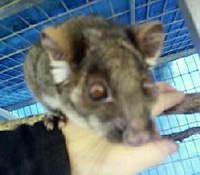
Dr. Jungle shares what Rose has to say about Monkey Boy… “I hand raised “Monkey Boy” from a bub, and he never stops moving for the camera! ” Ringtail Possums have adjusted to living amongst people very well. They are so good at getting used to routine that if you have them in your yard and start feeding them they will come down at the same time each night. If you forget to put food out once they are used to you, they will come and bang on your windows! “As pets they need the proper native plants and flowers like bottlebrush, grevillia, certain species of gum shoots etc… as part of an appropriate diet. Also if they are to be kept as pets they require a large aviary type enclosure, preferably with large flowering appropriate plants (some plants are highly toxic to possums) and small trees growing inside. (I am currently designing one for my boy). “My possum, Monkey Boy, should really be released back into the wild now that he is fully grown, but I am not sure how his survival rate will be. He’s a bit spoilt. They are very territorial and will fight amongst themselves, but their biggest predator is the cat and the human! …Rose | |
Featured Image Credit: Wattlebird, Shutterstock