
Rats can live 2 to 3 years, are easy to house and feed, and are mostly odorless. They are inexpensive, small, and have lovable personalities. Rats also tend to be hardy little animals.
When looking for a rat to purchase as a pet, make sure it is a young, healthy animal. It should ideally be between 4 and 8 weeks old. Make sure it is plump, has bright eyes, good sound teeth, and a healthy coat. Listen to the rat’s breathing, if you hear any wheezing or it makes a sound other than a distinct “eep”, these are signs of respiratory illness. Though the rat itself is inexpensive, visits to a veterinarian are not.
Either sex will make a good pet, however if you plan to buy more than one, make sure they are of the same sex. Females are generally more active while males tend to be more cuddly. It is a good idea to buy atleast two as they are highly social creatures and thrive with a constant companion. But don’t buy a male/female pair unless you want babies.
- For information about Small Animals and their care visit: Guide to a Happy, Healthy Small Animal
Scientific Classification
| Kingdom: | Animalia |
| Phylum: | Chordata |
| Class: | Mammalia |
| Order: | Rodentia |
| Family: | Muridae |
| Genus: | Rattus |
| Species: | norvegicus |
Scientific name
Rattus norvegicus
– Brown (or Norway) Rat, common pet
Rattus rattus
– Black (or ship) Rat
Background
Rats have been around for an extremely long time, and different varieties can be found almost everywhere in the world. Rats have often been thought of as pests because they have found advantages in living with people. People have always provided a good source of food for rats in their houses, buildings, and ships. The Brown Rat, which is the most common pet rat, traveled by ship to different countries across the globe. It gained prominence in the United States in the 1760’s when there were large numbers of European immigrants.
In the European Middle Ages, rats carried the deadly plagues (such as bubonic plague) which killed hundreds of thousands of people. This resulted in them being though of as a scourge. In other places they were seen as a possitive signs, such as a good luck symbol to ancient Romans and as a messenger of the gods to the Japanese.
In today’s world, many rats are domesticated and bred to display many different fur types and colors. They are also bred and used extensively in research laboratories to study heredity, and the effects of drugs and foods. One reason for this is that they can reproduce fairly quickly.
Description
Rats can vary in size, but normal pet rats average about 14 to 18 inches long including the tail, with an average weight of approximately half a pound. If well taken care of they can live from 2 to 3 years.
There are several varieties of rats, some well-known ones include kangaroo rats, packrats, bushy-tailed woodrats, African giant rats, and spiny rats. The disease-carrying rats of the Middle Ages which today are the most common pets, are the black and brown rats.
Pet rats can come in many different colors, including black, brown, beige, albino (white with red eyes), and many combinations of colors. Most rats are commonly a solid color or hooded. Hooded rats have one color covering their head with usually a stripe coming down their backs, with the rest of their bodies a different color.
Environment
When considering what type of cage to buy or build, make sure there at a minimum, it is 16″ x 10″ x 10″. Glass aquariums, or metal cages with small bar spacing are usually ideal, because they can’t chew through them or squeeze through the spaces.
The cage can be kept inside or outside as long as it does not drop below 40 degrees and as long as it is not kept in a direct draft. They are not as heat tolerant as humans, so should not be exposed to extremely high temperatures.
Provide a good soft bedding that is clean, non-toxic, absorbent, relatively dust free and easily acquired. Shredded paper or tissue, processed corn cob, wood shavings, or a prepared litter are preferred bedding. Avoid cedar or chlorophyll impregnated shavings as they have been associated with respiratory and liver disease. They love to burrow so make sure to give them a good layer, at least 1″ thick. Cages with removable trays may be a consideration, since they can help make cleaning easier.
Put in a cardboard house or logs for the rat so that he has a place to go when he is tired. Consider different toys also, such as wheels for young rats, mirrors, logs and ladders.
Clean the cage thoroughly with hot water at least once a week.

Care and feeding
A rat’s diet is a major factor in keeping your pet healthy. It needs to be well balanced and nutritrious, based on protein, vegetables and fruits. The best way to obtain this is to buy pre-mixed rat foods at pet stores, which have all the nutrition requirements in the right amounts. Otherwise, good protein sources are dog food, fish flakes, some grains, and other freeze-dried fish foods (like brine shrimp and plankton). Fruits and vegetables are also very important and they provide necessary vitamins and minerals. Good sources of these would be apples, carrots, lettuce, bananas, etc. Since rats are sometimes prone to vitamin deficiencies, you may want to consider getting a vitamin supplement to add to the food, which can be found in pet stores. They will also benefit from the addition of calcium, which you can offer in the form of a calcium block sold for birds in pet stores.
In general, rats should be fed once a day, usually at night since that is when they are most active. Make sure and remove any non-eaten fresh greens at the end of the day. Food should be put in heavy china or pottery dishes (making it harder for them to spill the contents) and should be thoroughly washed with hot water at least twice a week. They may also be given treats such as table scraps, soup, potatoes, meat, insects (mealworms, grasshoppers, moths), or treats found at pet stores.
Rats teeth are also constantly growing, so you should provide them with objects to gnaw on, such as rawhide bones, nuts, or wood pieces. This will help keep them in good shape.
Water is a very important thing for rats. They cannot survive without it, so make sure they have a constant supply. Gravity-flow water bottles, which can be found in pet stores, are a good choice, or just a plain dish will work too.
Social Behaviors
Most rats get along together, however there are some things to take into consideration. Occasionally, males will fight with each other, especially in the presence of females. Also, whenever adding a new rat to a cage, watch to make sure the new one is not picked on. Newcomers are sometimes not welcome, and there is always a pecking order established.
Rats are great companions for children. It’s okay to have only one as long as it is given a lot of attention, however their need for socialization is very great and they will thrive best if they also have another rat companion. They should be kept away from other household pets unless they are well acquainted with each other. Sometimes rats can become good friends with dogs or cats.
Never house rats with other rodents though, such as mice, hamsters, or gerbils, because they will usually kill them.
Handling and Training
When picking up your rat make sure to support it with both hands; with one hand under it’s shoulders and the other supporting it’s hind legs. Never pick your rat up by the tail and be careful not to squeeze it.
Rats can be taught simple tricks, such as coming when they are called and riding around on your shoulder. They can also be taught such things taking food from your fingers once they are comfortable with you. One of the best ways to train them to do these simple tricks is to reward them with a treat everytime they do something right.
To keep them tame and friendly, make sure to spend ample time with them and handle them at least once a day.
Activities – Exercise and Play
Rats need plenty of exercise and they also love short periods of time under supervision. They love to explore. A good source of entertainment and enjoyment for your rat is to construct a maze that they can explore. You can also put different toys, ladders, tunnels, and wheels in the cage itself to provide them with good exercise when you are not around.
Breeding/Reproduction
When breeding, you can either have a pair of rats, or you can put one male in with several females. Both males and females are fully sexually mature between 10 and 11 weeks old, though females can get pregnant as early as 5 weeks. You shouldn’t breed them until they are about 4 or 5 months old.
The gestation period for females is approximately 3 weeks and they have from 8 to 12 young. The father will not harm the mother or babies, however he should be removed before the babies are born as the mother will become pregnant again immediately if he is in the same cage. Because the mother will be nursing, this subsequent litter will tend to be runts.
Babies are born naked with their eyes and ears closed. They start growing fur within a few days, and their eyes usually open at about 2 weeks old. After this, the young rats will start exploring their home, and are weaned at about a month old.
While the mother is pregnant, feed her about 3 times more food than usual, because she will need many more nutrients to help the babies grow and develop correctly. Keep the cage exceptionally clean, and make sure there is ample room for the mother to leave her young when she needs a break from them.
| A white rat, “Snowflake” is seen here with her babies! | |
|---|---|
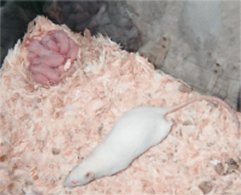 | 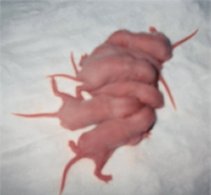 |
| Babies are a few days old | Newborn babies |
Photos @ Animal-World: Courtesy Jasmine Brough
Ailments/Treatments
Rats are hardy animals and rarely get sick. However, if not taken care of properly they can become ill, and they are very prone to respiratory illnesses. Most ailments are preventable simply from taking proper care of the animal.
Signs that the animal is not feeling well include: listlessness, huddling in a corner, a dull matted coat, refusing food, labored breathing, runny noise, watery eyes, and constipation. In most cases, there are medications available at pet stores which can be used to aid in treating the animal. In other cases a trip to a veterinarian may be required.
- Respiratory Infections – Pneumonia: The indications that your rat has a respiratory infection or even pneumonia are runny eyes and nose, coughing, sneezing, and labored breathing. Respiratory Infections can be caused from being in drafts and/or damp bedding. Make sure he is taken out of drafts and the cage is completely clean and dry, and place a dry cloth over the cage. Pneumonia will require an antibiotic therapy, and possibly a visit to a veterinarian.
- Diarrhea: If your rat has watery droppings and appears to have diarrhea, then the cause is most likely from having too many fresh greens. The simple remedy to this is to remove them completely and not feed them at all for a few days until he appears to be getting better. Then slowly re-introduce greens by giving them every few days.
- Constipation: If it appears that your rat is constipated, then it is most likely either not getting enough greens or water, so check both of those.
- Lice and Mites: If your rat is constantly scratching, it could be a sign that it has either lice or mites, which are parasites that live on the skin. There are sprays and powders available for the remedy of this.
- Fleas and Ticks: Fleas and ticks are bigger than lice and mites, but cause the same scratching and discomfort as lice and mites. Completely clean and disinfect the cage. The best way to naturally control fleas is as simple as a flea comb, hot soapy water, and a good vacuum cleaner. A home remedy used for dogs and cats is to season their food with brewer’s yeast and garlic, a natural flea repellant. Medication designed for cats can is often suggested for use, but a cat treatment flea dip can be harmful. Flea products are known to have caused deaths and illness in pets, so despite strong warning labels, we are hesitant to recommend them.
- Ringworm: Ringworm is a fungus infection on the skin. It is best to go to a veterinarian for this.
Availability
Pet rats are readily available.
Featured Image Credit: Bilanol, Shutterstock