Animal-World > Birds > Conures > Nanday Conure

Nanday Conure

Black-hooded Parakeet

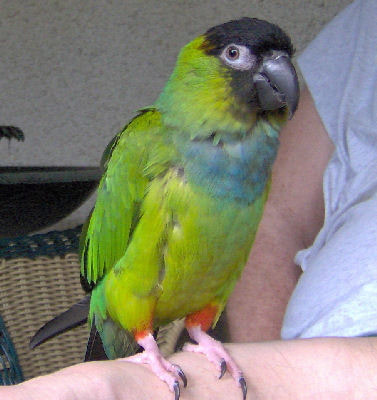
Family: PsittacidaePicture of a Nanday Conure or Black-hooded ParakeetNandayus nendayPhoto © Animal-World: Courtesy Dave Forsyth
Latest Reader Comment - See More
Nesting questions. Our nanday started laying eggs ten days ago. We have a jenday but do not know if it is male or female. The nanday mom is very protective of her... (more)  Tara

   This juvenile Nanday Conure or Black-hooded Parakeet is about 5 months old. He is a super sweet bird by anybody's standards!

   Typical behavior of the Nanday Conure or Black-hooded Parakeet is demonstrated by the cute little youngster 'Nan', pictured above.

   "Nan" loves to come out of the cage. He comes to the front of the cage every time someone comes near. He likes to tumble and toss everything in his cage. He knocks his perches down, empties his water as soon as you put it in, and tips over everything that is not securely attached...all for FUN! He has proven to be a very good escape artist, too. His cage doors must be securely fastened with wire.

For more information about the care of Conures see: Guide to a Happy, Healthy Conure


Geographic Distribution
Nandayus nenday
See All Data at Google Maps
Data provided by GBIF.org
  • Kingdom: Animalia
  • Phylum: Chordata
  • Class: Aves
  • Order: Psittaciformes
  • Family: Psittacidae
  • Genus: Nandayus
  • Species: nenday

Scientific Name:Nandayus nenday
(Syn: Aratinga nenday)

Distribution:
   The Nanday Conure or Black-hooded Parakeet is native to southeastern Bolivia, southern Mato Grosso, northern Argentina, Chaco Formosa, and Paraguay. It is also been introduced in North America with colonies reported in the southern and eastern parts of the United States.

Description:
   The head is black, along with the cheeks and throat, which looks like a cap. The rest of the body is green, the throat and breast are blue, and the feet are red.

Size - Weight:
   Mature birds are about 11-12 inches long and weigh 5.2 ounces.

Care and feeding:
   The main diet of the Nanday Conure or Black-hooded Parakeet should primarily be nuts, seeds, fruits, and vegetables. A commercially prepared pelleted diet can also be beneficial.

   See About Conures: Housing and About Conures: Care and Feeding for more information.

Social Behaviors:
  Wild conures are friendly and peaceful. They live together in large flocks, often with monk parakeets.

Activities: Loves to climb and play. Provide lots of toys Picture of a Nanday Conure or Black-hooded Parakeet
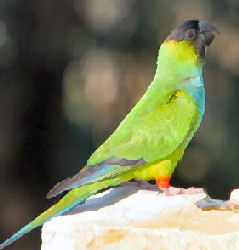
Photo © Animal-World: Courtesy Rob Hast

Breeding/Reproduction:
   Nanday Conures are sexually mature at three years of age. The hen will lay two to six eggs which incubate for 24-26 days. The cock usually sits on or near the nesting box. The parents should be fed food that is enriched with calcium and mineral supplements.

Potential Problems:    Like the Aratinga conures, the Nanday Conure or Black-hooded Parakeet can be noisy, they have a high pitched screech that can be annoying.
   See About Conures: Potential Problems for more information.


Availability: The Nanday Conure or Black-hooded Parakeet is readily available.

Author: Clarice Brough, CAS
Lastest Animal Stories on Nanday Conure

Tara - 2013-05-23
Nesting questions. Our nanday started laying eggs ten days ago. We have a jenday but do not know if it is male or female. The nanday mom is very protective of her eggs. We haven't candled them yet because she gets so upset. Her 1st egg was 10 days ago. About 3 days later she laid another one. Today she laid another one, about 5 or six days after the second one. The first two eggs have dark spots on them now. Is this a sign of life or death. It could be poop too. If they are not fertile will she stop nesting after a while? If the first ones are getting old and yucky how will I know and will that hurt the third egg? The third egg has a small crack indented in one side. Would anyone recommend repairing it? I have heard of people using glue or white-out. I intend to let the mother raise them if they hatch so I am not concerned about taking them to incubate myself. I will feel kind of bad if they are not fertile because she is so dedicated to them. Any suggestions? :)

  • Clarice Brough - 2013-05-24
     Your hen is  in egglaying mode, but if there's no male then the eggs are not fertile. Laying more than one is not unusual and it's important that you supplement her diet with calcium at this time to keep her healthy and prevent egg-binding. Don't take her eggs from her until she is disinterested in them, which is usually about 4 - 6 weeks. Inexperience females may accidently break an egg, and it can start to smell. Both broken eggs and removing her eggs will stimulate her to lay more, so the best bet is to get some artificial conure/cockatiel eggs to replace any broken ones with. Make sure she is eating. She may incubate the eggs for long periods of time, so you may want to move the food and water close to her nest.
Reply
cynthia - 2003-09-28
One day my mom and myself were walking out of petsmart. A lady was walking to the store with a nanday and i told her what a beautiful bird. The woman asked me if i wanted her. She said the birds name was 2k i said sure. well to make a long story short, 2k is very happy she gets to come out of her cage when she is ready the first day she was very nippy but now she is fine.She gets along with my children and myself. She a pleasure to have with our family and she rules the roost

Thanks
Cindy

Reply
Olga - 2003-07-31
I have the same bird, i got him from my sister, she couldn't take his screeming any more, and i felt sorry for him. No he lives with me and like to play a lot takes a shower with me every morning. His cages is always open so he flyes everywere in the house, and loves it, dosen't screm that much. I am very happy with him. Needs a lot of attention. Read a lot about those birds before buying!!!

Reply
nahomi - 2012-07-22
I just bought a nanday conure and she looks like missing feathers on her chest I went to petsmart and bought her some vitamins for some plumage and feathers. It's my first time having a bird what do I need to do or buy.

  • Charlie Roche - 2012-07-22
    I can't know whether the chest is bare cuz she is pulling her feathers or she is real young.  If young then just wait till feathers grow in.  If she is 3 - 4 monhs old (at least) she should be fully feathered.  Conures need a lot of toys and attention and distraction.  They love being with their human 24/7 and think we are one big toy made for them to play with.  If they aren't with us they need toys - lots.  TV is good and yes they do pay attention.  Cartoons and music work best.  I love (it will sound funny) but cash register paper rolls and they just scrunch up the paper or pull it and shred it.  However, they are shreddding the paper in peices and not their feathers.  They sell toys that hold cash register paper for birds but cheaper to buy the rolls at staples and put it in the cage with a piece of chain.  I would also bathe her/him with aloe bird spray. Possibly dry skin/feathers.  So conures are velcro birds and want to be with their human.  They need lots of toys and distraction to keep them entertined as sooo smart.  Aloe bird bath in case dry.  Enjoy and have fun.
  • nahomi - 2012-07-23
    Thank you. And well we just got her yesterday and shes not tamed at all so she bights do you know how I can atleast be aable to grab her so I can bath her
  • Jonny - 2013-04-24
    I also have a nanday and many other exotic birds if I were you I would go to a near by avian vet because there is a possibility that he has Thyroid problem which can possibly be helped with medicine but sometimes not this means parts of his feathers are falling out and normally it's just something you and him have to deal with I would definitely try finding by vet to diagnose the problem it also could be stress plucking which happens normally when the bird is in a new environment thanks hope you can use my advice best wishes your and your bird are in my prayers bye :)
  • Jonny - 2013-04-24
    I think the best way is gently pick her up with a thick towel and if you want to fix this problem she needs you to do that Quite frequently to get her socialized and use to you
Reply
Carol - 2013-01-06
Hi i have a nanday conure, he is been with us for a week, he was just fine for the first few days, coming out of the cage, getting on our shoulders, eating from our hand, and then out of the blue, he got so agressive, we cant even get close to the cage, because he tries to beat. can anybody help us please, thank you

  • Jeremy Roche - 2013-01-06
    Could an environmental issure triggered this?  Something scare the bird?  Maybe jealous of someone or something new?  Change in diet?
Reply

Copyright © [Animal-World] 1998-2012. All rights reserved.