
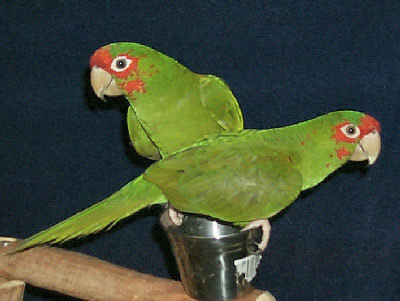
“I’m here to tell you… the original Heckel and Jeckel never got into as much trouble as these two!”…Dr. Jungle
For more information about the care of Conures see:
Guide to a Happy, Healthy Conure
- Kingdom: Animalia
- Phylum: Chordata
- Class: Aves
- Order: Psittaciformes
- Family: Psittacidae
- Genus: Aratinga
- Species: mitrata
Scientific Name:
Distribution:
These birds are native to central and souther Peru south through eastern Bolivia the La Rioja and western Cordoba in north-western Argentina.
Description:
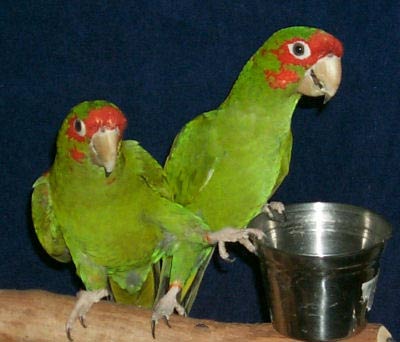
Mostly green but more yellowish on the underparts. The forehead is red with distinctive red markings around the eyes. There are scattered red feathers on the hindneck, mantle, throat, thighs, and bend of wing. The undersides of the wing-coverts are olive-green, while the undersides of tail and flight feathers are olive-yellow. The naked periophthalmic ring is creamy-white. Bill is horn colored. Irises are orange-yellow with and inner gray ring.
Size – Weight:
These birds get up to 15″ (38 cm). 8.6 ounces (244 g)
Care and feeding:
A roomy cage is required unless the bird is to be let out for extended periods. Many birds can spend most of their time on a play pen or parrot perch. They eat a variety of sprouts, seeds, nuts, fruits, vegetables, and commercial pellets, as well as the same nutritional foods humans eat.
See About Conures: Housing and About Conures: Care and Feeding for more information.
Social Behaviors:
In captivity these conures become very tame and will learn to speak. They need attention, patience, and toys.
Activities:
Loves to climb and play. Provide lots of toys.
Breeding/Reproduction:
They breed readily if they have the right size aviary. The hen lays two to four eggs which are incubated for about 23-26 days. The young fledge after about 59 days. The nest box size should be 12″ x 12″ x 12″.
Potential Problems:
As with many Aratinga species, MItred Conures can be noisy.
See About Conures: Potential Problems for more information.
Availability:
This bird is generally available at a pet stores or breeders.
Featured Image Credit: Ian Fox, Shutterstock