
“Rocky” loves attention and is a very playful comedian. When he gets excited he will lift up his crest like an Indian headdress, bob up and down, and dance. What a card!
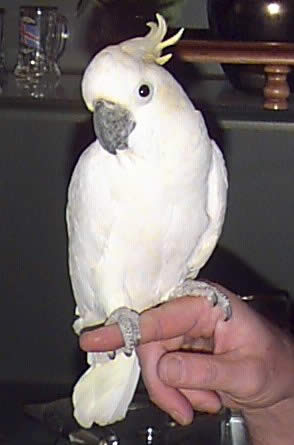
The Lesser Sulphur-crested Cockatoos are very docile. They can learn to speak and are easy to teach all kinds of tricks. This is a smaller cockatoo and they are sometimes referred to as the “apartment-sized cockatoo”. They are pretty birds with a delicate beautiful appearance and their movements are very gracefully.
Like cockatoos in general, they are a very loving type of bird. Affection is readily accepted and returned in kind. They are a pet that not only appreciates interaction but requires it and needs a lot of attention from their owners. Buy a cockatoo only if you can spend a lot of time with it.
Dr. Jungle shares a little bit more about “Rocky”!… Rocky is a mature bird, though only about 3 years old. While Rocky was at our store he was rather nervous about all the commotion and didn’t want to be held very much. Now though he spends most of his time outside his cage and loves to perch on his owners hand. |
To learn more about Cockatoos and their needs visit:
Guide to a Happy, Healthy Cockatoo
- Kingdom: Animalia
- Phylum: Chordata
- Class: Aves
- Order: Psittaciformes
- Family: Cacatuidae
- Genus: Cacatua
- Species: sulphurea
Scientific Name:
Subspecies:
- Lesser Sulphur-crested Cockatoo
Cacatua sulphurea sulphurea - Citron-crested Cockatoo
Cacatua sulphurea citrinocristata - Cacatua sulphurea djampeana
- Cacatua sulphurea abbotti
- Cacatua sulphurea occidentalis
- Cacatua sulphurea parvula
The Lesser Sulphur-crested Cockatoo is divided into six subspecies. They very much resemble the Greater Sulphur-crested Cockatoo but are much smaller, being 3 or 4 inches shorter in length. Except for the Citron-crested Cockatoo they are all similar to each other as well, with differences being in the amount of yellow, the size of the bill, or combinations of these. The Citron-crested Cockatoo is decidedly different in that its crest and ear-coverts are orange rather than yellow and it is a bit larger than the others.
Distribution:
This bird is found in Sulawesi (Celebes), Sunda Islands, and other adjoining islands. They inhabit open woodlands, the edge of forests, and cultivated wheat fields.
Description:
Lesser Sulphur-crested Cockatoos are a smaller cockatoo. They have a white plummage with a yellow or “sulphur” colored crest on the top of their head. There is also yellow their cheeks and on the undersides of their wings and tail. They can learn to talk, as can most cockatoos and are easy to teach all kinds of tricks. Mature birds are about 33 cm (13 inches) in length.
In many respects the Lesser Sulphur-crested Cockatoo resembles the Greater Sulphur-crested Cockatoo. Technically these two species would be referred to as ‘superspecies’, meaning two similar species that are geographically separated. Besides size, the Greater Sulphur-crested being a larger bird, there are a few other criteria used to identify them. The Lesser Sulphur-crested Cockatoos have a heavier, wider, and less protruding beak, their crest is usually narrower, and the bare skin around their eyes is much whiter.
Birds that are called the ‘Medium Sulphur-crested Cockatoo’ are generally the Eleanora Cockatoo Cacatua galerita eleonora, a subspecies of Greater Sulphur-crested Cockatoo, though in earlier writings this term sometimes referred to larger individuals of the Lesser Sulphur-crested Cockatoo.
Care and feeding:
A roomy cage is required unless the bird is to be let out for extended periods. Many birds can spend most of their time on a play pen or parrot perch.
In the wild they eat seeds, berries, nuts, fruits and probably vegetable matter. They eat a variety of seeds, nuts, fruits, and commercial pellets, as well as the same nutritional foods humans eat.
See About Cockatoos: Housing and About Cockatoos: Care and Feeding for more information.
Social Behaviors:
In the wild Cockatoos are friendly and peaceful. They live in pairs or small flocks though sometimes they will gather in very large flocks to feed.
They enjoy and require a lot of affection and attention. It is often recommended that they be kept in pairs so they will keep each other company. This can help to reduce the amount of time you will have to devote to an individual bird.
Breeding/Reproduction:
See About Cockatoos: Breeding for Cockatoo breeding information.
Sexual differences:
Hard to tell the sex of young birds. As they get older the iris of the females’ eyes will develop a reddish color, he males’ eyes will be dark brown to black.
Potential Problems:
Cockatoos can be quite loud screechers. This behavior can be reduced by giving attention and by proper surroundings. Also, since they are prone to chewing, if they are not given enough attention they will chew their own feathers.
See About Cockatoos: Potential Problems for information on illnesses.
Availability:
These birds are becoming readily available.
Activities:
Loves to climb and play and chew. Provide lots of toys.
Featured Image Credit: sandid, Pixabay