
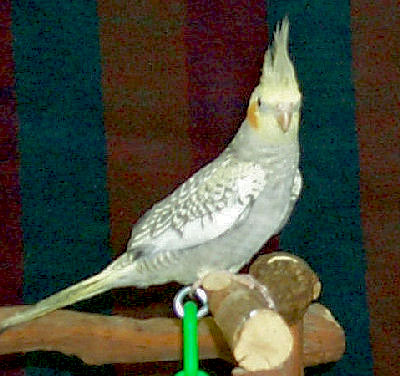
Pearl Cockatiels are beautiful pet birds with pearl markings over the back, nape, and wings!
The spectacular Pearled Cockatiel with its scalloped-looking feathers, was the third cockatiel mutation to be established. The coloration of the pearl is a result of a feather pattern change rather than a color change. The first cockatiel mutation was the Pied Cockatiel established prior to 1951. This was followed by the very popular Lutino Cockatiel in 1958. Then the Pearled Cockatiel appeared in Germany in 1967 or 1968. These very pretty birds are commonly known as Pearled Cockatiels, Laced Cockatiels, Opaline Cockatiels, Pearl Cockatiels, Pearly Cockatiels, and even just Pearl Tiels or Pearly Tiels.
Pearling is where the feathers on the back, nape, and wings are edged or laced in white or yellow. There are both lightly pearled birds and heavily pearled birds. Starting with the first molt, a male pearl will loose his markings and return to a normal gray coloration over a period of years. Males don’t actually loose the pearling but it becomes so faint that it can only be seen on some of the heavily pearled mature males, and even then it only looks like a shadow. The female will not loose her markings.
Cockatiels are probably the most popular of the parrot family with their main competition being the Budgerigar (referred to as the Parakeet in the United States). They are hardy, easily handle changes in their home, and are easy to breed. On top of that, keeping a cockatiel as a pet is easy because they are not noisy parrots and they are comfortable when left alone for long periods of time.
Cockatiels are considered parrots as can be seen by the shape of their beak. They are members of the Cockatoo family which is apparent by their cute little erectile crests. Unlike cockatoos however, they have long tails making up about half of their total length, and giving them more of a parakeet type appearance.
Cockatiel’s evolved as nomadic creatures, surviving in a variety of diverse and rugged habitats. They are constantly on the move, changing locations with the seasonal fluctuations of food and water supplies. This native habitat and their adaptive behavior has made them well suited as pets.
For more information about the care of Cockatiels see:
Guide to a Happy, Healthy Cockatiel
- Kingdom: Animalia
- Phylum: Chordata
- Class: Aves
- Order: Psittaciformes
- Family: Cacatuidae
- Genus: Nymphicus
- Species: hollandicus
Scientific Name
Distribution
Grey cockatiels are found over most of Australia except the coastal areas and most of Tasmania. Pearl cockatiels are a strain developed by breeders and is not seen in the wild.
Description
Cockatiels are considered parrots, as can be seen by the shape of their beak. Cockatiels are probably the most popular of the parrot family. They are closely related to the Cockatoos, and like Cockatoos they are members of the Cacatuidae family.
As members of the Cacatuidae family they too have an erectile crests. This cute little crest will be held erect when they are stimulated and excited, flattened when they are feeling angry, defensive, or submissive, and somewhere in between when they are in their normal ‘hanging out’ state. Unlike the other members of this family, however, they have long tails. The tail makes up about half of their total length and gives them more of a parakeet type appearance.
A Pearled Cockatiel has feathers on the back, nape, and wings that are edged or laced in white or yellow creating a pearl type appearance. Pearling patterns varying from large to small and there are both lightly pearled birds and heavily pearled birds. Yellow pearled birds are generally those that like the Cinnamon Cockatiels, whose coloring is tannish brown rather than grey or black. They are sometimes known as Golden Pearls. White pearling, sometimes called Silver Pearls, will be found in birds that have grey or black coloring. White-faced Cockatiels will always have a white pearling.
See descriptions of sexual differences for this pet bird cockatiel below, under the breeding cockatiels section.
Size – Weight
These birds get up to 30 cm (12 inches).
Care and feeding
Good sized bird cages are a must for good cockatiel care. A roomy cockatiel cage is required unless the bird is to be let out for extended periods. The cage for a cockatiel should measure a minimum of 24″ length by 18″ high and 18″ wide. This will leave enough room for several toys and still give the bird room to fully stretch his/her wings without hitting them. Many birds can spend most of their time on a playpen or parrot perch. Bird food consists of a variety of sprouts, seeds, nuts, fruits, vegetables, and commercial pellets.
See About Cockatiels: Housing and About Cockatiels: Care and Feeding for more information.
Social Behaviors
Cockatiels travel in flocks in the wild and this influences cockatiel behavior in captivity. Their social ‘flock’ disposition along with their native habitat makes them well suited as pets. They are hardy, adapt easily to change, and are easy to breed. A big plus is that cockatiels are not noisy and can be left alone for long periods of time. They make a very loving and devoted pet if bonded properly.
For taming cockatiels and cockatiel training, see About Cockatiels: Handling and Training.
Activities
Common bird activities for cockatiels, they like to climb and play. Cockatiel bird care includes providing lots of bird toys and excercise. Give them plenty of time outside the cage if possible, a playpen works well for this. Many cockatiels can learn to talk and whistle, especially the males.
See About Cockatiels: Activities for more information.
Breeding/Reproduction
Cockatiel breeding can be a very rewarding experience. Cockatiels will readily nest provided they have a nest box and some material to construct the nest from. They lay one egg every other day until they have laid about 5 eggs. The incubation period is 17 – 22 days. After hatching the young birds will open their eyes at 9 days of age.
This is a good time to start hand feeding if you don’t want to incubate the eggs yourself. Incubation and raising the chicks yourself requires dedication since the young chicks will need feedings every two hours for the first couple of weeks. Likewise, you can pull them from the nest earlier than 9 days, but with greater risk to the chick and greater effort on your part with frequent feedings. After about 18 days the orange cheek patch will appear on the babies. At about 30 days they will look like adult birds, and will fledge at about 35 days of age.
For more information on cockatiel breeding, see About Cockatiels: Breeding/Reproduction.
Sexual differences
There are a lot of opinions about how to sex these birds but usually they are just indicators and not sure ways to tell. The Pearl is probably the hardest to tell until the male loses his “pearl” coloration afte a year or two of age. The female will not lose her coloration.
Starting with the first molt, a male pearl will loose his markings and return to a normal gray coloration over a period of years. Males don’t actually loose the pearling but it becomes so faint that it can only be seen on some of the heavily pearled mature males, and even then it only looks like a shadow.
Potential Problems
The cockatiel health is easy to maintain as these are very hardy birds, but for all pet birds there are potential problems For optimum bird health care for your cockatiel, it is good to know what signs of illness to be aware of.
For information about cockatiel health, see About Cockatiels: Problems.
Availability
The Pearled cockatiel is one of the less common cockatiels for sale when compared to the the Grey Cockatiel, but it is generally available though a bit more expensive. There are also lots of different color mutations readily available including lutino, pied, cinnamon, and white-faced varieties.
Featured Image Credit: Reimar, Shutterstock