
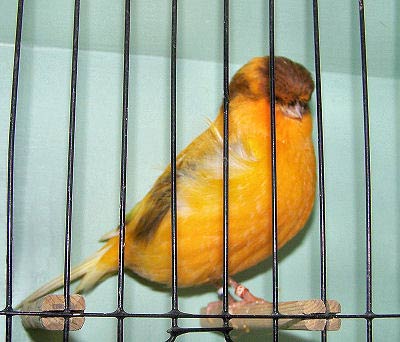
The Stafford Canary, the first new canary variety since the Fife Canary which was developed in the 1950’s, is a real dandy!
The Stafford Canary has a rather unique development, the standard for this bird was created before the final canary breed was actually developed. In the 1970’s an inspired group of breeders, aware of a red/rose canary variety that existed in Europe called the ‘Deutche Koife’, wanted to create a red/rose crested variety. Thus they decided on the standards and proceeded to develop the canary type.
The Stafford Canary is a “type canary”, bred for physical characteristics rather than color or song. They are a newer canary variety, originating as a cross between the Gloster and Red Factor types. They can be either a crested or non-crested version and they have red and rose ground colors. Being quite beautiful, they have created quite a stir among fanciers.
For more information about the care of Canaries see:
Guide to a Happy, Healthy Canary
- Kingdom: Animalia
- Phylum: Actiniform
- Class: Elasmobranchii
- Order: Passeriformes
- Family: Fringillidae
- Genus: Serinus
- Species: canaria
Scientific Name:
Distribution:
The Stafford Canary is a new variety of canary that was developed in the the 1980’s in Stafford, England. Their first appearance on the British National Exhibition bench was in 1987. Here Zoe Finn, the daughter of Peter Finn who was one of the pioneers in the development of this variety, exhibited what was to become recognized as the Stafford Canary, at the Perry Hill show in Birmingham. The Stafford Canary Club formed in 1988. They applied and received acceptance of the Stafford as a new breed of canary by The Canary Council of Great Britain in 1990. In 1992 in America, the National Cage Bird Show added the Stafford in the Type division, and today either crested or non-crested birds can be shown.
Description:
Fairly short compact birds, the Stafford Canary is 5 inches (12.7 cm) in length. As a “type canary”, they are bred to accepted type standard, meaning they can be clear, variegated or self. They come in bright red and rose ground colors evenly distributed throughout the plumage, with melanistic coloring in the self’s. There are three feather types, non-frosted, frosted, or mosaic (dimorphic) and they can be crested or non-crested.
Care and feeding:
Canaries like wide open spaces so provide a roomy cage. Provide a cage with vertical bars and small perches of different size for foot exercise. Have at least 1 perch set high in the cage for the canary to roost (sleep). The cage should be placed high, so the canary can look down on us so to speak.
Canaries eat mainly canary seed and rape seed. Vitamin coated canary seed mixes are readily available at a pet store. Greens are also enjoyed and can be offered daily along with a little calcium in the form of a cuttlebone.
They do like to bath, so should be offered a bird bath. Cage cleaning and toe nail trimming is about all the maintenance canaries need.
See About Canaries: Housing and About Canaries: Care and Feeding for more information.
Social Behaviors:
They are good-natured social creatures that do well when kept in cages or in aviaries. They are timid birds though and should not be housed with parakeets, lovebirds, or other hookbills that tend to be more aggressive birds by nature.
Male canaries should be kept in a cage by themselves to ensure quality singing. Males can be territorial and pairing up with two male canaries in a cage can cause fights. In a spacious aviary canaries can generally be housed with other canaries, finches, and other hardbills.
Activities:
Canaries do not require toys, mirrors or any other form of entertainment, a swing is all they need to keep themselves occupied. Most of the time, canaries are simply enjoyed for their beauty and singing. However, some canaries are allowed out of their cage to perch or are show canaries and therefore require taming or training.
See About Canaries: Handling/Training for information on taming and training.
Breeding/Reproduction:
Canaries breed easily and readily if provided with quality food, lighting, secure surroundings, and conditioning. They are best bred in breeding cages.
Breeding the Stafford Canary is similar to breeding colorbreds or any other variety of canary… but with a couple exceptions. Staffords should only be paired crested to non-crested as other pairings could create a lethal factor. Also a frosted bird should be paired to a non-frosted to help avoid feather lump. Feather lumps are an ingrown feather, where the feather attempts to grow out, but cannot break the skin so will grow backwards
They lay their eggs in a nest. The female will lay 3 to 6 eggs, one per day. Breeding season is usually from December to April; it is best to allow a hen to have only two clutches.
See About Canaries: Breeding/Reproduction for more information on breeding.
Potential Problems:
These birds are hardy and healthy if provided with a good environment and a good diet. Avoid an environment that is wet, cool, and drafty.
See About Canaries: Potential Problems for information on health.
Availability:
Stafford Canaries can be obtained, but often it will take getting placed on a waiting list with a breeder as there is more demand than availability. They can be found primarily through breeders, but may also occasionally be found through bird shows and on the internet.
Featured Image Credit: Rakha aim, Shutterstock